

Every digital clock, calendar invite, and flight itinerary you’ve ever looked at relies on two tiny abbreviations to keep your day from turning into chaos. Get the AM and PM meaning wrong just once , showing up for a job interview at 9 PM instead of 9 AM , and you’ll understand exactly why these two letters matter more than their size suggests.
This guide covers what AM and PM stand for, how the 12-hour clock works, how to convert to and from 24-hour time, what these terms mean in Hindi, Urdu, Punjabi, Tamil, Telugu, and Tagalog, and the specific mistakes that trip people up again and again , including the infamous 12 AM vs. 12 PM mix-up that even native English speakers get wrong.
What Does AM and PM Stand For?
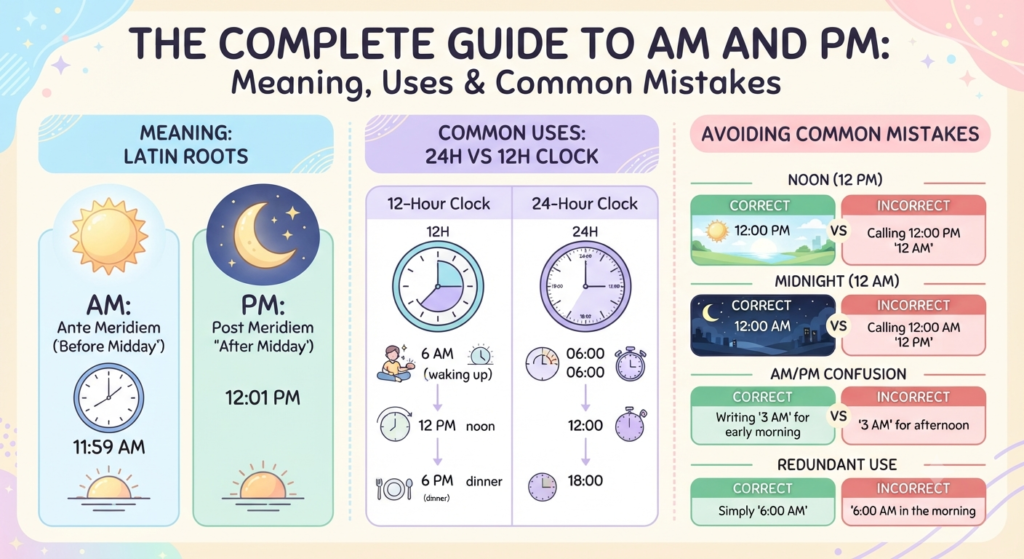
AM and PM are abbreviations of two Latin phrases used to describe the two halves of a 24-hour day:
- AM = Ante Meridiem, meaning “before midday”
- PM = Post Meridiem, meaning “after midday”
“Meridiem” refers to midday, the moment the sun sits at its highest point. Everything before that moment is labeled AM; everything after it is labeled PM. This is the basis of the 12-hour clock, and it’s why a single hour number , like 7 or 11 ; can mean two completely different times depending on which label follows it.
AM and PM Meaning in Time: How the Day Is Split
Picture a full day as a circle cut exactly in half, with 12 hours on each side:
- AM runs from midnight to just before noon : 12:00 AM through 11:59 AM.
- PM runs from noon to just before midnight : 12:00 PM through 11:59 PM.
So when your alarm rings at 6:30 AM, you’re six and a half hours past midnight. When dinner is booked for 6:30 PM, you’re six and a half hours past noon ; same numbers, opposite ends of the day.
Is 12 AM Midnight or Noon?
12 AM is midnight, the very start of a new day, coming right after 11:59 PM the night before. This confuses people because “12” feels like it should follow 11, when really it resets the clock to the beginning of the AM block.
Is 12 PM Midnight or Noon?
12 PM is noon, the exact midpoint of the day when the sun is directly overhead and the clock flips from AM to PM. Technically, noon and midnight sit on the boundary between periods rather than falling cleanly “before” or “after” midday , which is exactly why they’re the two most misused labels in the whole system. Many airlines, hospitals, and legal documents write “12 noon” or “12 midnight” instead, to avoid this exact confusion.
How to Use AM and PM Correctly
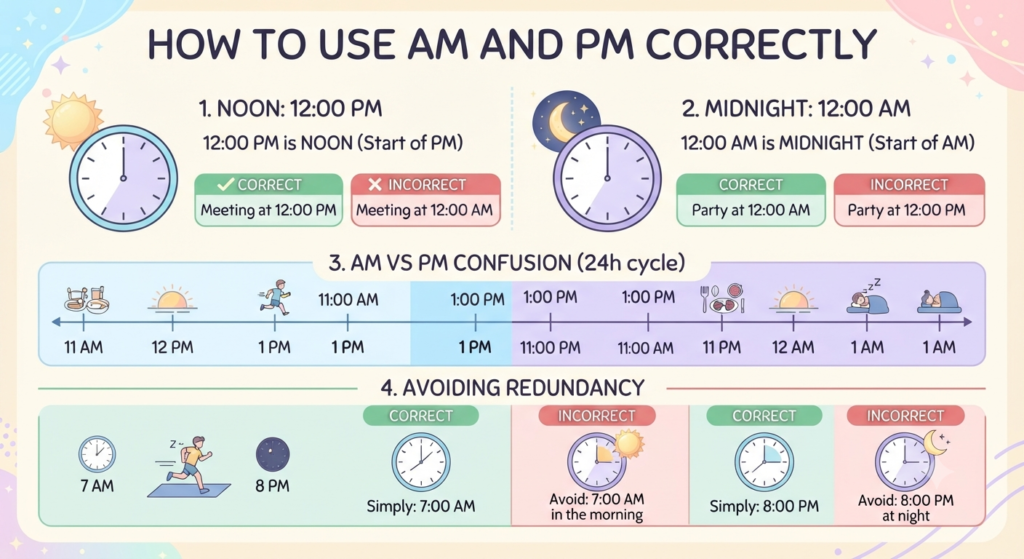
Using AM and PM correctly comes down to 5 rules:
- Always attach AM or PM when writing a time , “meet at 7” is ambiguous; “meet at 7 PM” isn’t.
- Set the abbreviation immediately after the time, with an interval: 19:00, no longer 19:00
- Either uppercase (AM/PM) or lowercase with periods (a.m./p.m.) is fine , just stay consistent within one document.
- Use “12 noon” or “12 midnight” on tickets, contracts, and schedules where precision matters most.
- In speech, adding “in the morning” or “at night” alongside AM/PM gives extra clarity, especially near the 12 o’clock hour.
Convert AM PM Clock to a 24-Hour Clock
- Midnight to 12:59 AM: Subtract 12 and drop the AM. (12:30 AM or 00:30)
- 1:00 AM to 12:59 PM: Keep the number, drop AM/PM. (9:15 AM or 09:15, 12:15 PM or 12:15)
- 1:00 PM to 11:59 PM: Add 12 and drop the PM. (3:45 PM or 15:45)
Convert a 24-Hour Clock to AM-PM Clock
- 00:00 to 00:59: Add 12, label it AM. (00:20 or 12:20 AM)
- 01:00 to 12:59: Keep the number; label AM before 12:00, PM from 12:00 onward. (09:40 or 9:40 AM, 12:40 or 12:40 PM)
- 13:00 to 23:59: Subtract 12, label it PM. (18:05 or 6:05 PM)
AM PM Time Chart
| 24-Hour Time | 12-Hour AM/PM | 24-Hour Time | 12-Hour AM/PM |
| 00:00 | 12:00 AM (midnight) | 12:00 | 12:00 PM (noon) |
| 01:00 | 1:00 AM | 13:00 | 1:00 PM |
| 03:00 | 3:00 AM | 15:00 | 3:00 PM |
| 06:00 | 6:00 AM | 18:00 | 6:00 PM |
| 09:00 | 9:00 AM | 21:00 | 9:00 PM |
| 11:00 | 11:00 AM | 23:00 | 11:00 PM |
Solved Examples on AM PM
Example 1: Convert 17:00 to the 12-hour clock. Subtract from 12 to 17:00 − 12 = 5:00. Since it’s past 13:00, it becomes 5:00 PM.
Example 2: Convert 12:45 AM to the 24-hour clock. It falls between midnight and 12:59 AM, so subtract 12 to 12:45 − 12 = 00:45.
Example 3: True or false , 12:00 PM refers to midnight. False. 14:00 is noon; 12:00 is midnight.
Practice Questions on AM PM
- Convert 08:15 to the 12-hour AM/PM format.
- Convert 9:50 PM to the 24-hour format.
- Is 11:59 PM closer to noon or midnight?
- Convert 00:05 to the 12-hour AM/PM format.
- True or false: 12:01 AM is one minute after noon.
(Answers: 1) 8:15 AM 2) 21:50 3) Midnight 4) 12:05 AM 5) False , one minute after midnight.)
AM and PM Meaning in Regional Languages
English isn’t the only place this system needs a translation ; most South and Southeast Asian languages express AM/PM through time-of-day words rather than a literal Latin equivalent, so context does a lot of the work.
| Language | AM (morning) | PM (afternoon/evening) | Example |
| Hindi | सुबह (subah) / formally पूर्वाह्न | शाम / रात (shaam / raat) / formally अपराह्न | 7 बजे सुबह = 7 AM |
| Urdu | صبح (subah) | شام (shaam) / رات (raat) | صبح ۷ بجے = 7 AM |
| Punjabi | ਸਵੇਰ (savere) | ਸ਼ਾਮ (shaam) | ਸਵੇਰੇ 7 ਵਜੇ = 7 AM |
| Tamil | காலை (kaalai) | மாலை / இரவு (maalai / iravu) | காலை 7 மணி = 7 AM |
| Telugu | ఉదయం (udayam) | సాయంత్రం / రాత్రి (sayantram / raatri) | ఉదయం 7 గంటలు = 7 AM |
| Tagalog | umaga | hapon (afternoon) / gabi (night) | 7 ng umaga = 7 AM |
A couple of things worth noting: AM PM meaning time in Hindi and Urdu is nearly identical in everyday speech, since both languages lean on “subah” for morning hours. In Punjabi, Tamil, Telugu, and Tagalog, there’s no single word covering the entire PM block ; speakers naturally switch between “afternoon,” “evening,” and “night” words depending on the exact hour, which is actually more precise than English’s single PM label. Formal AM/PM meaning today, in official Indian documents and digital displays, still defaults to the English abbreviations regardless of the local language being spoken.
Other Common AM/PM Questions
PM meaning in chat: In texting, “pm” almost always still means time (e.g., “call me at 3pm”), though in gaming or forum contexts, “PM” separately means private message ; context makes the difference obvious.
PM meaning as a job / PM meaning business: Outside of timekeeping, PM commonly stands for Project Manager or Product Manager ; someone overseeing a project’s timeline, budget, and deliverables. This usage is unrelated to clock time.
PM slang meaning: Online, “PM” is shorthand for sending a private message, separate from its time-based use.
1 PM meaning: 1 PM is one hour after noon ; early afternoon, equal to 13:00 on the 24-hour clock.
Morning (AM or PM): Morning hours fall under AM, though people usually think of “morning” as starting near sunrise rather than at midnight itself.
What does AM and PM stand for?
AM stands for Ante Meridiem (“before midday”) and PM stands for Post Meridiem (“after midday”), the Latin-derived labels used in the 12-hour clock system.
What is the difference between AM and PM?
AM covers the 12-hour period from midnight to just before noon, while PM covers the 12-hour period from noon to just before midnight.
Is 12 AM midnight or noon?
12 AM is midnight, marking the start of a new day.
Is 12 PM midnight or noon?
12 PM is noon, the midpoint of the day when AM switches to PM.
How do you convert AM/PM time to 24-hour format?
Keep AM hours as-is (except midnight, which becomes 00:00), and add 12 to PM hours between 1:00 PM and 11:59 PM.
What is AM and PM called in Hindi or Urdu?
There’s no exact one-word match ; both languages use “subah” for morning (AM) hours and switch to “shaam” or “raat” for afternoon/evening/night (PM) hours instead of a single fixed term.
Conclusion
The AM and PM meaning boils down to a simple Latin split ; before midday and after midday , but real-world confusion around 12 o’clock, casual writing habits, and regional language translation is what actually causes scheduling mishaps. Once you know that AM runs midnight to noon, PM runs noon to midnight, and 12 AM is midnight while 12 PM is noon, the rest falls into place. For anything time-critical ; flights, legal deadlines, medical appointments ; default to the 24-hour clock or spell out “noon” and “midnight” directly. It costs three extra words and saves you from missing the moment entirely.
