

You’re typing a sentence, “People ___ care about honesty” and for half a second, “does” actually looks right. It’s not a silly mistake. “People” ends without an obvious plural marker, it doesn’t look like “cats” or “dogs,” and that visual gap is exactly what tricks even confident writers.
Here’s the fast version: people do vs people does isn’t really a close call once you know the test. “People” is always plural, so it takes “do,” never “does” and there’s a three-second check you can run on literally any sentence to confirm it. This guide walks through the grammar rule behind it, shows you the test in action, and covers the specific situations where writers still get tripped up even after they’ve learned the rule.
People Do vs People Does: Which One Is Correct?
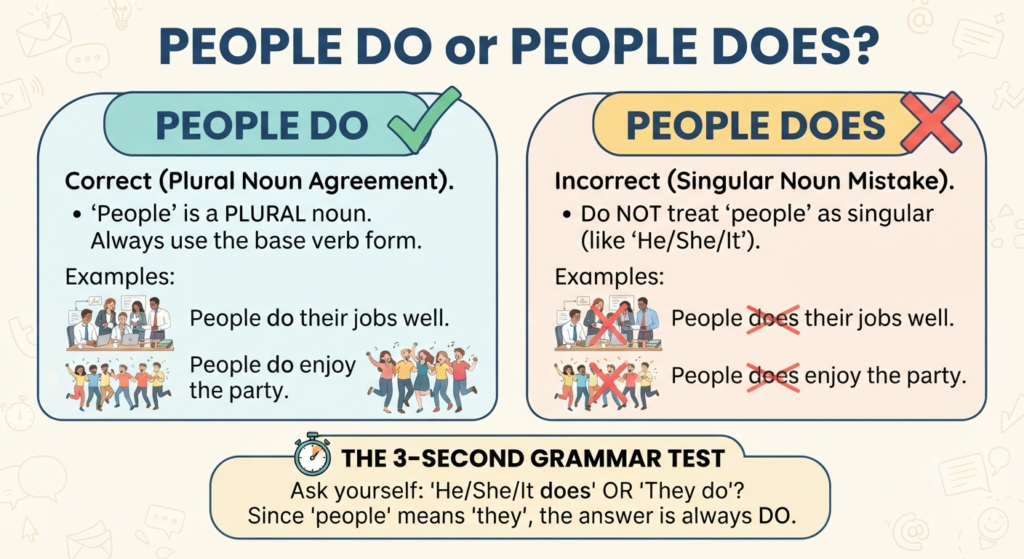
“People do” is the only correct form in standard English. People is a plural noun, and plural subjects always pair with the base form of the verb, “do,” not “does.” “People does” is a subject-verb agreement error, full stop, with no accepted exception in everyday writing.
Why Do We Say “People Do” Instead of “People Does”?
The short answer is that English verbs change form based on whether the subject is singular or plural, and “people” fails the singular test every time. Say “people” out loud and picture what it refers to; never one individual, always a group of them.
Compare it to a word that clearly looks plural, like “dogs” or “students.” Nobody would write “dogs does” or “students does,” because the plural ending makes the mismatch obvious. “People” just doesn’t carry that visual cue, so the same rule feels less intuitive even though it applies identically.
Is “People” Singular or Plural?
People is grammatically plural. It functions as the everyday plural of “person”, one person, many people and it behaves exactly like other plural nouns in terms of verb agreement, even though it doesn’t end in “-s” the way most plural nouns do.
There’s a rare exception worth knowing: “peoples” (with an added “s”) refers to multiple distinct ethnic or cultural groups, as in “the indigenous peoples of South America.” That specialized usage shows up almost exclusively in academic, historical, or anthropological writing, not everyday conversation.
Do vs Does: Understanding the Grammar Rule
English present-tense verbs split cleanly along one line: singular third-person subjects (he, she, it, or any singular noun) take “does,” while everything else takes “do.”
| Subject type | Verb form | Example |
| I | do | “I do my own research.” |
| You | do | “You do great work.” |
| He / She / It | does | “She does her homework early.” |
| A person / student / teacher | does | “A teacher does lesson planning nightly.” |
| We | do | “We do this every week.” |
| They | do | “They do it together.” |
| People | do | “People do care about fairness.” |
Notice that “does” only ever appears in one row of that table; singular, third-person. Since “people” never fits that category, it never takes “does,” in any tense, in any context.
Subject-Verb Agreement Rule With People
Subject-verb agreement simply means the verb has to match the subject in number. Get the subject wrong, and the whole sentence sounds off, even to someone who couldn’t name the grammar rule if you asked them.
The fastest way to check any sentence with “people” in it is the they-substitution test: swap “people” for “they,” and see which verb sounds natural.
- “They do their best.” ✔
“People do their best.” ✔
- “They does their best.” ✘
“People does their best.” ✘
If “they” pairs naturally with “do” (and it always does), then “people” needs “do” too. This is the fastest, most reliable subject-verb agreement shortcut for this specific word, and it works in every tense and sentence structure.
Examples of “People Do” in Sentences
Seeing the correct form across different contexts helps it stick faster than the rule alone.
- “People do amazing things when they work together.”
- “People do not always say what they mean.”
- “Most people do care about their communities.”
- “People do respond better to clear instructions.”
- “People do make mistakes, and that’s completely normal.”
Each of these keeps “people” as the true subject of the sentence, with “do” carrying the plural agreement all the way through negatives, questions, and statements alike.
Common Mistakes When Using “People”
A handful of related errors tend to travel alongside “people does,” usually because writers apply singular logic to the whole sentence rather than just the verb.
- “People does” instead of “people do”: The core mistake this article addresses.
- “People is” instead of “people are”: Same root cause, different verb.
- “People has” instead of “people have”: Plural subjects always pair with “have,” not “has.”
- Treating “a people” as always singular: It’s singular only when referring to one specific nation or ethnic group as a unit, not in everyday usage.
- Mixing “everyone” and “people” grammar: These two words look similar in meaning but follow completely different agreement rules (see below).
Can “People Does” Ever Be Correct?
No, “people does” is not correct in any form of standard English, formal or informal. There’s no dialect, regional variation, or specialized context in mainstream English where this pairing is considered grammatically acceptable. If you hear it in casual speech, it’s a slip, not an accepted alternative.
People Do vs Everyone Does: Why They Are Different
This is where a lot of the confusion actually comes from. “People” and “everyone” both refer to groups of individuals in a general sense, but they follow opposite grammar rules and that contradiction trips up even careful writers.
- People is grammatically plural; pairs with “do.” “People do care.”
- Everyone is grammatically singular; pairs with “does.” “Everyone does care.”
The logic behind “everyone” is that it treats the group as a collection of individual, singular units, ‘”every one” person, taken separately, while “people” treats the group as a single plural mass. Same general meaning, opposite grammatical treatment, which is exactly why writers sometimes carry the wrong verb over from one word to the other.
Is Anyone or Does Anyone
The same singular logic that governs “everyone” applies to “anyone” as well. “Does anyone” is correct, “anyone” is grammatically singular, so it takes “does” in questions and statements alike: “Does anyone have a pen?” not “Do anyone have a pen?”
Person Do or Person Does
“Person does” is the correct form, since “person” is singular. This is essentially the mirror image of the people rule: swap the plural “people” for the singular “person,” and the verb flips from “do” to “does”, “A person does what feels right to them.”
People Do or People Does: Quick Answer for Common Searches
“People do” is always correct, and “people does” is always incorrect in standard English. People is a grammatically plural noun, and plural subjects take “do,” never “does”; a rule that holds true across statements, questions, and negative sentences without exception.
FAQs
People do or people does; which is grammatically correct?
“People do” is correct in all standard English contexts. “People” is a plural noun, and plural subjects always take the base verb form “do,” never the singular “does.”
What does “people do” mean in a sentence?
“People do” simply indicates an action performed by more than one person, functioning the same way “they do” would in any sentence describing a plural group’s behavior.
Can you give examples of “people do” and “people does” side by side?
Correct: “People do care about honesty.” Incorrect: “People does care about honesty.” The only difference between the two is the verb, and only the first version follows standard subject-verb agreement.
What’s the grammar rule behind people do vs people does?
English requires singular third-person subjects (he, she, it) to take “does,” while all other subjects, including plural nouns like “people,” take “do.” Since “people” is always plural, it never pairs with “does.”
Is there a quick way to test whether to use “do” or “does” with people?
Yes, replace “people” with “they” in the sentence. If “they do” sounds correct, “people do” is correct too, since both words follow identical plural agreement rules.
Why do so many English learners make this mistake?
Because “people” doesn’t carry a visible plural ending like most English nouns do, it can visually read as singular even though it’s grammatically plural, which leads learners to default to “does” out of habit.
Why does “people” feel singular even though it’s plural?
“People” doesn’t end in the typical “-s” plural marker most English nouns use, so it visually resembles a singular word even though it grammatically functions as a plural one, that mismatch between appearance and grammar is the main source of confusion.
Is it “the people do” or “the people does”?
Adding “the” in front of “people” doesn’t change its number, it’s still plural, so “the people do” remains the correct form in every context.
Is “many people does” or “many people do” correct?
“Many people do” is correct. Adding a quantifier like “many” in front of “people” doesn’t change the underlying grammar, the noun stays plural, and the verb still needs to agree with it.
Does “people” ever take a singular verb in any context?
Only when “people” is used in its rare sense referring to a single nation or ethnic group as one unit, as in “a people”, even then, sentences about that group’s actions usually revert to plural verbs once the sentence continues.
Conclusion
The debate really comes down to one fact: “people” is plural, and plural subjects take “do,” not “does”, no exceptions in standard usage. The moment that feels uncertain, run the three-second test: swap in “they,” and let the sentence tell you the answer.
Once that substitution becomes automatic, you’ll stop second-guessing this one for good and the same trick works for catching similar plural-verb mistakes with other collective-sounding nouns down the road.

1 thought on ““People Do” or “People Does”? The 3-Second Grammar Test”