

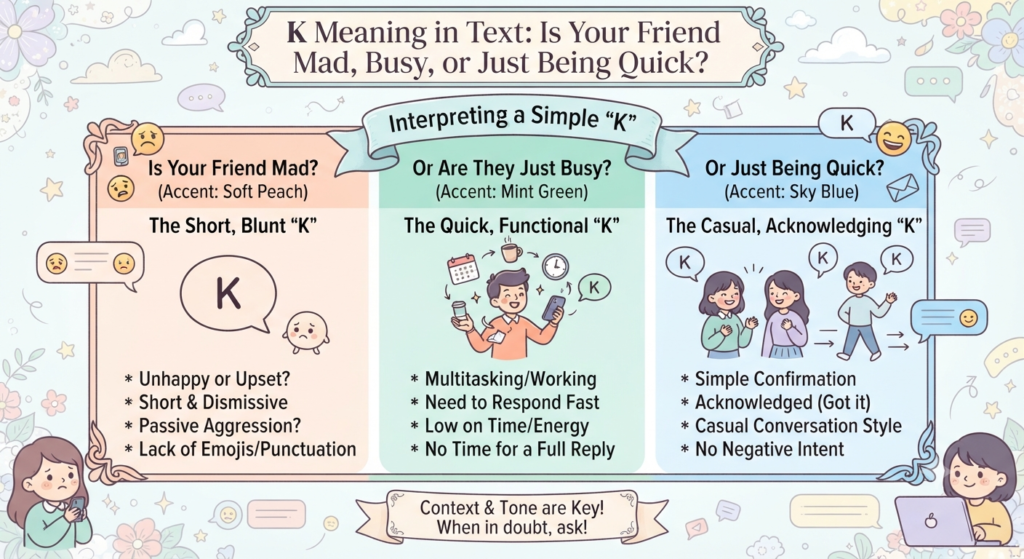
You send a paragraph explaining your whole week. The reply comes back thirty seconds later: “k.” Just that. No punctuation, no emoji, no follow-up. Your brain immediately starts running scenarios, are they mad? Busy? Over the conversation entirely?
The k meaning in text search exists for exactly this reason: a single letter carries almost no information on its own, so your brain fills in the emotional gap, usually with the worst-case guess. This guide breaks down what “k” actually means, where it came from, how it shifts across different apps and relationships, and most usefully, how to tell the difference between someone who’s annoyed and someone who’s just typing fast.
What Does K Mean in Text & Chat?
In texting, “K” is a shortened form of “OK” or “okay,” used to quickly acknowledge or agree with a message. On its own, it’s grammatically neutral, but because it strips away tone, punctuation, and warmth, readers often interpret it as cold, dismissive, or annoyed, even when the sender meant nothing by it.
That gap between intended meaning and perceived meaning is the entire reason this two-letter reply generates so much confusion.
Full Form, Stands For & Short Meaning of K
“K” doesn’t have a separate, hidden full form of its own; it’s simply the first letter of “okay,” used as shorthand. Understanding where “okay” itself comes from actually helps explain why “K” caught on so easily.
- Full form: OK / Okay
- Core meaning: Acknowledgment, agreement, confirmation
- Function: A minimal reply confirming a message was read and understood
- Tone (default): Neutral, though highly context-dependent
Because “okay” was already a widely used, informal confirmation word, shrinking it down to a single letter was a natural next step once texting made speed and brevity valuable.
Origin, History & First Known Use of K
The abbreviation “K” is a direct descendant of “OK,” which dates back to the 1830s as a playful misspelling of “all correct” (“oll korrect”), popularized in American newspapers before becoming a standard English word. “OK” spread quickly because it was short, easy to say, and worked in nearly any context.
“K” itself became common much later, during the rise of SMS texting in the late 1990s and early 2000s. Character limits and slow keypad typing pushed users toward the shortest possible replies, and “K” — a single keystroke — was about as efficient as language could get. What started as a practical shortcut eventually took on its own emotional reputation as texting culture evolved around it.
How People Use K in Daily Conversations
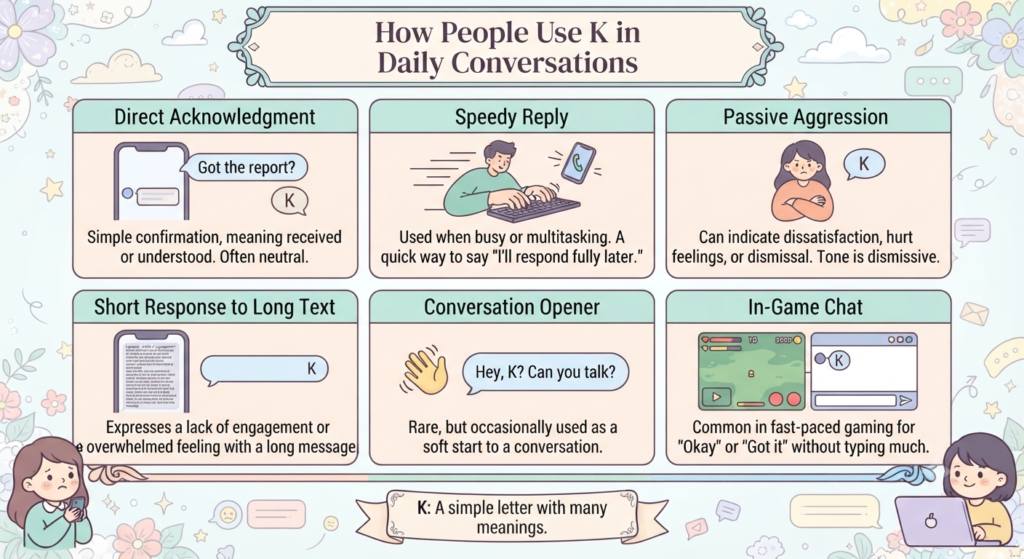
In everyday texting, “K” is most commonly used as a quick, easy way to say okay; it’s often for confirming plans, agreeing to something minor, or ending a conversation that’s already finished.
- “I’ll pick you up at 7.”
“K”
- “Don’t forget to call mom.”
“K”
- “Meeting moved to 3pm.”
“K”
Notice that none of these examples carry obvious emotional weight in writing, yet all three could be read as short, cold, or even irritated depending on the relationship and what came before them in the conversation.
K Meaning Across WhatsApp, Instagram, TikTok & Snapchat explained
The core meaning of “K” acknowledgment doesn’t really change from platform to platform, but the expected tone shifts depending on how casual or fast-paced the app tends to be.
| Platform | Typical Tone of “K” | Common Context |
| Neutral to warm | Everyday chats, family groups, quick confirmations | |
| Instagram DMs | Casual, sometimes distant | Replies to stories, quick acknowledgments |
| TikTok comments | Playful or dismissive | Reactions to videos, joking exchanges |
| Snapchat | Fast, casual | Quick back-and-forth, streaks, short replies |
| Text/SMS | Most variable | Ranges from friendly to noticeably cold depending on relationship |
| Workplace chat (Slack, Teams) | Generally discouraged | Can read as curt or unprofessional |
Snapchat and TikTok users tend to read “K” more casually simply because those platforms are built around speed and brevity already, so a short reply doesn’t stand out the way it might in a slower-paced text conversation.
Different Meanings of K in Other Fields
Outside of texting, “K” carries several completely unrelated meanings depending on context, and mixing these up is a common source of confusion for anyone new to a specific field.
- Numbers: “K” represents “thousand” (5K = 5,000; a 40k salary = $40,000), derived from the Greek “kilo.”
- Sports (baseball): “K” is the official scorekeeping symbol for a strikeout.
- Science: “K” is the chemical symbol for potassium and the SI symbol for Kelvin temperature.
- Finance: “K” often appears in salary listings, budgets, and pricing shorthand.
- Gaming: “K” can mean “kill” in stats like “K/D ratio” (kill/death ratio).
Common Confusions, Mistakes & Wrong Interpretations
Most of the anxiety around “K” comes from reading emotional intent into a message that was never designed to carry any. A few recurring misunderstandings show up again and again.
- Assuming “K” always means anger. Most senders are simply being quick, not upset.
- Ignoring conversation context. A “K” after a joke reads very differently than a “K” after bad news.
- Overanalyzing punctuation. “K.” with a period can feel more final than “K” alone, but this varies heavily by individual texting habits.
- Treating “K” the same across every relationship. A close friend’s “K” carries different weight than a coworker’s or a new match’s on a dating app.
- Forgetting platform norms. A “K” that feels normal on Snapchat might feel oddly abrupt in a formal email.
Common Misunderstandings
“K” is not inherently rude; it’s ambiguous. The letter itself carries no built-in emotion; readers project tone onto it based on timing, relationship history, and the emotional weight of whatever came before it in the conversation. Reading intent into a single letter is usually guesswork, not fact.
Similar Terms, Alternatives & Related Slang
Several close relatives of “K” exist, each carrying a slightly different tone despite meaning roughly the same thing.
- Kk: Often reads as friendlier and more relaxed than a single “K”
- Okay / OK: The full, warmer version, showing slightly more effort
- Okie / Okie dokie: Playful, casual, clearly upbeat
- Aight: Casual slang for “alright,” similar tone to “K”
- Sure: Neutral agreement, slightly warmer than a bare “K” in most contexts
- 👍 (thumbs up emoji): A nonverbal alternative that often reads warmer than text alone
Examples of K in Real Chat Situations
Seeing “K” in varied real conversations makes the tone-dependent nature of the word much clearer than any definition alone.
- Casual plans: “See you at 6!” , “K, see you then 😊” (clearly friendly, softened by emoji)
- Quick logistics: “Sending the file now.” , “K” (neutral, purely functional)
- After an argument: “Fine, whatever.” , “K.” (likely reads as cold or frustrated)
- Gaming chat: “Push mid now!” ,”k” (fast, functional, zero emotional weight)
- Dating app: “Running 10 minutes late!” , “k” (can feel distant without more context or warmth)
How to Reply When Someone Says K
If you’re unsure how to respond to a bare “K,” a few strategies keep the conversation moving without overreacting to a single letter.
- Match the energy if the conversation is casual and functional, a simple “cool” or “np” keeps things moving.
- Add warmth if you’re unsure of the tone, try “Kk, thanks!” or include an emoji to soften things.
- Ask directly if something feels off , “Everything good?” is more effective than guessing.
- Don’t over-read a single word, context from the rest of the conversation almost always matters more than the reply itself.
Is K Still Popular? Trends & Online Usage
Yes, “K” remains one of the most widely used single-letter text replies, even as texting habits continue to evolve. While some younger users have shifted toward alternatives like “kk,” “bet,” or emoji-based reactions to soften short replies, “K” hasn’t disappeared — it’s simply become more self-aware, with many people now consciously avoiding it in emotionally sensitive conversations.
Quick Facts Section
- “K” is short for “OK,” which itself dates back to the 1830s.
- It became widespread during the early SMS texting era due to character limits.
- Its tone is entirely context-dependent, there’s no fixed emotional meaning.
- “Kk” generally reads as warmer than a single “K.”
- Outside texting, “K” also means thousand, potassium, strikeout, and Kelvin, depending on the field.
- Most communication researchers attribute the “coldness” of short replies to the lack of tone, not the words themselves.
FAQs
What does K mean in text from a girl or a guy?
The core meaning doesn’t change based on who’s sending it, “K” means “okay” regardless of gender. Any perceived difference in tone usually comes down to individual texting habits and the specific relationship, not a general rule tied to gender.
Why does “K” feel ruder than “OK”?
“K” strips away an extra letter and, with it, a small amount of perceived effort, since typing a slightly longer word can subconsciously signal more warmth, the shorter version often reads as more abrupt, even though the meaning is identical.
Does adding a period after “K” change its meaning?
For many texters, yes, “K.” with a period can feel more final or curt than “K” without one, since periods in casual texting are often associated with seriousness or finality rather than standard grammar.
Is it okay to reply with just “K” in a work chat?
It’s generally best avoided in professional messaging, where a slightly fuller reply like “Got it, thanks” reads as more polished and less likely to be misread as curt or dismissive.
What does “K” mean in hood slang?
In casual and regional slang usage, “K” still functions primarily as a quick form of “okay,” though tone and delivery can shift its feel toward relaxed agreement or, in more clipped exchanges, mild dismissiveness, context and relationship matter just as much here as anywhere else.
What does K mean in numbers?
In numbers, “K” stands for “thousand,” derived from the Greek word for a thousand, so “10k” means 10,000, commonly used for salaries, prices, and social media follower counts.
What does K mean on WhatsApp?
On WhatsApp, “K” functions the same way it does in standard texting; a quick acknowledgment meaning “okay.” Because WhatsApp conversations are often casual and ongoing, it usually reads as neutral rather than cold.
Is “K” rude in a text message?
Not inherently; “K” is neutral by default, but its brevity can make it feel cold or dismissive depending on the conversation’s tone, timing, and the relationship between the people texting.
What’s the difference between “K” and “Kk”?
Both mean “okay,” but “Kk” generally feels friendlier and more casual, since the repeated letter softens the abruptness that a single “K” can sometimes carry.
What does K mean in social media comments?
On platforms like TikTok and Instagram, “K” in comments usually signals quick agreement, acknowledgment, or occasionally light sarcasm, depending on the surrounding context of the post or conversation.
Conclusion
At its core, “K” simply means “okay”; a fast, efficient acknowledgment that’s been part of digital communication since the earliest days of texting. The real complexity isn’t in the letter itself but in how much emotional weight readers project onto something so short, especially when tone and body language are missing from the conversation entirely.
Next time you receive a bare “K,” resist the urge to assume the worst. Look at the bigger picture, the relationship, the timing, what came before it and if something genuinely feels off, a quick direct question will tell you far more than staring at one letter ever could.
