
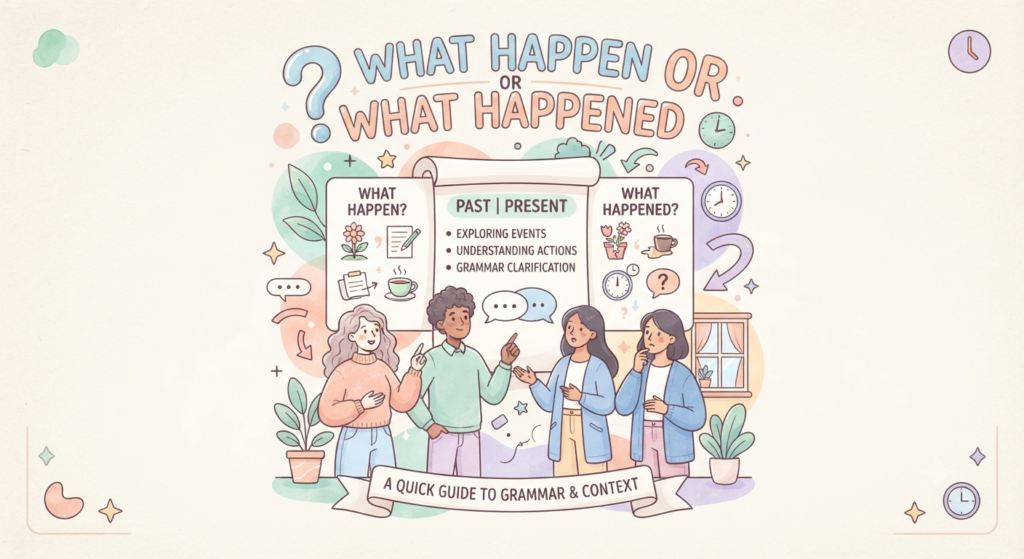
You’re texting a friend, something just went wrong, and your fingers move faster than your brain. Do you type “what happen” or “what happened”? If you’ve ever paused mid-sentence over this, you’re not alone; it’s one of the most common grammar mix-ups among English learners and even native speakers typing on autopilot.
The short answer: “what happened” is correct, and “what happen” is not standard English. But the reason why matters just as much as the rule itself, because understanding it will fix a whole category of similar mistakes in your writing and speech. This guide breaks down the grammar behind the phrase, shows you exactly when to use each form, and gives you enough real examples that you’ll never second-guess yourself again.
Understanding Why “What Happen” Feels Right
“What happen” sounds fine to a lot of people, and there’s a real reason for that. Spoken English is fast and messy. Native speakers routinely swallow the “-ed” ending in casual conversation, so “What happened?” can sound almost like “What happen?” to someone who is still learning to tell the difference.
Add texting culture to the mix, and the confusion deepens. Typing quickly on a phone encourages shortcuts, and dropped endings rarely get corrected in a group chat. Over time, learners who mostly absorb English through speech and social media start to treat the shortened version as normal, even though it never was.
There’s also a structural reason. In many languages, verbs don’t change form the way they do in English, or tense is signaled through context rather than a suffix. Learners translating directly from those languages often skip the “-ed” instinctively, because their native grammar doesn’t require it.
How Verb Tenses Communicate Time
English leans heavily on verb tense to tell you when something happened, since word order alone often isn’t enough. Change the verb form, and you change the timeline of the sentence entirely.
- Present tense: Describes what happens now or regularly. “Accidents happen.“
- Past tense: Describes something that already occurred. “The accident happened last night.“
- Future / modal forms: Describe what hasn’t occurred yet, using a helping verb. “Something will happen.“
Notice that the base verb “happen” only stands alone correctly in the present tense or with a helping verb attached. On its own, asking about a finished event, it simply doesn’t carry the right meaning.
Understanding the Verb Happen
“Happen” is an intransitive verb, meaning it never takes a direct object. Something happens, full stop. You can’t “happen” a thing the way you can “throw” a ball or “write” a letter.
Its forms follow the standard regular-verb pattern:
| Form | Word | Example |
| Base form | happen | “Things happen for a reason.” |
| Present simple (3rd person) | happens | “It happens more often than you’d think.” |
| Past simple | happened | “It happened last week.” |
| Present participle | happening | “What is happening right now?” |
| Past participle | happened | “Nothing has happened yet.” |
Because “happen” is a regular verb, its past tense simply adds “-ed.” There’s no irregular twist to memorize, no “hapened” or alternate spelling — just the standard rule, applied consistently.
Why “What Happen” Is Grammatically Incorrect
“What happen” breaks down because it strips the sentence of its tense marker. Once you take away “-ed,” the verb goes back to its original form, and in English questions, base-form verbs need a helper word like “do,” “does,” or “did” to work properly.
Compare these two:
- ❌ What happen yesterday? base verb, no helping verb, no valid tense.
- ✔ What did happen yesterday? base verb, correctly paired with “did.”
- ✔ What happened yesterday? past tense verb, no helping verb needed.
“What happen” on its own is neither of these. It’s an unfinished construction; a base verb floating without the grammatical support it needs, which is exactly why it reads as broken English rather than casual shorthand.
Why “What Happened” Works
“What happened” works because the past tense is already built into the verb itself. You don’t need “did” in front of it, because “did” and “-ed” are doing the same job, and English doesn’t stack two past-tense markers on one verb.
This is a feature of subject questions; a category worth understanding on its own.
Subject Questions vs Object Questions
English questions split into two structural types, and “what happened” belongs firmly to one of them.
Subject questions ask about the subject of the sentence; the “who” or “what” doing the action. These skip the auxiliary verb entirely:
- Who called you? (not “Who did call you?”)
- What happened? (not “What did happened?”)
Object questions ask about the object receiving the action, and these require an auxiliary verb plus the base form:
- What did you eat?
- What did you see at the museum?
Because “what” in “what happened” is asking about the event itself, the subject of the sentence; the auxiliary “did” is dropped, and the past-tense verb carries the full weight of the question alone. This is also why “What did happened?” is wrong: it duplicates the past tense, once through “did” and once through “-ed.”
When to Use “What Happened”
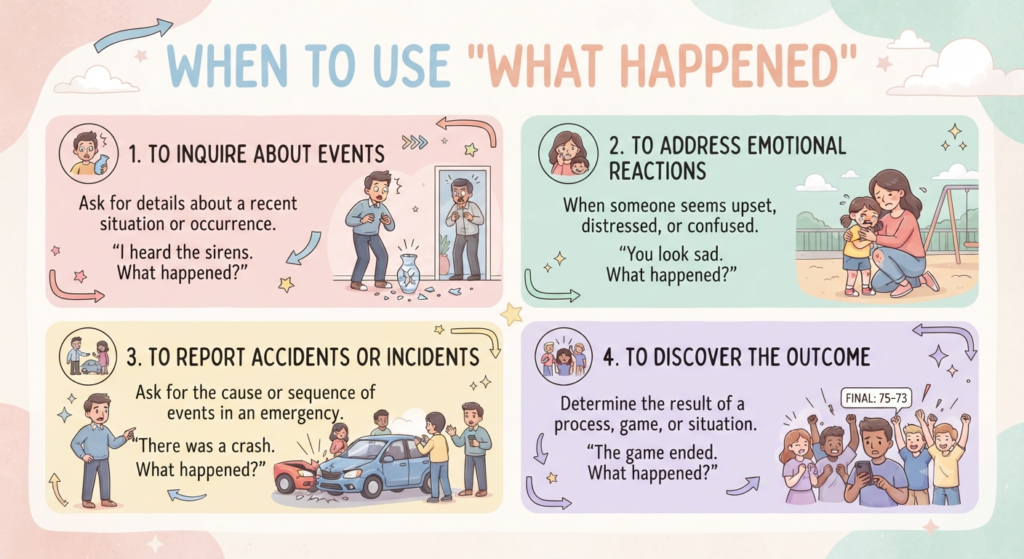
Use “what happened” any time you’re asking about something that has already occurred and is now finished. It’s the default, safest, most natural choice in the vast majority of real conversations.
Typical situations include:
- Asking about a past event: “What happened at the game last night?”
- Reacting to visible evidence of something: “Your car has a dent, what happened?”
- Following up on a story someone started: “You said you had a rough day. What happened?”
- Formal or written contexts: reports, emails, interviews, exam answers.
If you can insert a time marker like yesterday, last night, earlier, this morning, or just now and the sentence still makes sense, “happened” is almost certainly the verb you want.
Why “What Happen” Should Be Avoided
Outside of very casual texting, “what happen” carries real downsides. In an email to a colleague, a customer service message, or an exam answer, it reads as a mistake rather than a stylistic choice and that impression sticks with the reader.
- It signals a tense error to anyone paying attention to grammar.
- It can make the sentence ambiguous, since it doesn’t clearly mark past, present, or future.
- It undermines credibility in professional or academic writing.
- It’s inconsistent with how “happen” behaves in every other context (compare “it rain” vs. “it rains” or “it rained”; nobody drops the ending there either).
There’s no context in standard English where “what happen” is the technically correct choice. At best, it’s tolerated as informal shorthand; at worst, it reads as a basic grammar slip.
Spoken English vs Written English
Spoken and written English don’t play by identical rules, and that gap is exactly where “what happen” survives.
| Context | Common Form | Grammatically Correct? |
| Fast, casual speech | “What happen?” (sounds reduced) | Technically no, but rarely noticed |
| Texting / social media | “What happen” | No — informal only |
| Everyday conversation | “What happened?” | Yes |
| Emails, essays, reports | “What happened?” | Yes — required |
| Exams and formal tests | “What happened?” | Yes — required |
| Song lyrics / stylized writing | “What happen” | Stylistic exception only |
The takeaway is simple: even if you hear a shortened form in a song or a quick voice message, that doesn’t make it correct grammar, it makes it a feature of relaxed pronunciation or artistic license, neither of which applies once you’re writing something someone will actually read closely.
Common Mistakes Related to “What Happened”
A few related errors tend to travel together with this one. Watching for these will clean up your grammar well beyond this single phrase.
- “What did happened?” double past tense; should be “What happened?” or “What did happen?”
- “What is happen?” mixing present continuous incorrectly; should be “What is happening?”
- “What happen to you?” missing “-ed”; should be “What happened to you?”
- “What has happen?” missing past participle; should be “What has happened?”
- Confusing “happen” with “happening” in questions about ongoing events — use “happening” for something still in progress right now.
Real-Life Examples: Correct vs Incorrect Usage
Seeing the pattern across different situations makes it stick better than any rule alone.
- ❌ What happen to your phone screen? ✔ What happened to your phone screen?
- ❌ I don’t know what happen at the meeting. ✔ I don’t know what happened at the meeting.
- ❌ What happen next in the story? ✔ What happened next in the story? (if referring to a past/completed event)
- ❌ Tell me what happen last night. ✔ Tell me what happened last night.
- ❌ What happen to the old building downtown? ✔ What happened to the old building downtown?
Every incorrect example above shares the same fix: add “-ed” and drop nothing else. The sentence structure stays identical; only the tense marker changes.
Quick Rule to Remember
If the event is over, use “happened.” That’s the entire rule in one sentence. “What” is the subject of the question, so no auxiliary verb is needed; the past tense sits directly on the verb itself. Use “happen” only in the present tense (“Mistakes happen”) or right after a helping verb (“What could happen?”).
FAQs
What Happen or What Happened — which one is correct?
“What happened” is correct. It’s the proper past-tense form used to ask about a completed event, while “what happen” lacks the tense marker and is not accepted in standard grammar.
What Happen or What Happened meaning?
“What happened” asks about an event that has already taken place, seeking an explanation or account of it. “What happen” carries no distinct grammatical meaning of its own — it’s simply an incomplete or incorrect version of the same question.
What Happen or What Happened in a sentence?
Correct: “What happened at the office today?” Incorrect: “What happen at the office today?” The past-tense form fits naturally into questions, reported speech, and follow-up statements alike.
What did just happen, or what happened?
Both are grammatically valid, but they’re not identical. “What just happened?” emphasizes that the event occurred moments ago, while plain “What happened?” simply asks about a past event without specifying how recently.
What Happen or What Happened grammar rule?
“What” functions as the subject of the question here, so English drops the auxiliary “did” and lets the past-tense verb “happened” stand alone. “What happen,” by contrast, uses the unmarked base verb, which has no valid role in this sentence structure.
What Happen to or What Happened to, which is right?
“What happened to” is correct, as in “What happened to your car?” This follows the same past-tense rule; “what happen to” is missing the required “-ed” ending.
Is “what’s happened” the same as “what happened”?
They’re closely related but not identical. “What’s happened?” (short for “what has happened”) uses the present perfect to emphasize that the result is still relevant now, while “what happened?” simply asks about a past event without that present-day connection.
Conclusion
The rule behind “what happen or what happened” comes down to one core idea: English marks time through verb tense, and a finished event always needs the past-tense form. “What happened” fits that rule perfectly, dropping the auxiliary verb because “what” is the subject of the question. “What happen” skips the tense marker entirely, which is why it never holds up outside of rushed speech or texting.
Next time you’re about to type “what happen,” pause for one second and add the “-ed.” That single habit will clean up your grammar across emails, conversations, and exams alike — and it’s the kind of small fix that native speakers notice, even when they can’t quite explain why a sentence sounds right or wrong.
