

You’ve typed “quickly,” “honestly,” and “friendly” a thousand times without thinking twice about them. But the -ly meaning behind those three letters actually does two very different jobs in English grammar, and mixing them up is one of the most common small errors in everyday writing.
This guide covers the -ly suffix meaning in full; where it came from, how it turns adjectives into adverbs, when it does the opposite, spelling rules that trip people up, and a quick note on what “ly” means when someone texts it to you instead.
What Does “-ly” Mean?
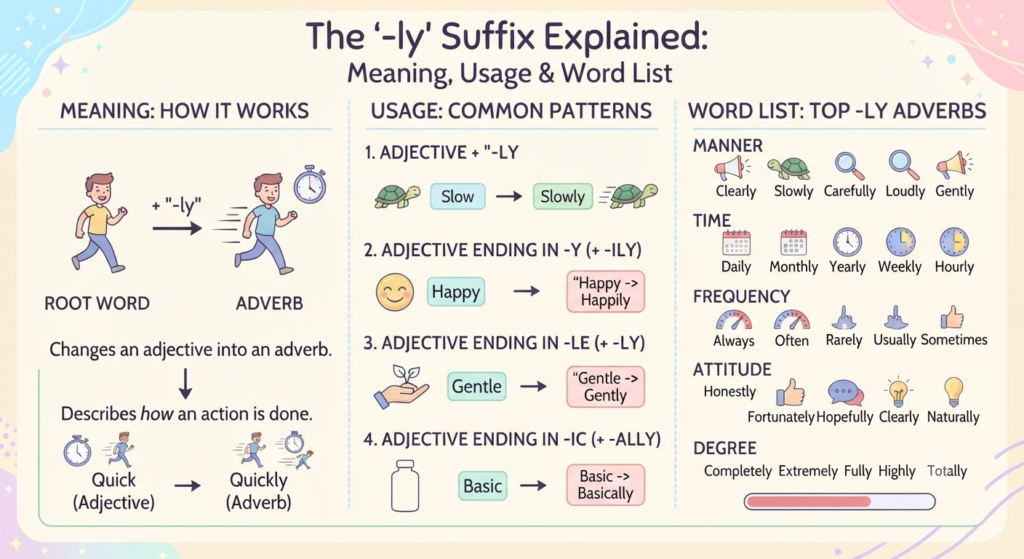
Quick answer: “-ly” is a suffix added to the end of a word, usually to change an adjective into an adverb that explains how an action is done.
That root sense; “like” or “in the manner of”, still shapes how the suffix works today. “Friendly” behavior is behavior like a friend’s. “Quickly” describes doing something in the manner of something quick.
Where “-ly” Comes From (Word History)
The suffix traces back to Old English -lic, which itself descended from a Germanic word related to “body” or “form”; the same root that gives us the standalone word “like.” Over centuries, “-lic” softened into “-ly” as English pronunciation shifted, and the suffix split into the two grammatical roles it plays today.
Understanding the origin helps explain an odd quirk: because “-ly” originally meant “having the likeness of,” it can attach to nouns (friend becomes friendly) as easily as adjectives (quick becomes quickly), which is why the suffix does double duty in modern English.
The Adverb Suffix: Turning Adjective into Adverb
This is the job most people associate with “-ly.” Attach it to an adjective, and you usually get an adverb that describes how, when, or to what degree something happens.
- Quick becomes quickly
- Honest becomes honestly
- Careful becomes carefully
- Silent becomes silently
- Brave becomes bravely
These adverbs usually change the meaning of verbs, adjectives, or other adverbs.
- She answered honestly. (modifies the verb “answered”)
- He was remarkably calm. (modifies the adjective “calm”)
Spelling Rules for the Adverb Suffix
A few spelling patterns account for most of the confusion people run into:
- Most adjectives: just add “-ly”; careful becomes carefully
- Adjectives ending in “-y”: change y to i, then add “-ly”; happy becomes happily
- Adjectives ending in “-le”: drop the “e,” add “-y”; gentle becomes gently
- Adjectives ending in “-ic”: add “-ally,” not just “-ly”; basic becomes basically
- Adjectives ending in “-ll”: add just “-y”; full becomes fully
| Base Adjective | Rule Applied | Adverb Result |
| careful | add -ly | carefully |
| happy | y → i, add -ly | happily |
| gentle | drop e, add -y | gently |
| basic | add -ally | basically |
| full | add -y only | fully |
| true | drop e, add -ly | truly |
The Adjective Suffix: Turning Noun into Adjective
Here’s where things get interesting and where a lot of grammar explainers stop short. “-ly” doesn’t only make adverbs. Attached to a noun, it often creates an adjective instead.
- Friend becomes friendly
- Cost becomes costly
- Love becomes lovely
- Coward becomes cowardly
- Time becomes timely
This is the reverse direction of the adverb rule, and it’s why “friendly” isn’t an adverb even though it ends in “-ly.” You wouldn’t say “he behaved friendly”, you’d say “he behaved in a friendly way,” because “friendly” is describing a noun-like quality, not modifying a verb.
This distinction matters for writing correctness. Using a noun-based “-ly” word as an adverb is a frequent mistake.Words like “friendly,” “lonely,” “lively,” and “silly” often end in “-ly,” but they are not adverbs.They are adjectives, and this can lead to incorrect usage.
Combining Form: “-ly” vs. Related Suffixes
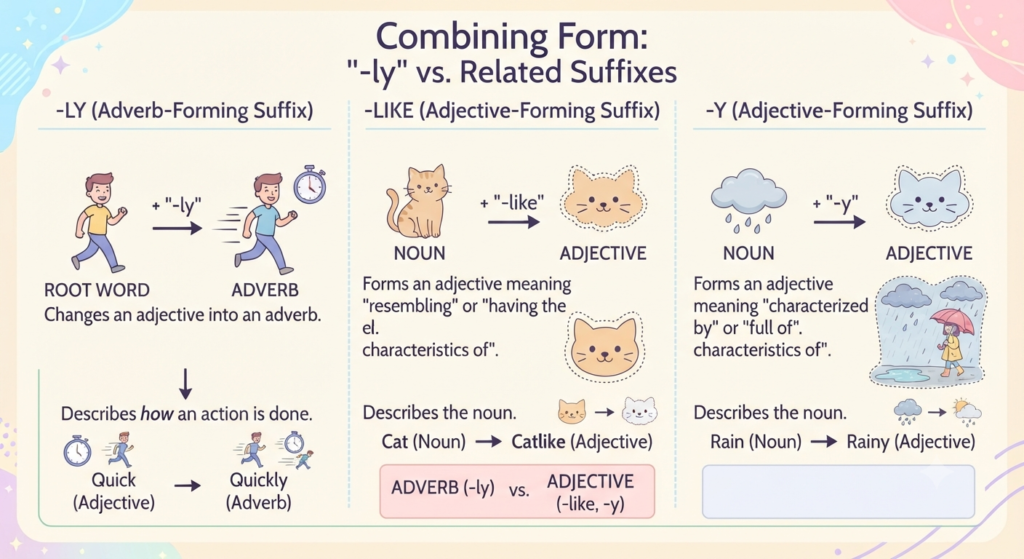
Linguists sometimes describe “-ly” as a combining form; a word part that attaches productively to other words to build new terms, rather than a fixed, closed set of words. That productivity is part of why English keeps generating new “-ly” words (think “bigly” or informal coinages) even outside strict dictionary entries.
It’s worth separating “-ly” from a few suffixes people sometimes confuse it with:
| Suffix | Typical Function | Example |
| -ly | adjective to adverb, or noun to adjective | quickly, friendly |
| -ally | adjective ending in -ic to adverb | basically, tragically |
| -ish | noun/adjective to adjective (approximation) | childish, greenish |
| -like | noun to adjective (resemblance) | lifelike, childlike |
Adverb Suffix vs. Adjective Suffix: How to Tell Them Apart
Since this is the single most-asked grammar question about the suffix, here’s a fast test.
Quick answer: Check what the word is doing in the sentence. If it modifies a verb, adjective, or another adverb (describing how something happens), it’s functioning as an adverb. If it describes a noun directly (describing what kind), it’s functioning as an adjective even though both forms end in “-ly.”
- “She smiled warmly.”; adverb (modifies “smiled”)
- “It was a warmly lit room”; technically fine, but “It was a cozy room” avoids the awkward double “-ly” stacking many editors’ flags.
- “He gave a friendly wave.”; adjective (modifies “wave,” a noun)
If you’re ever unsure, try removing the word and asking what it’s attached to. Nouns get adjectives; verbs get adverbs.
Examples of “-ly” in a Sentence
Seeing both functions side by side makes the pattern click faster:
- Adverb use: She finished the report quickly and sent it before the deadline.
- Adverb use: He spoke softly so he wouldn’t wake the baby.
- Adjective use: The staff at the hotel were incredibly friendly.
- Adjective use: Repairing the roof turned out to be a costly mistake.
- Adjective use: It was a lonely walk back to the car.
Common Exceptions and Irregular Forms
Not every “-ly” pattern follows the rules cleanly, and a few high-frequency words break them outright.
- Good becomes well, not “goodly,” when used as an adverb (“She sings well,” not “She sings goodly”)
- Hard stays hard, unchanged as an adverb (“He worked hard”), while “hardly” exists as a separate word meaning “barely”
- Fast stays fast, no “-ly” form needed (“She ran fast”)
- Late stays late or becomes lately, with different meanings (“He arrived late” vs. “I’ve been busy lately”)
These irregularities are worth memorizing individually rather than trying to force a rule onto them, since native speakers learn them by exposure rather than pattern.
What Does “LY” Mean in Texting? (A Different “ly” Entirely)
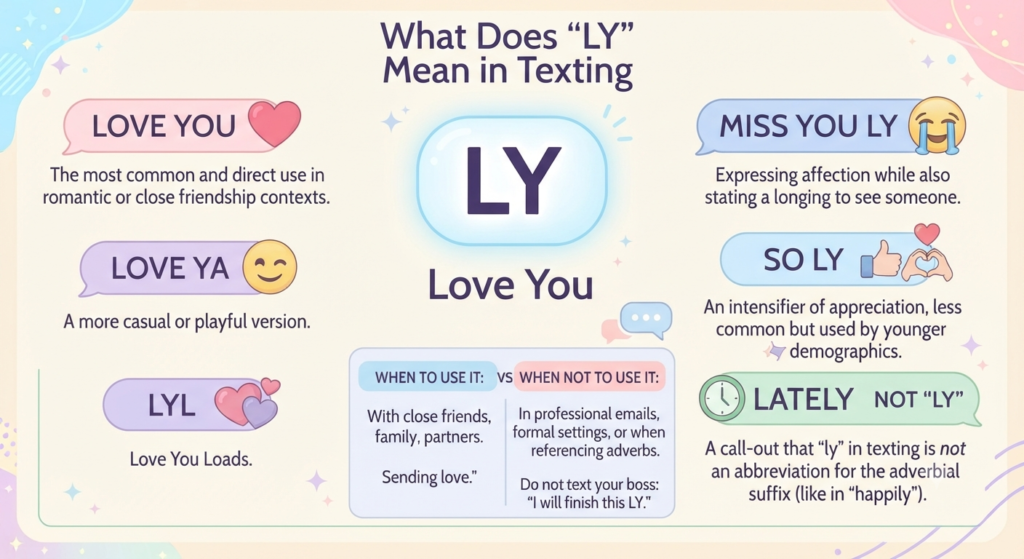
If you searched for “-ly meaning” hoping to understand a text message, this is a completely separate use of the letters. In casual chat and social media, a standalone “ly” is shorthand, not a suffix; most commonly for “love you.”
- LY meaning in chat/text: almost always “love you,” sent as a quick sign-off
- Ly meaning in text from a girl or guy: context matters more than gender; it usually signals affection between close friends, family, or partners, without the intensity of typing out “I love you” in full
- Ly meaning Gen Z: used casually and often platonically among friends, not necessarily romantic
- Ly meaning as a tone tag: occasionally appended after a message (e.g., “that’s so funny, ly”) to soften or add warmth, similar to other tone indicators like “/j” or “/gen”
This texting shorthand has nothing grammatically to do with the adverb or adjective suffix, it’s simply an abbreviation that happens to share the same two letters.
FAQs
What does the suffix “-ly” mean?
It’s a suffix that typically turns adjectives into adverbs (quick becomes quickly) or nouns into adjectives (friend becomes friendly), rooted in the Old English “-lic,” meaning “having the form of.”
Is “-ly” always an adverb ending?
No. While “-ly” commonly forms adverbs from adjectives, it also forms adjectives from nouns, as in “friendly,” “lovely,” and “costly.”
What’s the spelling rule for adjectives ending in “-ic”?
Add “-ally” instead of just “-ly”; for example, “basic” becomes “basically,” not “basicly.”
What does “ly” mean in a text message?
In texting and casual chat, a standalone “ly” is shorthand for “love you,” unrelated to the grammatical suffix.
Why doesn’t “good” become “goodly”?
English uses the irregular adverb “well” instead of a regular “-ly” form for “good,” one of several exceptions native speakers learn individually.
What is the difference between “-ly” and “-ally”?
“-ally” is used specifically for adjectives ending in “-ic,” while “-ly” applies to most other adjectives; both ultimately serve the same adverb-forming function.
Conclusion
The “-ly” suffix looks simple on the surface, but it’s really doing two different grammatical jobs depending on what it’s attached to; turning adjectives into adverbs, or nouns into adjectives. Once you can tell the two apart, spelling rules and odd exceptions like “well” instead of “goodly” start making a lot more sense. Next time you’re second-guessing a word like “friendly” or “basically,” run it through the noun-versus-verb test above, and the right form should follow.
