

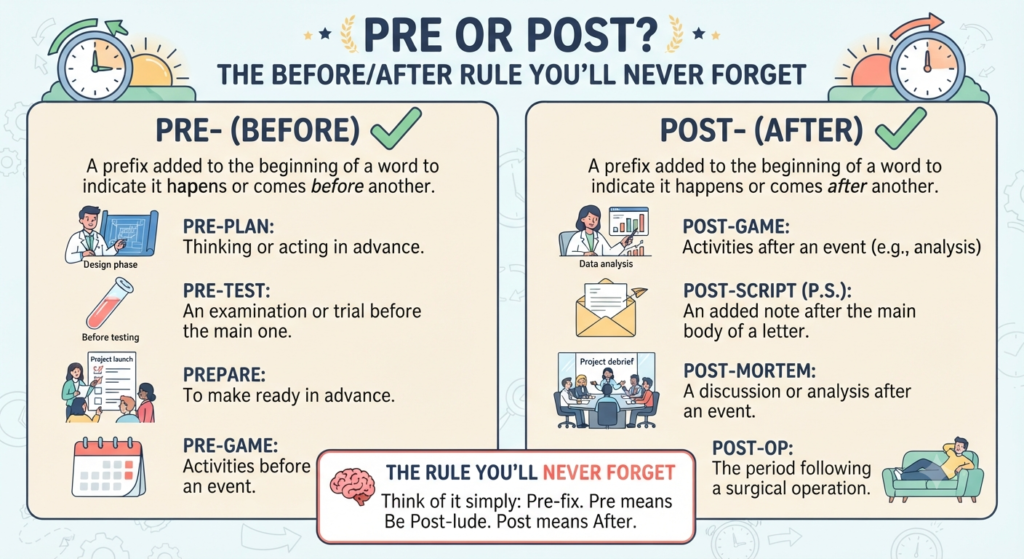
You’re filling out a medical form, and it asks about your “post-op” symptoms. Simple enough, until the next line asks about “pre-op” instructions, and for half a second, your brain has to actively stop and think about which one comes first. Two tiny prefixes, and somehow they still manage to trip people up daily.
The pre vs post meaning distinction sounds almost too basic to need explaining, pre means before, post means after, but the confusion shows up constantly in real writing, from business emails to medical paperwork to social media captions. This guide breaks down exactly what each prefix means, where the mix-ups actually happen, and gives you a rule so simple you’ll never second-guess it again.
What Does Pre Mean?
Pre- is a prefix borrowed from Latin “prae,” meaning “before” or “in front of.” Attach it to a word, and you’re signaling that something happens earlier in time, in advance of an event, or as preparation for what’s coming next.
- Preheat: Heat the oven before cooking
- Prepay: Pay before receiving a service
- Preview: See something before its official release
- Preschool: Education before formal schooling begins
The common thread across every “pre-” word is anticipation. Something hasn’t happened yet, but you’re getting ready for it.
What Does Post Mean?
Post- also comes from Latin, directly from “post,” meaning “after” or “behind.” Where “pre-” signals preparation, “post-” signals the aftermath, what happens once the main event is already over.
- Postgame: The period right after a sports match
- Postpone: Technically means to place after, hence delaying something
- Postgraduate: Studies pursued after completing a degree
- Postscript: A note added after the main body of a letter
If “pre-” is about getting ready, “post-” is about looking back or following up.
Importance of Pre and Post
These two prefixes carry more weight than their size suggests. Getting pre and post usage right isn’t just a grammar nicety, in fields like medicine, business, and event planning, mixing them up can create real confusion about timing, sequence, and responsibility.
- They compress longer phrases into a single word (“pre-meeting” instead of “before the meeting”).
- They establish a clear sequence in instructions, contracts, and schedules.
- They prevent costly misunderstandings in technical or medical documentation.
- They appear across nearly every professional field, from healthcare to software development.
Just like the rules for comparatives (such as knowing when to use Friendlier vs. More Friendly), mastering prefixes requires a simple memory trick.
Pre and Post Meaning in Daily Life
Most people use “pre-” and “post-” constantly without thinking about it. You “preheat” the oven, “prewash” your vegetables, and check a movie’s “preview” before deciding to watch it. On the other end, you write a “postscript” at the bottom of a letter or talk about your “post-workout” routine.
The everyday version of the rule is simple: if it happens before the main action, use pre; if it happens after, use post. It’s the same logic whether you’re cooking dinner or planning a road trip.
Pre and Post Meaning in Education
In schools and universities, these prefixes map directly onto stages of learning. A pretest measures what students know before instruction; a posttest measures what they’ve learned after it. Preschool happens before formal schooling; postgraduate studies happen after a degree is finished.
Educators also use “pre-assessment” and “post-assessment” specifically to measure growth, comparing where a student started against where they ended up.
Pre and Post Meaning in Business
Business communication leans on these prefixes constantly, especially around events, launches, and financial terms. A pre-launch checklist covers everything that needs to happen before a product goes live, while a post-launch review analyzes how it actually performed.
- Prepaid: Payment made before using a service
- Postpaid: Payment made after using a service
- Pre-approval: Confirmed before a formal application
- Post-mortem (business sense): A review conducted after a project ends, examining what went right or wrong
Pre and Post Meaning in Medicine
Healthcare is where getting preoperative vs postoperative exactly right actually matters for patient safety, not just style. A preoperative checklist covers instructions before surgery; fasting, medication adjustments, arrival times. A postoperative plan covers recovery instructions after the procedure is done.
Confusing the two isn’t just a grammar slip in this context, it can lead to patients following the wrong instructions at the wrong time, which is exactly why medical documentation is so precise about hyphenation and placement.
Pre and Post Meaning in Technology
Tech and AI writing has picked up these prefixes heavily in recent years. “Pre-training” refers to teaching a model on general data before it’s fine-tuned for a specific task, while “post-processing” refers to cleanup or refinement applied after the main computation is finished.
- Pre-release: Software available before its official launch
- Post-update: Issues or improvements noticed after a software update
- Pre-loaded: Content or software installed before a device reaches the customer
Pre vs Post Meaning in Social Media
Social platforms have their own casual spin on these prefixes. “Pre-game” (or “pregaming”) describes hanging out before an event, often before going out. “Post” itself has even become a standalone verb meaning to publish content, separate from its use as a prefix entirely, which is worth noting since it can confuse the pattern at first glance.
Influencers and brands also use “before and after” content heavily, which is really just “pre and post” dressed up in more visual, casual language for a feed.
Key Differences Between Pre and Post
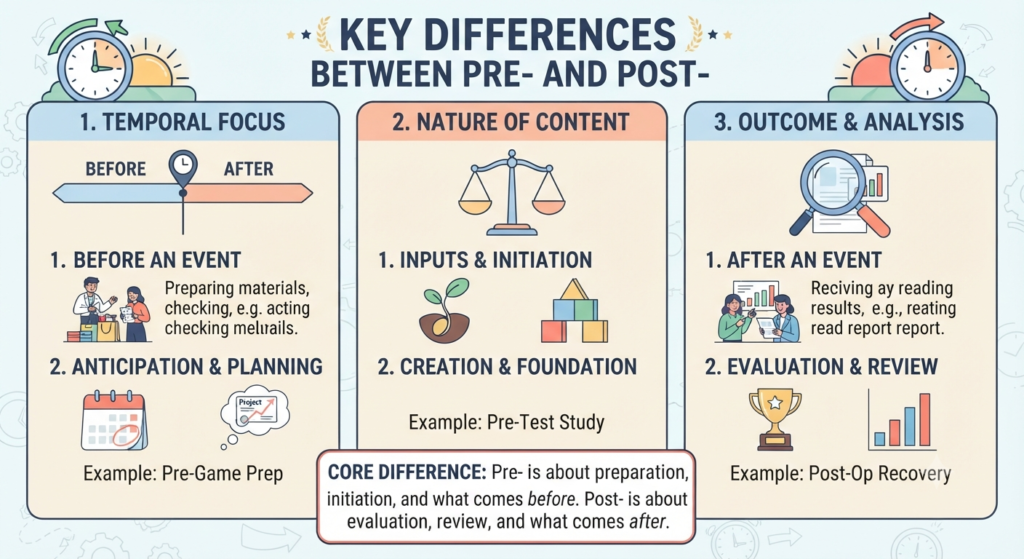
| Feature | Pre- | Post- |
| Core meaning | Before | After |
| Latin root | Prae (“before, in front of”) | Post (“after, behind”) |
| Signals | Preparation, anticipation | Aftermath, follow-up, reflection |
| Common fields | Planning, scheduling, medicine, business | Review, recovery, analysis, results |
| Example pair | Pre-op, pre-launch, pre-test | Post-op, post-launch, post-test |
| Typical question it answers | What happens before this event? | What happens after this event? |
| Quick test | Can you replace it with “before”? | Can you replace it with “after”? |
Common Misunderstandings About Pre and Post
A few recurring mistakes show up across writing at every level, from casual texts to professional reports.
- Treating them as interchangeable. “Post-approval” and “pre-approval” describe opposite timelines, not two versions of the same idea.
- Redundant phrasing. Saying “pre-plan” is often unnecessary, since “plan” already implies preparation ahead of time.
- Inconsistent hyphenation. Some words are standardized without a hyphen (preview, postpone), while others commonly use one (pre-launch, post-op), style guides vary, so consistency within a single document matters more than a universal rule.
- Confusing “post” the prefix with “post” the verb. Posting content on social media has nothing to do with the “after” meaning of the prefix, even though they’re spelled identically.
- Assuming “post” always means “after” in every context. Rare exceptions exist in specific technical or postal terminology, but in standard modern usage, “after” is the safe, reliable default.
Pre vs Post Examples
Seeing both prefixes applied to the same root word side by side makes the pattern click fastest.
- Pre-event preparation vs. post-event cleanup
- Pre-surgery consultation vs. post-surgery recovery
- Pre-season training vs. post-season playoffs
- Pre-interview research vs. post-interview follow-up
- Pre-purchase reviews vs. post-purchase feedback
Pre and Post Synonyms
When “pre-” and “post-” don’t fit naturally, several standalone words carry the same meaning. For before: prior to, ahead of, in advance of, preceding. For after: following, subsequent to, in the aftermath of, later than.
Pre vs Post Discussions Online
Online grammar and language communities, including forums like Reddit, regularly revisit this exact question, usually sparked by a specific confusing example like “postpone” (which sounds like it should mean “after” something, but actually just means “place later”). These discussions tend to circle back to the same core advice: when in doubt, mentally substitute “before” or “after” into the sentence and see which one fits.
Pre, Post, and Peri
A third, less common prefix rounds out this family: peri-, meaning “around” or “during.” It shows up most often in medical terminology, describing something happening during or surrounding an event rather than strictly before or after it.
- Perioperative: The entire period surrounding surgery, including before, during, and after
- Perimenopause: The transitional period surrounding menopause, not fully before or after it
- Perinatal: The period around childbirth, covering both before and shortly after birth
Pre, Post, and During
Grouping all three together gives you a complete timeline: pre-covers what happens before an event, during covers what happens as it’s actively occurring, and post covers what happens once it’s finished. Some contexts use “peri-” instead of “during” as the prefix form, but the underlying three-part structure; before, during, after stays the same across medicine, business, and event planning alike.
Does “Post” Ever Mean Before?
No, in standard modern English, “post” as a prefix always means “after,” never “before.” The confusion sometimes comes from words like “postdate,” which can mean assigning a future date to something, but that still describes an action happening later, not earlier, which keeps it consistent with the core “after” meaning.
FAQs
What is the difference between pre and post?
Pre means before an event, action, or point in time, while post means after it. The distinction is about sequence, whether something happens in preparation for an event or as a follow-up to it.
What does “post” mean before or after?
“Post” as a prefix always means after, never before, it signals that something follows a specific point in time, such as an event, action, or milestone.
How do you remember when to use pre or post?
Use the substitution test: try replacing the prefix with “before” or “after” in plain English. Whichever word makes the sentence accurate is the correct prefix to use.
Is “preoperative” the same as “before surgery”?
Yes, “preoperative” specifically refers to the period and preparations before a surgical procedure, while “postoperative” refers to the recovery period afterward.
Can pre and post be used in the same sentence?
Yes, it’s common and often useful to use both prefixes together to show a full sequence, such as “we compared pre-launch projections with post-launch results.”
What is the Latin origin of pre and post?
“Pre-” comes from the Latin “prae,” meaning before or in front of, while “post-” comes from the Latin “post,” meaning after or behind, both entered English through French usage centuries ago.
Is it “pre-planned” or just “planned”?
“Planned” alone is usually sufficient, since planning inherently happens before an event, “pre-planned” is technically redundant, though it’s common enough in casual speech that it rarely reads as a serious error.
Why does “postpone” mean “delay” instead of literally “after”?
“Postpone” comes from Latin roots meaning “to place after,” so delaying an event effectively means placing it later on the timeline, the “after” logic is still there, just applied to scheduling rather than sequence of events.
Do “pre-” and “post-” always need a hyphen?
Not always, many established words drop the hyphen entirely (preview, postgraduate), while newer or less common combinations often keep one for clarity (pre-launch, post-pandemic); when unsure, check your style guide or stay consistent throughout your document.
What’s the opposite of “pre-” in a sentence?
The direct opposite of “pre-” is “post-,” though standalone words like “after,” “following,” or “subsequent to” work as alternatives when a prefix doesn’t fit naturally.
Conclusion
The pre vs post meaning question really comes down to one reliable test: does the word mean “before” or “after”? Pre always points backward in preparation, and post always points forward into the aftermath and once that substitution trick becomes second nature, you’ll stop hesitating over pre-launch checklists, postoperative instructions, or anything else built on these two small but powerful prefixes.
Next time you catch yourself pausing mid-sentence, run the quick before/after test from this guide. It takes seconds, and it’s the kind of small habit that keeps your writing precise across every field where timing actually matters.
