

Picture two texts arriving within a minute of each other. One friend says, “Renewing my passport was such a hassle.” Another says, “I’m hustling to launch my side business.” You’re halfway through an email, “The new manager seems ___ than the last one” and your cursor just sits there. Friendlier? More friendly? Both look fine. Both sound fine. And that’s exactly the problem, because English usually forces you to pick one comparative form, not two.
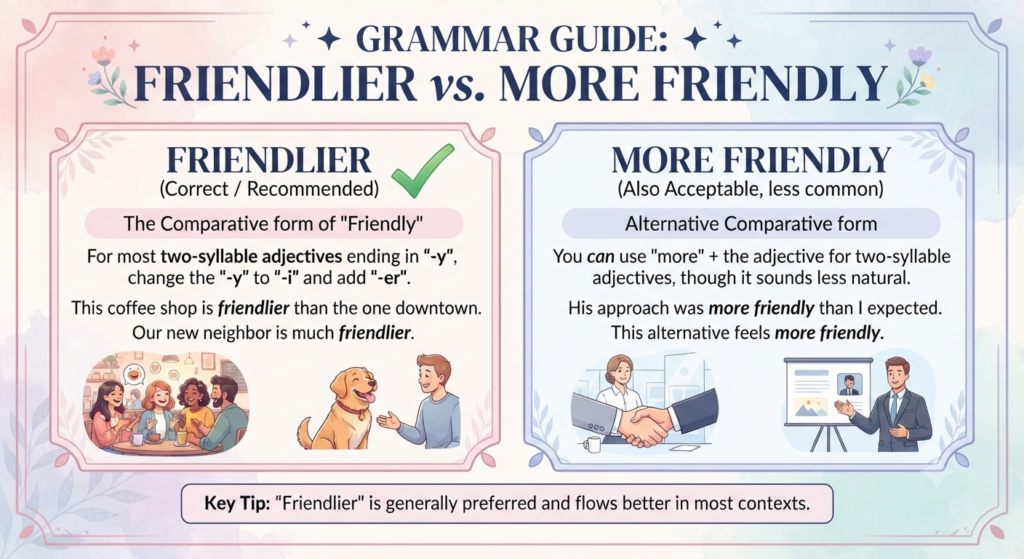
The friendlier vs more friendly debate is one of the rare cases where both answers are technically correct, but they’re not always interchangeable. This guide explains the actual grammar rule behind it, shows you when each form fits best, and covers the exceptions that trip up even confident writers; things like compound adjectives, branding language, and formal tone.
Understanding Comparative Adjectives in American English
A comparative adjective shows how one thing measures up against another; bigger, faster, more interesting. English builds these in two ways, and which method you use usually depends on the length of the word.
- One-syllable adjectives: Almost always take -er: tall to taller, fast to faster.
- Three-or-more-syllable adjectives: Almost continuously take more: beautiful to more beautiful, expensive to more highly expensive.
- Two-syllable adjectives: The messy middle ground can go either way, and this is exactly where “friendly” lives.
Most two-syllable adjectives ending in -y follow the same pattern as one-syllable words: happy becomes happier, busy becomes busier, easy becomes easier. That pattern is strong enough that “friendlier” feels like the default. But “friendly” has a quirk that keeps “more friendly” alive too.
Why “Friendly” Allows Both Forms
Here’s the twist: “friendly” isn’t built the way most -ly words are. It’s not an adjective plus an adverb-forming suffix; it’s the noun friend plus -ly, which historically produced an adjective, not an adverb (unlike “quickly” or “slowly,” which are adverbs built from adjectives).
Because of that unusual structure, “friendly” doesn’t fit neatly into either camp. Grammar authorities generally treat it as following the -y to -ier pattern (like happy to happier), which makes “friendlier” the standard, dictionary-preferred comparative. But because “friendly” visually ends in “-ly” ; the ending normally associated with adverbs and longer words, many writers instinctively reach for “more” instead, and that instinct isn’t wrong; it’s just less common.
The result: both forms passed into accepted modern usage. Friendlier vs more friendly isn’t a right-versus-wrong situation, it’s a preferred-versus-alternative one.
When You Should Use “Friendlier”
Friendlier is the standard, most natural comparative form of friendly, and it’s correct in the vast majority of sentences. Use it as your main choice, especially when speaking, writing in a casual style, and making direct comparisons between two people, places, or things.
- “The new hire is friendlier than her predecessor.”
- “This neighborhood feels friendlier since the renovation.”
- “Our support team got friendlier after the training.”
Native speakers reach for this form automatically because it’s shorter and matches the rhythm of similar words like happier, easier, and busier.
When “More Friendly” Is the Better Choice
“More friendly” earns its place in specific situations rather than everyday conversation. It tends to show up when the sentence structure, tone, or word combination makes the “-ier” form feel clunky or out of place.
- When “friendly” is part of a longer compound phrase: “more environmentally friendly,” “more user-friendly.”
- When you need a more formal or careful tone, especially in professional writing.
- When you’re highlighting a comparison of several qualities in the same sentence, like “The office felt more open, more relaxed, and more friendly
- When the sentence already contains another “-er” comparative and repeating the pattern would sound awkward.
Special Cases and Exceptions (Important!)
This is where most grammar guides stop short, the exceptions are exactly where writers get tripped up, so it’s worth breaking each one down individually.
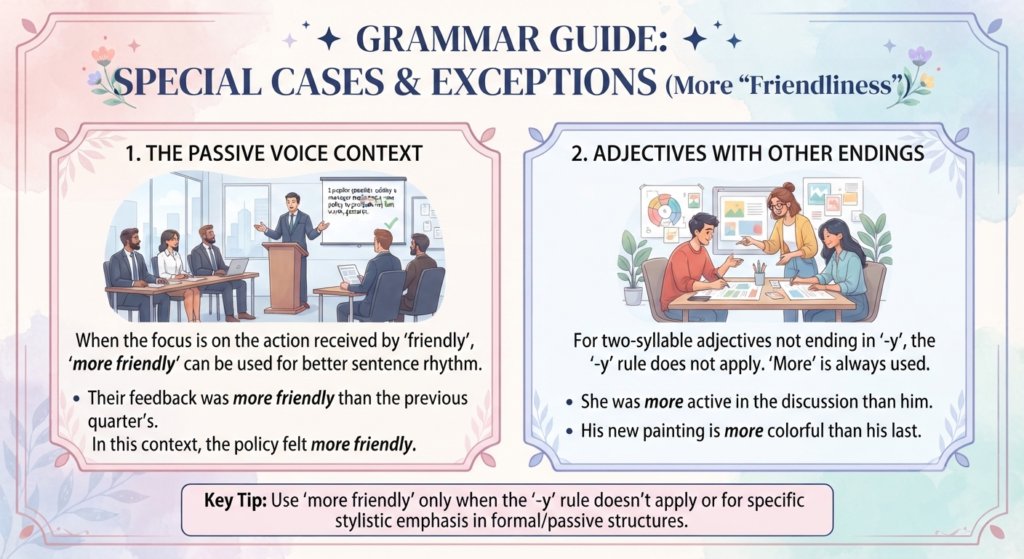
1. Compound Adjectives
When “friendly” is fused into a compound word, “more” is the only option. You can’t say “eco-friendlier” or “user-friendlier”; neither exists in standard English. Instead: more eco-friendly, more user-friendly, more budget-friendly.
2. Technical or Scientific Writing
Technical and academic writing tends to favor precision and neutrality over stylistic flow, and “more friendly” often reads as more measured. Phrases like “more environmentally friendly materials” or “a more friendly interface design” are often used in reports and documents, even though “friendlier” would be grammatically correct.
3. Advertising and Branding
Marketing copy often picks words based on how they sound and match the brand’s style instead of sticking strictly to grammar rules. A slogan built around “friendlier service” sounds warm and casual; “more friendly, more reliable” sounds structured and deliberate. Brands pick whichever fits the sentence they’re building around it.
4. Formal Tone vs. Casual Tone
In everyday speech, emails to friends, or social posts, “friendlier” is almost always the natural pick. In business writing, legal documents, or formal reports, “more friendly” can feel intentionally measured; not better grammar, just a different register.
5. When Emphasis Matters
Sometimes “more” adds emphasis that “-ier” can’t. “She became more friendly over time” can subtly stress a gradual, ongoing shift, while “She became friendlier” reads as a flatter, simpler statement of fact.
“More Friendly” vs “Friendlier”: Real-World Side-by-Side Comparison
| Context | Preferred Form | Example |
| Casual conversation | Friendlier | “He’s way friendlier than his brother.” |
| Direct two-item comparison | Friendlier | “This café is friendlier than that one.” |
| Compound adjective | More friendly | “We need a more user-friendly checkout.” |
| Formal/business writing | Either (more friendly often preferred) | “The revised policy is more friendly to small businesses.” |
| Advertising/branding | Either (depends on rhythm) | “Friendlier service, faster results.” |
| Academic/technical writing | More friendly | “A more friendly interface reduces user errors.” |
| Emphasizing gradual change | More friendly | “Customers found the staff more friendly with each visit.” |
Case Study 1: Customer Service Teams
A retail company retrained its support staff and wanted to describe the change in an internal report. The writer initially drafted “our team is friendlier now,” but revised it to “our team has become more friendly and more responsive” to keep both qualities parallel in the same sentence. The compound comparison made “more” the smoother choice.
Case Study 2: App Redesign
A software company redesigning its onboarding flow described the update as making the app “more user-friendly” ; never “user-friendlier,” which isn’t standard. But in casual release notes aimed at everyday users, the team wrote, “The new version just feels friendlier to use,” choosing the shorter form because the tone was informal.
Case Study 3: Environmental Policy
A sustainability report described a manufacturing change as making the process “more environmentally friendly.” Here, “friendlier” was never a real option — the compound adjective structure (“environmentally friendly”) locks the sentence into using “more.”
Practical Guidelines for Choosing the Right Form
Use “friendlier” when:
- You’re making a simple, direct comparison between two things.
- The tone is casual or conversational.
- The sentence doesn’t include a compound adjective.
- You want the shortest, most natural-sounding option.
Use “more friendly” when:
- “Friendly” is attached to another word (eco-, user-, budget-, environmentally).
- You’re writing in a formal or technical register.
- The sentence lists multiple comparative qualities together.
- You want to add subtle emphasis on a gradual or deliberate change.
Quick “Say It Out Loud” Test
If you’re still unsure, read the sentence aloud. Comparatives are shaped by rhythm as much as rule, so whichever version flows more naturally in your specific sentence is usually the better pick, unless a compound adjective locks you into “more” regardless of how it sounds.
5 Common Myths About “More Friendly” vs “Friendlier”
- Myth: “More friendly” is always incorrect. It’s grammatically valid and preferred in several specific contexts.
- Myth: “Friendlier” is only for casual writing. It’s also standard in professional writing when the sentence doesn’t call for “more.”
- Myth: You can add “-er” to any friendly compound. Compound adjectives like “eco-friendly” never take “-ier.”
- Myth: Dictionaries reject one of the two forms. Major dictionaries list “friendlier” as the primary comparative but don’t mark “more friendly” as wrong.
- Myth: The choice doesn’t matter at all. Tone, formality, and sentence structure all shift slightly depending on which form you choose.
Friendly’s or Friendlies
Neither is standard as a plural of the adjective “friendly,” since adjectives don’t pluralize in English. “Friendlies” does exist as a separate noun, referring to informal, non-competitive sports matches (“the team played two friendlies before the season started”).
Most Friendly or Friendliest
Friendliest is the correct superlative form, following the same -y to -iest pattern as “friendlier.” “Most friendly” is possible but far less common, parallel to how “more friendly” trails “friendlier” in the comparative.
How Friendly Is Too Friendly
This isn’t a grammar question but a social one; “too friendly” typically describes behavior that crosses into overly familiar, intrusive, or inappropriate territory for the relationship or setting involved. Context determines the line, not a fixed rule.
Is Friendly and Nice the Same Thing
Not quite. Friendly describes warmth and approachability in behavior toward others, while nice is a broader term covering pleasantness, kindness, or general good quality, you can be nice without being especially friendly, and vice versa.
FAQs
Friendlier or more friendly, which is correct?
Both are grammatically correct, but friendlier is the standard, more commonly used comparative form of “friendly.” “More friendly” is reserved for specific cases like compound adjectives, formal tone, or emphasis.
Is “friendlier” a word?
Yes. “Friendlier” is a fully accepted comparative adjective listed in standard dictionaries, formed by changing the “-y” in “friendly” to “-i” and adding “-er.”
What is the comparative and superlative of friendly?
The comparative is friendlier, and the superlative is friendliest. “More friendly” and “most friendly” are grammatically acceptable alternatives but less commonly used.
Friendlier or more friendly, Cambridge Dictionary’s take?
Standard dictionary references list “friendlier” as the primary comparative form of “friendly,” while acknowledging “more friendly” as an accepted variant in specific contexts.
Can you say “eco-friendlier”?
No. Compound adjectives built with “friendly”, like eco-friendly, user-friendly, or budget-friendly, only take “more,” never the “-ier” ending.
Why does “friendly” allow two comparative forms?
“Friendly” is built from a noun (“friend”) plus “-ly,” an unusual structure that doesn’t fit cleanly into either the “-er” or “more” comparative pattern, which is why both forms became accepted over time.
Conclusion
The friendlier vs more friendly question doesn’t have a single winner; it has a default and a set of exceptions worth knowing. Reach for friendlier in everyday writing and conversation, and switch to more friendly when you’re dealing with compound adjectives, formal tone, or a sentence that needs it to flow better.
Next time you hit that pause mid-sentence, run the quick test: say it out loud, check for a compound word attached, and consider your tone. That’s really all the rule comes down to and once you’ve internalized it, you won’t second-guess the choice again.

2 thoughts on “Is It “Friendlier” or “More Friendly”? Grammar Rule + Examples”