
You’re signing off an email, writing a birthday card, or drafting a farewell message, and you pause.Should I say ‘I wish you all the best’ or ‘Wishing you all the best’? Both look right. Both sound polite. That’s exactly why so many people get stuck comparing wish you all the best or wishing you all the best before hitting send.
The short version: it comes down to grammar, not correctness. One is a complete sentence built around a verb. The other is a phrase that works as a fragment, usually as a sign-off. Neither one is more correct than the other; they just serve different purposes in a sentence. Below, you’ll get the grammar explained plainly, real examples for each version, a side-by-side comparison table, and answers to the questions people actually type into Google about this phrase.
Wish You All the Best vs Wishing You All the Best: Meaning & Key Differences
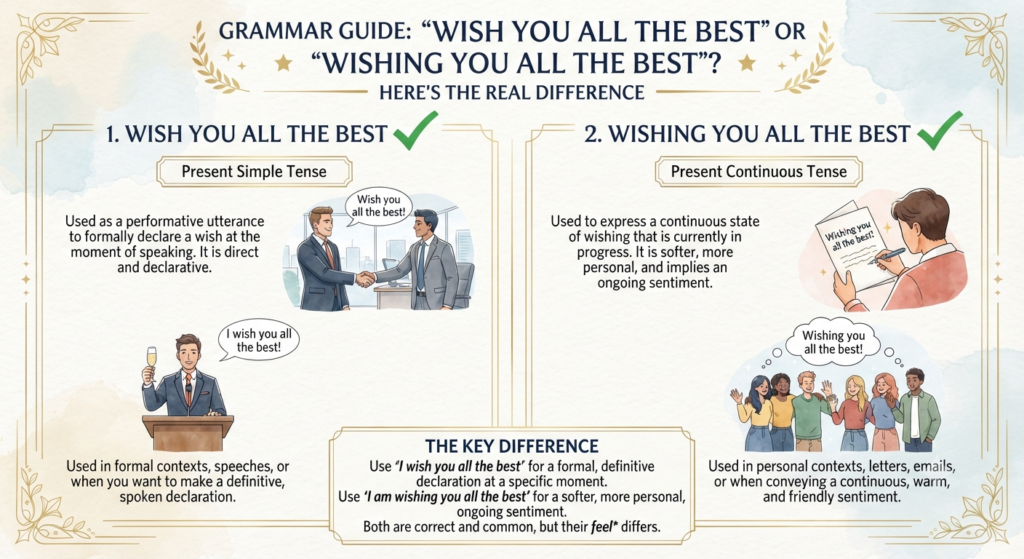
“Wish” is a base-form verb. That means it needs a subject in front of it to make a complete sentence; for example, I wish, we wish, she wishes, they wish. Drop the pronoun and “wish you all the best” on its own reads like a command or an instruction rather than a heartfelt statement, which is why most style guides recommend keeping the “I” or “we” attached.
“Wishing” is the present participle form of the same verb. Participles don’t need a subject to function in casual writing, they can stand alone as a sentence fragment, which is completely normal in greetings, cards, and sign-offs. That’s why “wishing you all the best” reads naturally by itself, while “wish you all the best” without a pronoun can feel clipped.
In terms of tone, people who study these two versions generally agree on a subtle distinction: the full verb form feels more direct and personal, like you’re stating something in the moment, while the participle form feels a little softer and more ongoing, as though the good wishes are continuing rather than a one-time statement. Neither is inherently more formal, context decides that.
Quick Answer (Featured Snippet Style)
“Wish you all the best” and “wishing you all the best” are both correct English, but they aren’t interchangeable on their own. “Wish you all the best” needs a subject like “I” or “we” before it to form a full sentence. “Wishing you all the best” is a fragment that works fine alone, especially as a greeting or sign-off, because participle phrases don’t require a subject in casual writing.
Wish You vs Wishing You: The Grammar Behind It
To really get this, it helps to separate the two building blocks: “wish” and “wishing.”
- Wish is a finite verb. It changes with the subject (I wish, he/she wishes) and needs that subject to make a grammatically complete sentence.
- Wishing is a non-finite verb form (a present participle). It doesn’t change based on the subject, and it can be used without one in informal writing, similar to how “Hoping you feel better soon” works as a stand-alone line in a card.
This is the same pattern you’ll notice in other common phrases, which is worth remembering any time you’re deciding between wish you or wishing you happy birthday, a good trip, or a fast recovery.
| Feature | “Wish you all the best” | “Wishing you all the best” |
| Grammar type | Finite verb phrase | Participle phrase |
| Needs a subject? | Yes (“I,” “We,” “She,” etc.) | No — works as a fragment |
| Best used for | Full sentences, spoken or written | Sign-offs, cards, headers, captions |
| Tone | Direct, personal | Slightly softer, ongoing |
| Common placement | Mid-sentence or sentence-ending | Start of a message or standalone line |
| Formality | Works in both formal and informal writing | Works in both, very common in formal closings |
Examples of “Wish You All the Best”
Because “wish” is a full verb, this version almost always needs a subject attached. Here’s what that looks like in practice:
- I wish you all the best in your new position.
- We wish you all the best for the exam results.
- She wishes you all the best on your move overseas.
- My whole team and I wish you all the best in retirement.
- I just wanted to wish you all the best before you go.
Notice the pattern: there’s always a subject doing the wishing. That subject is what makes the sentence grammatically complete rather than a fragment.
Examples of “Wishing You All the Best”
This version works as its own line, without a pronoun attached, which is exactly why it shows up so often in cards, closing lines, and captions:
- Wishing you all the best on your orientation day!
- Wishing you all the best as you begin this new chapter.
- Wishing you all the best for a quick recovery.
- We’re all here wishing you all the best.
You’ll also see it combined with a subject, as in “We are wishing you all the best,” which turns it into a complete present-continuous sentence rather than a fragment.
Wish You or Wishing You Happy Birthday
This question keeps coming up all the time, and the same rule still applies. “Wish you a happy birthday” needs a subject: “I wish you a happy birthday” or “We wish you a happy birthday.” On its own, without “I” or “we,” it sounds like an instruction rather than a greeting.
“Wishing you a happy birthday,” on the other hand, works perfectly fine as a stand-alone line on a card or in a text message, because it’s a fragment used as a greeting, not a demand for a complete grammatical sentence.
Wish You All the Best or Wishing You the Same
If someone signs off a message with “wishing you all the best,” a natural, grammatically sound reply is “wishing you the same” or “wish you the same too” if you’re including a pronoun. Both work; the fragment version simply mirrors the tone of what was said to you, which makes it a natural, low-effort way to respond in emails, texts, or cards without sounding repetitive.
“Wishing You All the Best” as a Sign-Off
In professional emails, “wishing you all the best” is an extremely common closing line, right alongside “best regards” or “warm wishes.” It works well because:
- It doesn’t require restructuring the rest of your email around a subject.
- It reads as warm without being overly casual.
- It fits naturally after a resignation notice, a goodbye message, a congratulations note, or a farewell to a colleague.
If you want something that reads slightly more personal or direct, switch to the full sentence form instead: “I wish you all the best in this next chapter,” followed by your name.
Related Phrase Comparisons
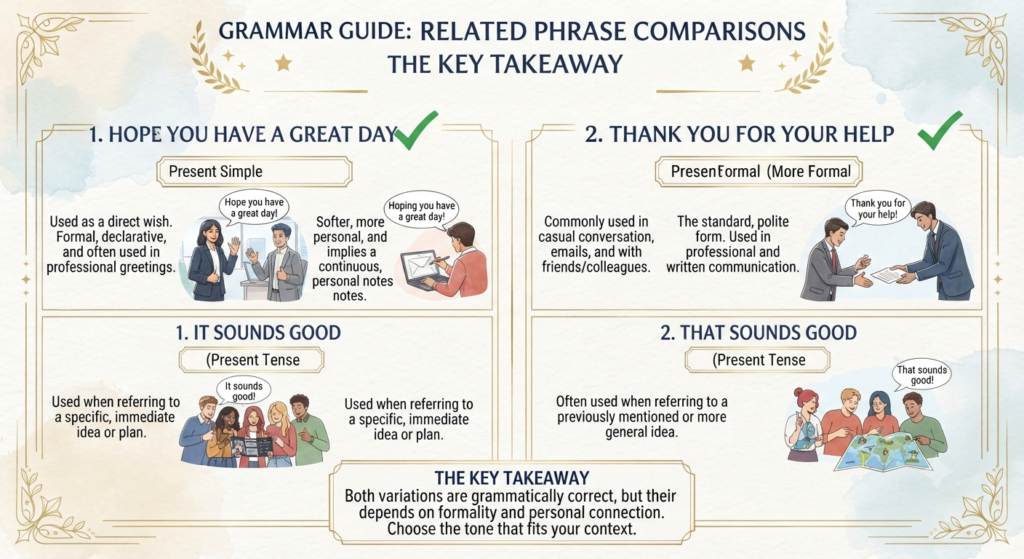
A few nearby phrases trip people up for the same grammatical reason:
- Wishing you well vs. wishing you all the best: “wishing you well” is a shorter, slightly more general version; “all the best” implies a broader, more complete set of good outcomes.
- Wish you all the best vs. best wishes: “best wishes” is a noun phrase, not built on a verb at all, which is why it works as a sign-off without any subject or participle rule to worry about.
- Wishing you all the best synonym options: “sending you my best,” “hoping everything goes well for you,” and “rooting for you” all carry a similar sentiment with a slightly different register.
FAQs: What People Actually Ask About This Phrase
Is “wishing you all the best” grammatically correct?
Yes. As a present participle phrase, it functions correctly as a stand-alone fragment in greetings, cards, and sign-offs, even without a subject attached.
Is it correct to say “wish you all the best” without “I”?
It’s understood, but most grammar guides recommend keeping a subject like “I” or “we” in front of it, since “wish” is a full verb that technically needs one to form a complete sentence.
What is a formal way to say “good luck”?
“I wish you every success,” “wishing you continued success,” and “best wishes for your future endeavors” are common formal alternatives used in professional emails and reference letters.
Can I use “wishing you all the best” to start an email?
It’s more common as a closing line than an opener, but it can work as a header on a card or short note, especially for farewells and congratulations messages.
What’s the difference between “wishing you all the best” and “wishing you the best”?
They mean essentially the same thing. “All the best” is simply a slightly more emphatic, idiomatic version of “the best,” and both are used interchangeably in everyday English.
Which version is more popular in everyday English?
Data from large text corpora shows “wish you” as the base verb form appears more frequently overall, largely because it’s used across so many different sentence structures, while “wishing you” is concentrated in greetings and sign-offs.
Conclusion
There’s no winner between wish you all the best or wishing you all the best, they’re both correct, and the right pick depends on the sentence around them. Use “I wish you all the best” (or any subject + wish) when you’re writing a complete sentence. Use “wishing you all the best” when you want a warm, stand-alone line for a card, caption, or email sign-off. Once you remember that “wish” needs a subject and “wishing” doesn’t, you’ll never second-guess this one again.

1 thought on ““Wish You All the Best” or “Wishing You All the Best”? Here’s the Real Difference”