

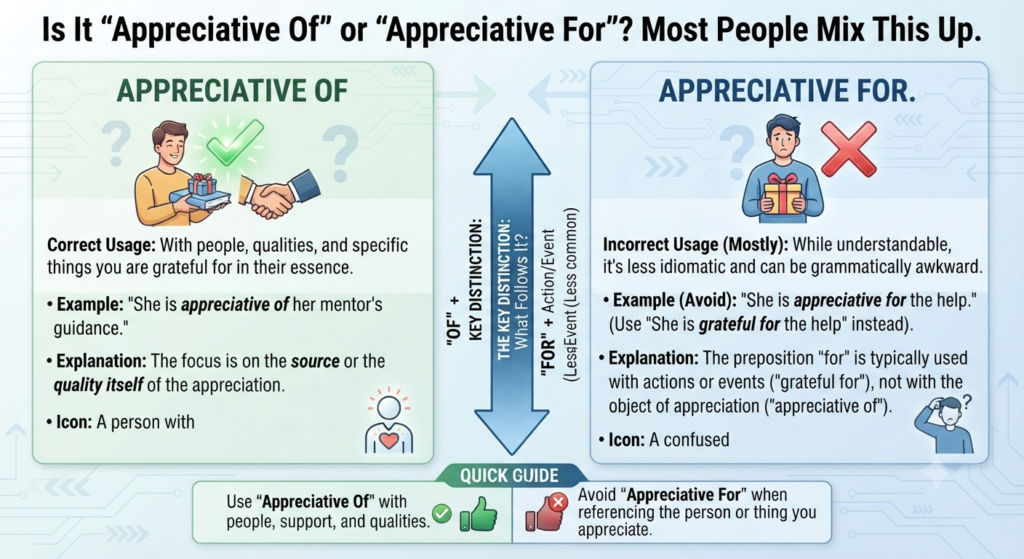
You type out “I’m so appreciative for your help,” pause, and wonder if it should be “appreciative of” instead. If that’s why you’re here, you’re not alone; appreciative of vs appreciative for is one of those small preposition choices that trips up native speakers and learners equally.
This guide breaks down what “appreciative” actually means, which preposition is grammatically standard, when the less common option still works, and how to avoid sounding off in formal writing.
Appreciative Of or Appreciative For: Why So Much Confusion?
Prepositions are tiny words, but they carry real grammatical weight. “Of” and “for” both express relationships between an adjective and its object, and English doesn’t always make it obvious which one an adjective “wants.”
Part of the confusion comes from a nearby word: grateful. Since “grateful for” is completely standard (“grateful for your support”), people naturally assume “appreciative for” should follow the same pattern. It doesn’t and that mismatch is where most of the mix-ups start.
What “Appreciative” Really Means
“Appreciative” is an adjective built from the verb “appreciate,” which carries two related meanings:
- To understand how good something is or what it’s worth (“She’s appreciative of good design.”).
- To feel thankful for an action or effort (“He’s appreciative of everything you did.”)
Appreciation doesn’t always require gratitude, you can be appreciative of a skill, a piece of music, or someone’s patience without necessarily “owing” anyone thanks. That subtle range is part of why the word pairs more naturally with “of,” a preposition built for pointing at a specific object of recognition, rather than “for,” which leans toward reasons or purposes.
Appreciative Of: The Most Natural and Standard Form
“Appreciative of” is the grammatically standard, most widely used form, and it’s what you’ll find recommended across major dictionaries and grammar references. It works by directly connecting the feeling of appreciation to a specific person, action, quality, or thing.
- “I’m appreciative of your guidance throughout this project.”
- “We are appreciative of efforts the team put in.”
- “She felt appreciative of the quiet morning before her shift.”
In each example, “of” links appreciation straight to the object being recognized, the guidance, the hours, the quiet morning. That directness is exactly why editors and style guides default to this form in professional and academic writing.
Similar term explained here “”Wish You All the Best” or “Wishing You All the Best”? Here’s the Real Difference“
Appreciative For: Less Common but Not Always Wrong
“Appreciative for” isn’t a hard grammatical error, but it’s non-standard; it shows up mostly in casual speech and social media captions rather than edited writing. Usage data from language corpora shows that “appreciative of” is used much more frequently than “appreciative for,” which supports the idea that the “of” form is the standard choice in educated writing.
That said, “appreciative for” hasn’t disappeared. You’ll still hear it in relaxed, spoken contexts:
- Feeling really appreciative for all the birthday messages I got today!
- I’m genuinely appreciative for everything you’ve done for me.
In these cases, the phrase leans closer in feel to “thankful for” or “grateful for,” even though “appreciative of” would be the more precise and formally accepted choice.
How Meaning Changes: Appreciative Of vs Appreciative For
Here’s the direct answer to the core question: “Appreciative of” is the grammatically correct and standard form, used to recognize a specific person, action, or quality. “Appreciative for” is informal and non-standard, more common in casual speech, and often blurs into the meaning of “grateful for” rather than true appreciation.
The nuance goes a bit deeper than “one is right, one is wrong,” though:
| Aspect | Appreciative Of | Appreciative For |
| Grammatical status | Standard, widely accepted | Non-standard, informal |
| Focus | Specific person, action, or quality | General reason or broader benefit |
| Best context | Formal writing, email, academic work | Casual speech, social captions |
| Closest synonym match | “Recognizing the value of” | “Thankful for” / “grateful for” |
| Frequency in edited writing | Dominant | Rare |
The table makes the practical takeaway clear: when you’re naming exactly what you’re recognizing; someone’s help, effort, or quality , “of” is the safer, more precise choice.
Historical and Modern Usage Trends
Older English texts occasionally used “appreciative for,” but as grammar references and style guides standardized adjective-preposition pairings over the 20th century, “of” solidified as the dominant, recommended form. Modern editorial style; in journalism, academic publishing, and professional communication has stayed consistent on this point ever since.
Spoken English, unsurprisingly, has always been looser than written English. That gap explains why “appreciative for” still surfaces in everyday conversation and social posts, even though it rarely appears in edited, published writing.
Common Mistakes Learners Make
- Assuming “appreciative” behaves like “grateful”: Grateful pairs with “for” (“grateful for your help”); appreciative pairs with “of.”
- Using “appreciative for” in formal emails or reports: This reads as a small but noticeable error to careful readers.
- Dropping the object entirely: “I’m so appreciative!” works fine casually, but formal writing usually benefits from naming what you’re appreciative of.
- Overcorrecting in speech: There’s no need to sound stiff in casual conversation; “appreciative for” isn’t offensive, just less precise.
Learn more about “The Complete Guide to AM and PM: Meaning, Uses & Common Mistakes“
Easy Rules to Remember
- Default to “of” whenever you’re unsure, it’s correct in nearly every context, formal or casual.
- Reserve “for” for spoken or very casual writing, and even then, know it’s the less precise option.
- If you can swap in “grateful,” consider “for” but if you’re naming a specific quality or action, “of” almost always fits better.
- In professional or academic writing, always choose “of.” There’s no scenario where it reads as wrong.
Case Studies: Real-World Examples

Case Study 1: Formal Business Email
A project manager wrote, “I am appreciative of your detailed feedback on the proposal.” The phrasing reads as polished and precise, exactly the tone expected in professional correspondence.
Case Study 2: Team Recognition Message
A department head sent a note reading, “We are appreciative of everyone who stayed late to meet the deadline.” Here, “of” cleanly connects the appreciation to the specific group being recognized.
Case Study 3: Teacher Feedback
A teacher wrote on a student’s report, “I’m appreciative of the effort you put into this assignment, even though the results need work.” The phrase praises the specific effort without overstating the outcome, a distinction “appreciative of” handles gracefully.
Case Study 4: Social Media Post
A user posted, “Feeling so appreciative for all the birthday love today! 🎉” In this casual, emotional context, “for” doesn’t jar the reader, it fits the relaxed tone of a social caption, even though “of” would still be the more technically standard choice.
Expert Quote
As one ESL grammar instructor put it: “Appreciative of connects appreciation to a clear object or quality. Appreciative for expresses a broader emotion. Both exist, but they aren’t interchangeable in careful writing.”
“Anyone Has” vs “Anyone Have”: Rule, Examples & Common Mistakes
FAQs
What’s a good synonym for “appreciative of” or “appreciative for”?
Close synonyms include “grateful for,” “thankful for,” and “recognizing the value of”; though “grateful for” is the most natural direct substitute in most sentences.
What does “appreciative of” or “appreciative for” actually mean?
Both express recognition or thankfulness, but “appreciative of” points to a specific object of recognition, while “appreciative for” leans toward a general reason for gratitude.
Is there an actual grammar rule behind appreciative of vs appreciative for?
Yes, “appreciative” is conventionally paired with “of” as its standard preposition, similar to how “aware of” or “capable of” follow the same pattern, while “for” is considered non-standard here.
Can you give examples of appreciative of and appreciative for in sentences?
“I’m appreciative of your patience” is standard and precise; “I’m appreciative for your patience” is understood but reads as informal or slightly imprecise in edited writing.
Is it “appreciative of you” or “appreciative for you”?
“Appreciative of you” is the correct, standard phrasing; for example, “That was so appreciative of you to notice.”
Why do people confuse appreciative of and appreciative for so often?
The confusion mostly comes from “grateful for,” a similar phrase that does use “for” correctly, leading people to assume “appreciative” follows the identical pattern.
Does using “appreciative for” make a sentence grammatically wrong?
Not technically wrong, but it’s considered non-standard and less polished, formal writing and professional communication should stick with “appreciative of.”
Conclusion
“Appreciative of” and “appreciative for” both point to gratitude, but only one is the grammatically standard, widely accepted choice and it’s “of.” Reach for “appreciative of” whenever you’re writing an email, a report, or anything meant to read as polished and precise. Save “appreciative for” for relaxed, spoken moments where a slightly looser phrase won’t raise an eyebrow. When in doubt, “of” is the safe, correct default every time.
Read the full grammar rule on Purdue OWL
