

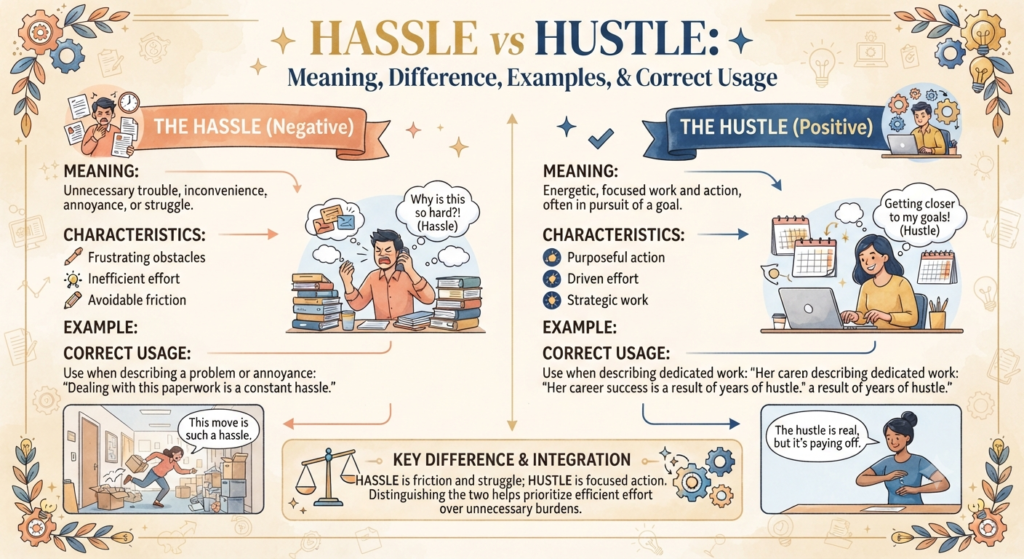
Picture two texts arriving within a minute of each other. One friend says, “Renewing my passport was such a hassle.” Another says, “I’m hustling to launch my side business.” Same rough sound, completely different feelings; one is complaining, the other is celebrating hard work.
That’s the core of the hassle vs hustle meaning and difference: they look alike, they even share a few letters in the same order, but they point in opposite emotional directions. This guide breaks down what each word actually means, where the spelling confusion comes from, and how to use both correctly in writing, speech, and everyday conversation — with real examples you can borrow directly.
What Is the Correct Spelling: Hassle vs Hastle?
There’s no debate here: “hassle” is the only correct spelling. “Hastle” doesn’t appear in any standard English dictionary; it’s a misspelling, not a variant.
The word has two S’s and no T. If you’re ever unsure, say it slowly: hass-le, not hast-le. That small pause is usually enough to catch the mistake before you hit send.
Why People Mistype “Hassle” as “Hastle”
The mix-up isn’t random; it comes from how English speakers process familiar spelling patterns. A few specific habits are usually to blame:
- Pattern matching with “castle” and “whistle.” Both of those words have a silent T, so the brain assumes “hassle” should too.
- Influence from “hustle.”: Because of the word “hustle,” which is often talked about along with “hassle,” the letter T from one word can mix into the other when typing quickly.
- Phonetic blur in casual speech. Said quickly, the soft double-S in “hassle” can sound almost like a T to an untrained ear.
- Autocorrect gaps. Older keyboards and some non-English input settings don’t always flag “hastle” as wrong.
None of these make “hastle” acceptable, they just explain why the error is so common, even among fluent writers.
What the Word “Hassle” Actually Means
At its core, hassle describes something that’s annoying, inconvenient, or more trouble than it’s worth. It carries a negative charge; nobody enjoys a hassle, they endure it.
The word works as both a noun and a verb, and the meaning shifts slightly depending on which one you’re using.
Hassle as a Noun: Meaning + Examples
As a noun, hassle refers to a situation, task, or process that causes irritation or difficulty. It’s the “trouble” itself, not the act of causing it.
- “Finding parking downtown is always a hassle.”
- Returning the package was more of a hassle than I expected.
Hassle as a Verb: Meaning + Examples
As a verb, hassle means to trouble, push, or keep annoying someone again and again. This version involves a person actively causing the trouble, not just experiencing it.
- “Stop hassling your brother about his homework.”
- “The salesman kept hassling us to upgrade our plan.”
- “She was hassled by telemarketers all afternoon.”
How “Hassle” Is Used in Daily Life
Hassle shows up constantly in casual conversation because it’s the perfect word for low-stakes frustration, not a crisis, just friction. You’ll hear it in customer service exchanges, travel complaints, workplace small talk, and product marketing alike.
Brands lean on it too. Phrases like “hassle-free returns” or “hassle-free checkout” promise the opposite of what the word describes; ease, speed, and zero friction. That contrast is exactly why the phrase works so well in advertising.
Etymology: Where the Word “Hassle” Comes From
“Hassle” is a relatively young word by English standards. It emerged in American slang around the 1940s and 1950s, and most linguists trace it to a blend of “haggle” and “tussle”, two words that both carry a sense of friction and minor conflict.
It started as informal, spoken slang describing arguments or petty disputes, then gradually softened into its modern meaning: general inconvenience, not necessarily involving conflict at all. By the 1970s, “hassle” had fully entered mainstream English and started appearing regularly in print, advertising, and pop culture.
Why the Confusion? Why People Think It’s Spelled “Hastle”
Beyond the pattern-matching explained earlier, there’s a simple reason “hastle” persists: the correct spelling looks slightly unusual. English has plenty of words ending in “-stle” with a silent T (castle, whistle, bristle, thistle), but very few common words ending in “-ssle.” Without a strong visual anchor, the brain defaults to the more familiar pattern.
How to Remember the Correct Spelling of “Hassle”
A quick memory trick solves this permanently: “Two S’s for stress, no T for trouble.” Hassle is about stress and inconvenience; remembering that both words share double letters (stress has one S, hassle has two) can help lock in the spelling.
Another approach: connect it to “hustle.” They’re often mentioned together, share four letters, and neither one has a T hiding in the middle. If you know hustle has no T, hassle doesn’t either.
Hassle in Pop Culture & Media
“Hassle” has had staying power in casual American English since the 1960s, often used to capture the small frustrations of everyday life rather than anything dramatic. It’s a favorite in sitcom dialogue, where characters complain about hassles at work, in relationships, or with bureaucracy; the word fits naturally because it’s light enough for comedy but relatable enough to land.
Marketing has borrowed the word just as heavily. “No-hassle” guarantees, warranties, and return policies became a recognizable promise in advertising throughout the late twentieth century, and that pattern continues today across e-commerce and insurance branding.
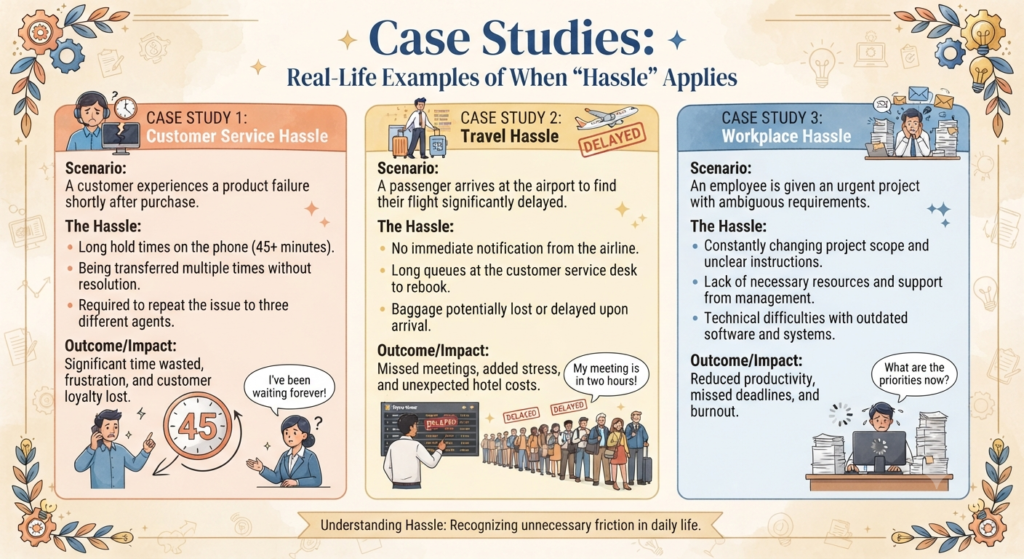
Case Studies: Real-Life Examples of When “Hassle” Applies
Seeing the word in realistic scenarios makes the meaning stick better than definitions alone.
Case Study 1: Customer Service Hassle
A customer orders a product that arrives damaged. Getting a refund requires three phone calls, a mailed receipt, and two weeks of waiting. That entire process; not the damaged item itself, is the hassle. The company later loses the customer, who says, “It just wasn’t worth the hassle.”
Case Study 2: Travel Hassle
A traveler’s flight gets delayed, their gate changes twice, and their checked bag is randomly selected for extra screening. None of these events are dangerous or even that serious individually, but stacked together, they create the exact kind of low-grade frustration the word “hassle” was built for.
Case Study 3: Workplace Hassle
An employee has to fill out the same expense form through three different systems because none of them sync properly. It’s not a crisis, and nobody’s getting fired over it, but it eats up time and patience every single week; a textbook workplace hassle.
Sentence Examples Using “Hassle” Correctly
- “I don’t want to deal with the hassle of switching banks.”
- “Thanks for handling that, it saved me a huge hassle.”
- “He hassled the referee about every close call.”
- “Moving apartments is always more of a hassle than people expect.”
- “She promised a hassle-free setup process, and she delivered.”
Common Mistakes People Make With “Hassle”
- Spelling it “hastle”: Always double-check for the double S and missing T.
- Confusing it with “hustle”: Hassle is negative and passive; hustle is usually positive and active.
- Using “hassle” to describe hard work: Saying “I’m hassling to finish this project” is incorrect; that’s a job for “hustling.”
- Overusing it in formal writing: In professional or academic contexts, words like “inconvenience,” “difficulty,” or “obstacle” often fit better.
- Treating “hassle-free” as two words: It’s typically hyphenated as a compound adjective before a noun (“hassle-free process”).
Hassle: Quick Facts
Hassle means an annoying inconvenience or the act of bothering someone repeatedly. It functions as both a noun (“what a hassle”) and a verb (“stop hassling me”), always carries a negative tone, and is spelled with two S’s and no T; never “hastle.” The word entered American slang in the 1940s–50s.
Hassle vs Hustle: Meaning, Difference & Examples Compared
| Feature | Hassle | Hustle |
| Core meaning | Annoying inconvenience or trouble | Energetic activity or hard work |
| Tone | Negative | Usually positive |
| Part of speech | Noun & verb | Noun & verb |
| Typical use | Describing frustration (“what a hassle”) | Describing effort (“grinding out a hustle”) |
| Common phrase | Hassle-free | Side hustle |
| Example sentence | “Renewing my license was such a hassle.” | “She’s building a side hustle on weekends.” |
| Pronunciation | /ˈhæs.əl/ (HASS-uhl) | /ˈhʌs.əl/ (HUSS-uhl) |
| Misspelling to avoid | Hastle | Hussle |
Hassle vs Hustle Pronunciation
The vowel sound is the giveaway. Hassle rhymes with “castle” minus the T sound, a short “a” as in “cat.” Hustle uses a short “u” sound, like the “u” in “cut.” Say them side by side; “HASS-uhl” versus “HUSS-uhl” and the difference becomes obvious even in fast speech.
Hassle vs Hustle Meaning in Tagalog
In casual Tagalog usage, hassle is often explained as “abala” or “gulo”; something bothersome or inconvenient. Hustle, on the other hand, aligns more closely with “sipag” or “kayod”; hardworking effort, especially toward earning money or building something. Filipino English speakers frequently borrow both words directly, using “nakaka-hassle” to describe an annoying situation and “nag-huhustle” to describe hard, active work.
Related Phrases Worth Knowing
- Hassle-free meaning: Describes something simple, smooth, and free of complications; “a hassle-free checkout process.”
- Side hustle meaning: A secondary job or income stream pursued alongside a primary one, often driven by ambition or financial need.
- Less hassle meaning: A comparative phrase indicating reduced friction or inconvenience compared to an alternative option.
- Hassle synonym: Inconvenience, bother, nuisance, trouble, aggravation.
- Hustle synonym: Grind, hard work, drive, effort, side gig.
FAQs
What is the difference between hassle and hustle?
Hassle refers to an annoying inconvenience or the act of bothering someone, and it carries a negative tone. Hustle refers to energetic effort or hard work, usually with a positive, driven connotation, the two describe opposite emotional experiences despite their similar sound.
Is “hastle” ever a correct spelling?
No. “Hastle” is a common misspelling of “hassle” and doesn’t appear in any standard dictionary. The correct spelling always has a double S and no T.
Can hassle and hustle be used interchangeably?
No, they can’t. Using “hustle” to describe frustration, or “hassle” to describe hard work, creates confusion because native speakers strongly associate each word with a specific tone and meaning.
What does “hassle-free” mean?
“Hassle-free” describes a process, product, or experience that involves no unnecessary difficulty or inconvenience; the opposite of a hassle.
What does “side hustle” mean?
A “side hustle” is extra work or a business pursued outside of someone’s main job, typically to earn additional income or build toward a bigger goal.
How do you pronounce hassle and hustle correctly?
Hassle is pronounced “HASS-uhl” with a short “a” sound, while hustle is pronounced “HUSS-uhl” with a short “u” sound. The vowel in the first syllable is the easiest way to tell them apart when speaking.
Conclusion
Hassle and hustle may look like near-twins on the page, but their meanings sit at opposite ends of the emotional spectrum; one describes friction you want to avoid, the other describes effort you’re proud to put in. Remember the spelling rule (double S, no T), keep the tone in mind (negative for hassle, positive for hustle), and you’ll never confuse the two again.
Next time you catch yourself typing “hastle” or reaching for “hustle” to describe a frustrating morning, pause for a second and pick the word that actually matches the feeling. Getting it right is a small habit, but it’s the kind that makes your writing sound sharper and more precise every time.

Hi, this is a comment.
To get started with moderating, editing, and deleting comments, please visit the Comments screen in the dashboard.
Commenter avatars come from Gravatar.