
If you’ve ever typed “I have a MA in English” and then stopped, deleted it, and typed “an MA” instead, you’re dealing with one of the sneakiest grammar traps in English. The a MA or an MA question isn’t really about the letters M and A at all; it’s about how they sound out loud. Get that one distinction, and the confusion disappears for good.
This guide walks through the actual rule, why abbreviations bend it in unexpected ways, and how the same logic applies to degrees, acronyms, and even words like “university” that trip people up constantly.
Understanding A MA or An MA: The Definitive Guide
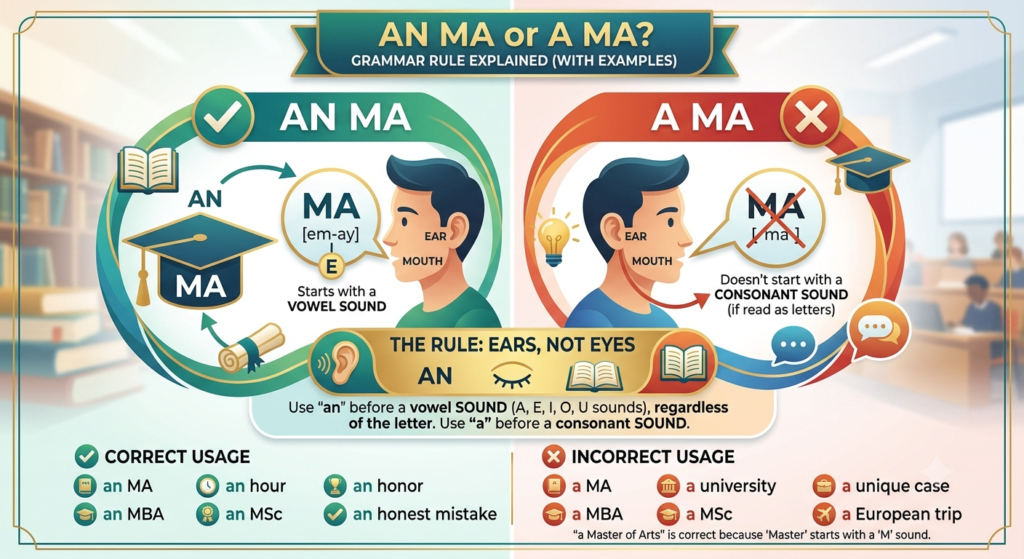
Here’s the direct answer: it’s “an MA,” not “a MA.” Even though “MA” starts with the letter M, which is a consonant, the letter M is pronounced “em” and “em” starts with a vowel sound. English articles follow sound, not spelling, which is why “an MA” is the grammatically correct form every time.
This single rule solves almost every version of this question people search for, whether it’s phrased as “is it a MA or an MA,” “an MA vs a MA,” or simply “a or an MA.”
How English Articles Work: A vs An
The rule for a vs an is one of the most misunderstood basics in English, mostly because people learn it as a spelling rule when it’s actually a sound rule. Use “a” before words that start with a consonant sound, and “an” before words that start with a vowel sound.
- A before consonant sounds: a dog, a car, a plan
- An before vowel sounds: an apple, an idea, an hour
Notice “an hour”, the H is silent, so the word actually starts with a vowel sound. That’s the exact same logic that governs “an MA.”
Examples That Prove It’s About Sound
- An honest mistake (the H is silent, so it starts with a vowel sound)
- A university (starts with a “yoo” sound, which is a consonant sound, despite U being a vowel letter)
- An hour (silent H again)
- A one-time offer (“one” sounds like “won,” a consonant sound)
These examples matter because they prove the rule has nothing to do with whether a letter is technically a vowel or consonant. It’s entirely about pronunciation.
Why Abbreviations Change the Rule
Abbreviations and acronyms are where this rule gets genuinely tricky, because you have to say the letters out loud in your head before deciding. Some abbreviations are spoken letter-by-letter (like MA, MBA, or FBI), while others are pronounced as whole words (like NASA or NATO).
When an abbreviation is spoken letter-by-letter, the article depends on how the first letter’s name sounds, not the letter itself:
- F is pronounced “ef”, an FBI agent
- M is pronounced “em”, an MA degree
- H is pronounced “aitch”, an HR department
- N is pronounced “en”, an NBA player
This is exactly why a or an before abbreviations confuses so many writers, the visual letter and the spoken sound simply don’t match up the way people expect.
So… Is It A MA or An MA?
By now the answer should be locked in, but let’s make it airtight with direct examples.
Correct Sentence Examples
- She earned an MA in Linguistics last spring.
- He’s applying for an MA program in History.
- Getting an MA took her two years of full-time study.
- I don’t have an MA, but I do have a bachelor’s degree.
Incorrect Examples
- She earned a MA in Linguistics last spring.
- He’s applying for a MA program in History.
- I don’t have a MA, but I do have a bachelor’s degree.
If you remember nothing else from this article, remember this: say the abbreviation out loud, and let your ear decide the article.
Understanding What MA Means (Pronunciation + Meaning)
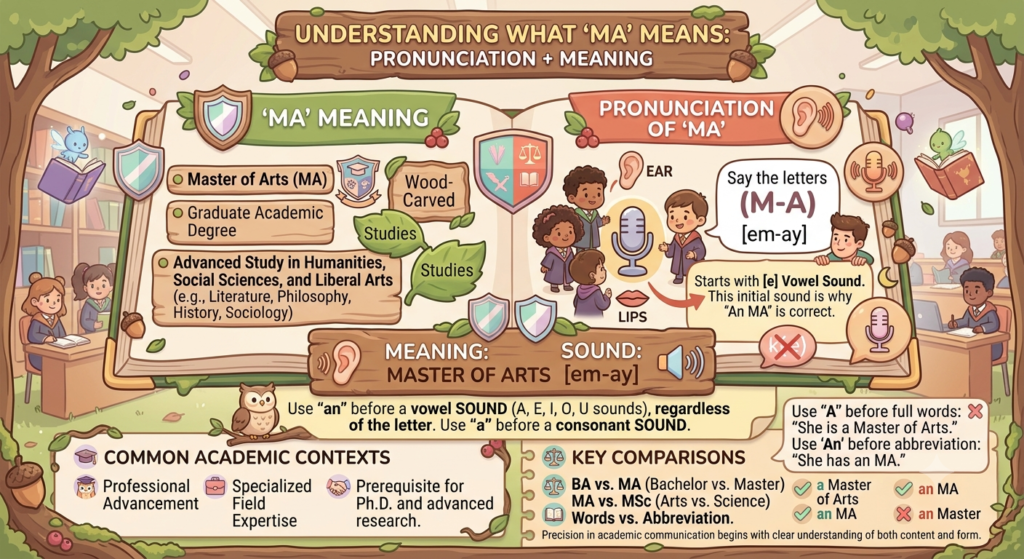
MA stands for Master of Arts, a graduate-level academic degree typically awarded in humanities, social sciences, and some fine arts fields. It’s pronounced as two separate letters; “em-ay”, never as a single blended word.
Key Facts About the MA Degree
- Usually takes one to two years of full-time study
- Common in fields like English, History, Sociology, and Communications
- Distinct from an MS (Master of Science), which covers technical and scientific fields
- Often requires a thesis, capstone project, or comprehensive exam
- Can be abbreviated as MA or M.A., depending on style guide preference
A Master of Arts or An Master of Arts?
This is where a lot of writers stumble after mastering the MA rule, because spelling out the full degree name flips the article entirely. Once you write out “Master of Arts” instead of the abbreviation, the first sound is now “M” as in “muh,” which is a consonant sound.
Correct Examples
- She holds a Master of Arts in Psychology.
- He’s pursuing a Master of Arts degree part-time.
- A Master of Arts typically requires 30 to 45 credit hours.
So the full phrase takes “a,” while the abbreviation takes “an.” Same degree, different article, because the sound at the start of each version is different.
Capitalization Rules for Academic Degrees
Degree names follow their own quiet set of rules, and getting them wrong is one of the most common resume and cover letter mistakes.
Table: What to Capitalize
| Context | Correct Format | Example |
| Full degree name | Capitalize | Master of Arts |
| Abbreviation | Capitalize both letters | MA or M.A. |
| Generic reference | Lowercase | She has a master’s degree |
| Field of study | Capitalize if a proper noun | Master of Arts in English |
| Degree used as adjective | Lowercase | a master’s-level course |
Examples From Style Guides
Most major style guides, including APA and Chicago, agree that the full degree name is capitalized when referring to the specific credential (“Master of Arts”) but lowercase when used generically (“she’s working on her master’s”). AP style tends to favor periods in abbreviations (M.A.), while APA and Chicago often drop them (MA).
Possessive Forms: Master’s vs Masters
This one causes near-constant confusion, and it has nothing to do with the a/an rule; it’s a punctuation issue.
Correct Usage
- She’s earning her master’s degree.
- He completed his master’s in two years.
Incorrect Usage
- She’s earning her masters degree.
- He completed his masters in two years.
The apostrophe shows possession; it’s a degree “of the master,” grammatically speaking, so “masters” without the apostrophe is considered incorrect in formal writing, even though it’s extremely common informally.
Abbreviating the Degree: MA vs M.A.
Both MA and M.A. are acceptable, and the choice mostly comes down to which style guide you’re following:
- MA: Increasingly standard, especially in academic and digital writing
- M.A.: More traditional, still common in formal resumes and older institutional documents
Whichever version you pick, stay consistent throughout the same document. Mixing “MA” in one paragraph and “M.A.” in another looks inconsistent to careful readers.
Degree vs Field of Study
People often mix up the degree type with the actual subject, which creates confusing phrasing like “an MA of Communications” instead of “an MA in Communications.”
Quick Comparison Table
| Element | Example | Notes |
| Degree type | MA / Master of Arts | The credential itself |
| Field of study | Communications, History, English | What the degree is in |
| Correct phrasing | an MA in Communications | Use “in,” not “of,” with the abbreviation |
| Full phrase version | a Master of Arts in Communications | “of” only follows the full degree name |
Common Mistakes People Make
- Writing “a MA” instead of “an MA”
- Writing “an Master of Arts” instead of “a Master of Arts”
- Using “masters” without the apostrophe
- Capitalizing generic references like “a Master’s Degree” mid-sentence
- Confusing “MA in” with “MA of”
- Assuming all abbreviations follow the same article rule without checking pronunciation
How to Avoid These Mistakes
- Say the abbreviation out loud before choosing “a” or “an”
- Remember: abbreviation sound decides the article, not the spelling
- Double-check possessive forms with an apostrophe rule reminder
- Keep a consistent abbreviation style (MA or M.A.) throughout one document
- When in doubt, spell out “Master of Arts” and re-check whether “a” or “an” fits the new sound
FAQs
Is it “a MA” or “an MA”?
It’s “an MA.” Even though M is a consonant letter, it’s pronounced “em,” which starts with a vowel sound, so “an” is grammatically correct.
Is it “a Master of Arts” or “an Master of Arts”?
It’s “a Master of Arts.” The full phrase starts with the consonant sound “muh,” unlike the abbreviation, which starts with a vowel sound.
MA vs MS; what’s the difference?
MA (Master of Arts) generally applies to humanities and social science fields, while MS (Master of Science) applies to technical, scientific, or quantitative fields. Both follow the same a/an sound rule as MA, so it’s correctly “an MS” as well.
Is it “a European” or “an European”?
It’s “a European,” even though the word starts with a vowel letter, because “European” is pronounced with a “yoo” sound, which counts as a consonant sound.
Is it “a university” or “an university”?
It’s “a university,” for the same reason as “European”, the word starts with a “yoo” sound rather than a true vowel sound.
Is it “an MBA” or “a MBA”?
It’s “an MBA,” following the identical rule as MA, the letter M is pronounced “em,” a vowel sound, regardless of the letters that follow it.
Why does English use “an” before some abbreviations and not others?
It depends entirely on how the first letter is pronounced when spoken aloud. Letters like F, H, L, M, N, R, S, and X all start with vowel sounds when spoken as letters, which is why abbreviations beginning with them take “an.”
Conclusion
The rule behind a MA or an MA boils down to a single habit: say it out loud before you write it down. “MA” sounds like “em-ay,” a vowel sound, so “an MA” is always correct; while the fully spelled-out “Master of Arts” flips back to “a” because it starts with a consonant sound. Keep that sound-based logic in mind, and you’ll never second-guess this one again, whether you’re writing a resume, an email, or your next LinkedIn headline.
