

You’ve just finished reviewing three separate reports, and you sit down to summarize them: “These ___ all point to the same conclusion.” Analysis? Analyses? The word looks almost identical either way, and spellcheck won’t save you here, because both spellings are real, correct English words, just not interchangeable ones.
The analysis vs analyses distinction comes down to a rule most English speakers never learned explicitly: this word doesn’t pluralize the normal way, because it isn’t originally an English word at all. It’s Greek, and it plays by Greek rules. This guide breaks down exactly how that works, why “analysises” will never be correct no matter how tempting it looks, and how to get the singular and plural forms right every time you write.
Core Definitions
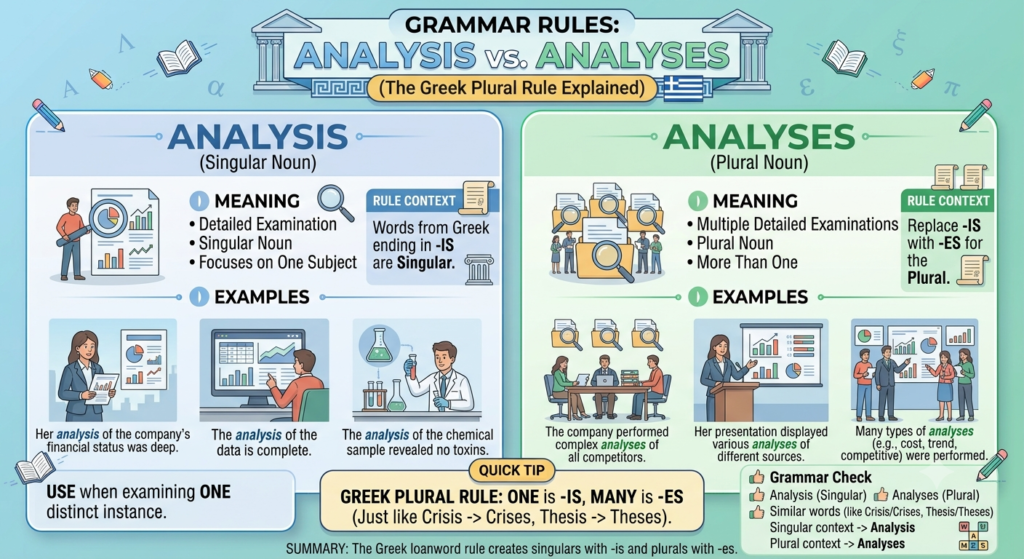
Analysis (singular) refers to a single, detailed examination of something; a report, a dataset, a situation, or an argument, broken down and studied closely. Analyses (plural) refers to more than one of those examinations, whether that means multiple reports, multiple studies, or multiple rounds of the same investigation.
- “The analysis revealed a clear pattern.” (one examination)
- “The analyses revealed similar patterns across regions.” (multiple examinations)
The meaning stays consistent between the two forms; only the number changes, exactly the way “study” becomes “studies” or “child” becomes “children.” The tricky part is how that number changes.
What “Analyses” Means (Plural)
“Analyses” is the correct plural form of “analysis,” used any time you’re referring to two or more separate examinations, evaluations, or breakdowns of information. It follows the same pattern as several other academic and scientific terms borrowed from Greek.
- “Researchers compared analyses from five separate studies.”
- “Our team ran multiple analyses before finalizing the report.”
- “The analyses conducted last quarter all pointed to the same trend.”
Note that “analyses” refers to distinct, separate acts of analysis, not simply “a lot of analysis” as an abstract concept. If you’re describing analysis in a general, uncountable sense (“There’s been a lot of analysis on this topic”), the singular form still applies.
Grammar Breakdown
| Form | Word | Function | Example |
| Singular noun | analysis | One examination | “The analysis was thorough.” |
| Plural noun | analyses | Multiple examinations | “The analyses were thorough.” |
| Verb (US) | analyzes | Third-person singular verb | “She analyzes the data daily.” |
| Verb (UK) | analyses | Third-person singular verb | “She analyses the data daily.” |
| Incorrect plural | analysises | Never valid | ❌ Not a word |
The overlap between the British verb spelling and the plural noun spelling is exactly where a lot of the confusion creeps in, more on that shortly.
Why “Analysises” Is Never Correct
“Analysises” is not a word in any form of English, and it’s never grammatically correct. The mistake happens when writers apply the standard English pluralization rule; just add “-s” or “-es” — to a word that doesn’t follow that pattern at all, because “analysis” isn’t a native English noun.
Regular English nouns double up easily: book/books, fox/foxes, dish/dishes. “Analysis” skips that pattern entirely. Instead of adding letters to the end, the final “-is” transforms into “-es,” which is a completely different mechanism than simple addition. That’s the core reason “analysises” looks plausible but is always wrong.
Greek Origin of the Word “Analysis”
“Analysis” comes directly from the Greek word “analysis” (ἀνάλυσις), built from “ana-” (up, throughout) and “lysis” (a loosening or breaking apart) literally, “a breaking up” or “a loosening throughout.” The word entered English through Latin in the late 16th century, carrying its Greek grammatical behavior along with it.
Greek nouns ending in “-is” typically form their plurals by changing that ending to “-es,” and English absorbed a whole cluster of these words wholesale, plural pattern included, rather than reshaping them to fit standard English rules. That’s the entire explanation behind the analysis-to-analyses shift, and it’s the same mechanism responsible for several other familiar academic terms.
Special Plural Patterns in English
“Analysis” isn’t alone; several other common English words follow the exact same Greek “-is” to “-es” pluralization pattern, which is worth recognizing as a group rather than memorizing one word at a time.
- Diagnosis , diagnoses
- Hypothesis , hypotheses
- Thesis , theses
- Crisis , crises
- Axis , axes
- Basis , bases
- Parenthesis , parentheses
- Synthesis , syntheses
Once you notice the pattern, it becomes far easier to predict: any English noun ending in “-is” that traces back to Greek origin is a strong candidate for this same “-is” → “-es” transformation, rather than a simple added “-s.”
American vs British English Usage
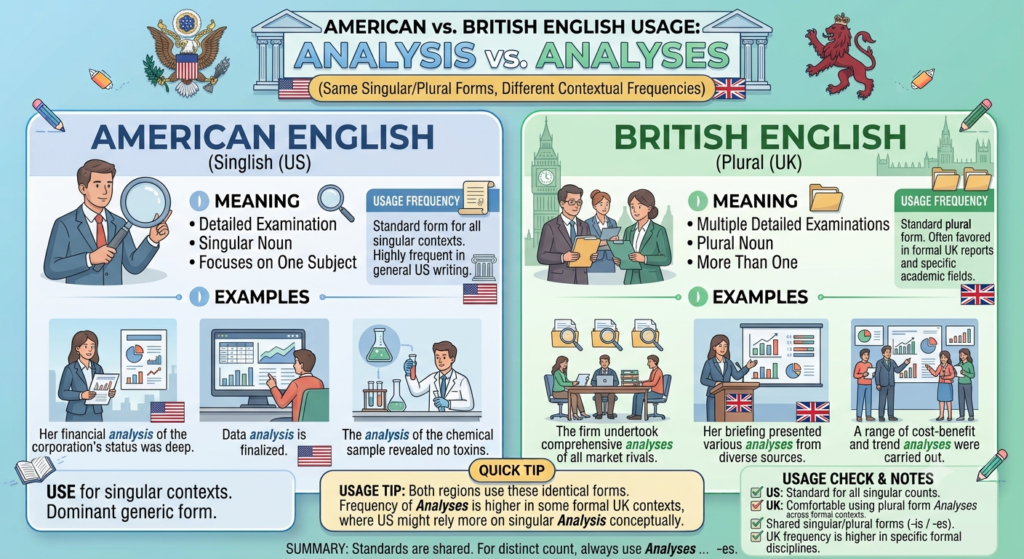
The singular and plural noun forms of “analysis” and “analyses” don’t change between American and British English; both dialects use them identically. Where the two diverge is in the verb form, and that’s where spelling confusion often sneaks in.
| Context | American English | British English |
| Plural noun | analyses | analyses |
| Verb, third-person singular | analyzes | analyses |
| Base verb | to analyze | to analyse |
| Example (verb) | “He analyzes the results.” | “He analyses the results.” |
| Example (plural noun) | “The analyses were conclusive.” | “The analyses were conclusive.” |
This overlap is exactly why British writers occasionally see “analyses” doing double duty, once as a plural noun, once as a present-tense verb while American writers keep the two visually distinct thanks to “analyzes.”
Common Errors and How to Fix Them
A handful of recurring mistakes show up across student papers, business reports, and casual writing alike.
- “Analysises”: Never correct; fix to “analyses.”
- “The analyses shows a trend.”: Subject-verb mismatch; “analyses” is plural, so it needs “show,” not “shows.”
- “We did several analysis on the data.”: Should be “several analyses,” since “several” signals more than one.
- Confusing British “analyses” (verb) with the plural noun: Context usually clarifies which one is meant, but American writers should stick to “analyzes” for the verb to avoid ambiguity.
- Using “analysis” when referring to multiple distinct studies: If you’re citing more than one separate examination, “analyses” is required, not “analysis.”
Practical Usage in Writing
Choosing the right form comes down to one simple test: are you referring to one examination, or more than one? If you can count them — “three analyses,” “multiple analyses,” “several analyses” — the plural is required. If you’re referring to a single, unified examination, even a long and detailed one, “analysis” stays correct.
- ✔ “The company’s financial analysis was released Tuesday.” (one report)
- ✔ “The company’s financial analyses were released throughout the quarter.” (multiple reports)
- ✔ “A meta-analysis combines the results of many individual studies.” (a specific singular term for a study of studies)
Using “Analyses” in Research
Academic and scientific writing relies on precise pluralization more than almost any other genre, since the number of studies referenced often signals the strength of an argument. Saying “based on one analysis” versus “based on multiple analyses” tells the reader something meaningful about how much evidence actually supports a claim.
Research papers frequently use phrases like “cross-study analyses,” “comparative analyses,” or “longitudinal analyses” to describe methodology involving more than one dataset or time period. Getting the plural right in these contexts isn’t just a grammar nicety, it accurately represents the scope of the work.
Why Proper Pluralization Matters in Research
In academic and professional writing, using “analysis” when you mean “analyses” (or vice versa) can misrepresent the scope of your work, implying either less evidence than you actually gathered or overstating a single study as multiple ones. Precise pluralization signals credibility and helps readers accurately judge the strength of your findings.
Tips for ESL Learners
Learners coming from languages with simpler or different pluralization systems often find this word especially tricky, since the change happens in the middle of the word rather than at the end. A few practical strategies help this stick faster.
- Group “analysis” with its Greek relatives (thesis, crisis, diagnosis) rather than memorizing it in isolation.
- Practice saying both forms aloud, the pronunciation shift is often easier to remember than the spelling shift.
- Write out full sentences using both forms rather than memorizing the words alone; context reinforces the rule better than a word list does.
- Double-check plural usage specifically in academic writing, where the stakes for getting it wrong are higher.
Visual Cue
A simple visual trick: analysis ends in “-is,” just like “singular” starts with “si”; a small letter-based coincidence that can help lock in which form is which. For the plural, picture the word splitting apart at the ending, the “-is” opening up into “-es,” mirroring the word’s own meaning of “breaking apart.”
Pronunciation Trick
Analysis is pronounced “uh-NAL-uh-sis,” with the stress on the second syllable and a soft “s” sound at the end. Analyses shifts that final sound to a long “e,” pronounced “uh-NAL-uh-seez”, rhyming with “trees,” not “kiss.” If you can remember that the plural ends on a long “ee” sound, you’ll rarely mix up which form you’re hearing or saying.
FAQs
How do you pronounce “analyses”?
“Analyses” is pronounced “uh-NAL-uh-seez,” with the final syllable rhyming with “trees” rather than matching the softer ending of the singular “analysis.”
What is the grammar rule for analysis vs analyses?
“Analysis” is singular and refers to one examination, while “analyses” is its irregular plural, formed by changing the Greek-derived “-is” ending to “-es” rather than simply adding “-s.”
Can you give examples of analysis vs analyses in sentences?
Singular: “The analysis confirmed our hypothesis.” Plural: “Several analyses confirmed the same hypothesis across different datasets.” The only difference is whether one or multiple examinations are being described.
What is the plural of “analysis”?
The plural of “analysis” is “analyses,” following the same Greek “-is” to “-es” pattern seen in words like “thesis/theses” and “diagnosis/diagnoses.”
Is “analysis” countable or uncountable?
“Analysis” can be both, depending on context; it’s countable when referring to a specific, distinct examination (“an analysis,” “three analyses”), and uncountable when referring to the general concept or process of analyzing something (“a lot of analysis went into this”).
What is a “meta-analysis”?
A meta-analysis is a specific research method that statistically combines results from multiple existing studies into one unified analysis, it’s singular because it refers to one combined study, even though it draws on many analyses.
Does “analyses” ever function as a verb?
Yes, but only in British English, where “analyses” is the third-person singular present-tense form of “to analyse” (e.g., “she analyses the results”). In American English, that verb form is spelled “analyzes” instead, keeping it visually distinct from the plural noun.
Why do some words borrowed from Greek keep their original plurals?
English often preserves the original pluralization pattern of borrowed words, especially in academic and scientific vocabulary, rather than forcing them into standard English rules, this is common with Greek- and Latin-derived terms across many fields.
Should I write “data analysis” or “data analyses”?
Use “data analysis” when referring to the process or a single examination of a dataset, and “data analyses” only when referring to multiple, distinct examinations, most everyday references to the general process use the singular form.
Is “analyse” or “analyze” correct?
“Analyze” is the standard American English spelling, while “analyse” is the standard British English spelling, both are correct within their respective regional conventions, and neither is grammatically wrong.
Conclusion
The analysis vs analyses rule isn’t really about memorizing an exception, it’s about recognizing that this word plays by Greek grammar, not standard English pluralization. One examination is an analysis; more than one becomes analyses, with that “-is” shifting to “-es” rather than picking up a simple added letter.
Next time you’re unsure, run the quick count test: are you talking about one study or several? That single question, paired with the pronunciation trick, “seez” for plural, will keep you from ever second-guessing this word again, in research, writing, or everyday conversation.
