

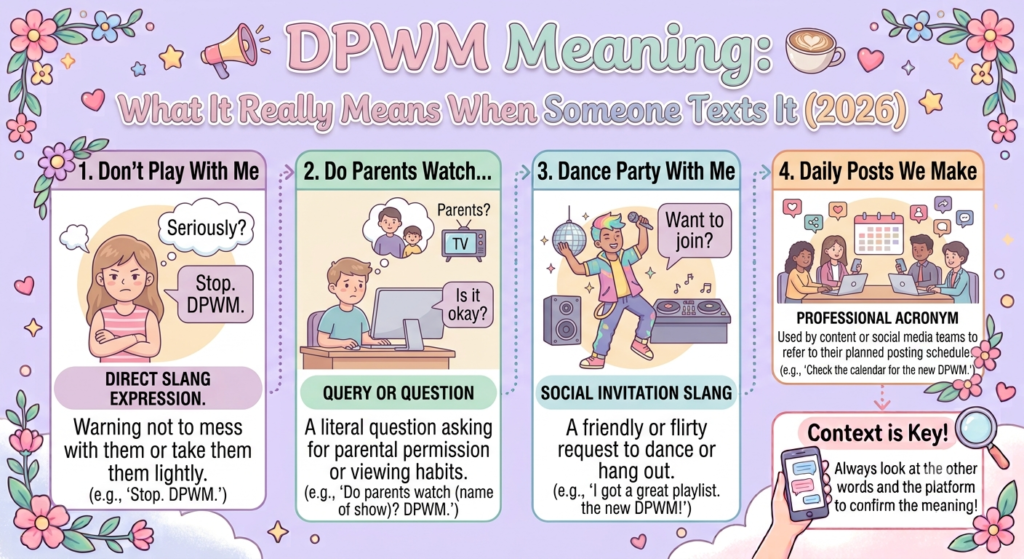
Someone sends you “DPWM” mid-conversation, and suddenly you’re not sure if they’re joking, warning you, or genuinely annoyed. DPWM meaning most commonly boils down to “Don’t Play With Me”, but that short phrase carries a surprising amount of range, swinging anywhere from playful teasing to a real, firm warning depending on the tone behind it.
This guide covers what DPWM stands for, where it came from, how to tell serious from playful, and how to reply without misreading the moment.
Things You Should Know
- DPWM stands for “Don’t Play With Me” in the vast majority of casual texting and social media use.
- The meaning depends heavily on tone, punctuation, and emojis, the same four letters can read as a joke or a genuine warning.
- It’s mostly used among Gen Z and younger texters, spreading through TikTok captions and reaction videos.
- DPWM is informal slang and doesn’t belong in professional emails or workplace messaging.
- Outside of texting, the same letters occasionally stand for something else entirely, more on that below.
What Does DPWM Mean?
Direct answer for quick reference: DPWM stands for “Don’t Play With Me.” It’s used in texting and social media to express seriousness, disbelief, frustration, or playful warning, depending on the tone of the conversation. It’s especially common on TikTok, Snapchat, Instagram, and WhatsApp among younger users.
The phrase “don’t play with me” has existed in spoken English for decades, long before texting shortened it into an acronym. People used it to show disbelief or to tell someone to stop joking around — texting culture simply compressed that same sentiment into four letters.
Steps to Understand How DPWM Is Being Used
Figuring out what someone means by DPWM isn’t complicated once you break it into a few quick checks:
- Look at the punctuation. All-caps or an exclamation point (“DPWM!”) usually signals something closer to serious. Lowercase with an emoji feels lighter.
- Check what came before it. If the conversation was already tense or serious, DPWM likely continues that tone rather than shifting into a joke.
- Notice who sent it. Close friends and partners often use DPWM playfully; someone you don’t know well may be using it more literally.
- Read the emojis, if any. A laughing emoji next to DPWM softens it into teasing; no emoji at all can leave it feeling more direct or firm.
- Consider the platform. A TikTok comment reacting to a video tends to be playful; a private DM during an argument tends to be serious.
Running through these five checks takes a few seconds and almost always clears up the ambiguity.
See the full breakdown “What Does TSK Mean? Full Guide to Its Use in Texting & Slang“
The Three Main Tones of DPWM
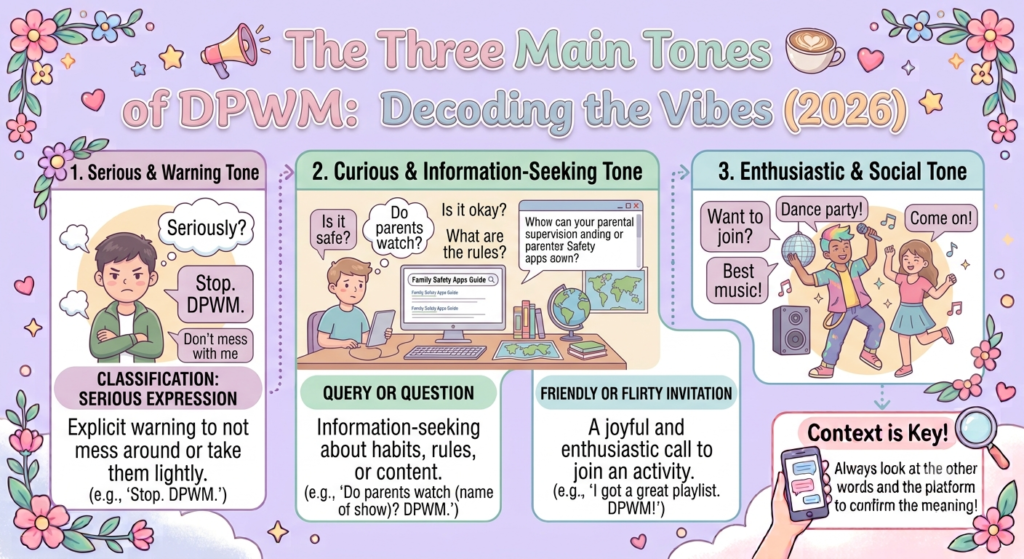
Serious Warning
Used when someone genuinely wants to be taken seriously and feels they’re not being believed or are being pushed too far.
- “I already told you the truth. DPWM.”
- “Stop joking, I mean it. DPWM.”
Playful Teasing
Used lightly among friends, often reacting to something surprising or funny, without any real tension behind it.
- “Wait you actually did that? DPWM 😂”
- “DPWM, there’s no way that’s true.”
Disbelief or Shock
Used as a reaction to news that feels hard to believe, closer to “no way” or “are you serious?”
- “They canceled the concert?? DPWM.”
- “You got the job?! DPWM, congrats!!”
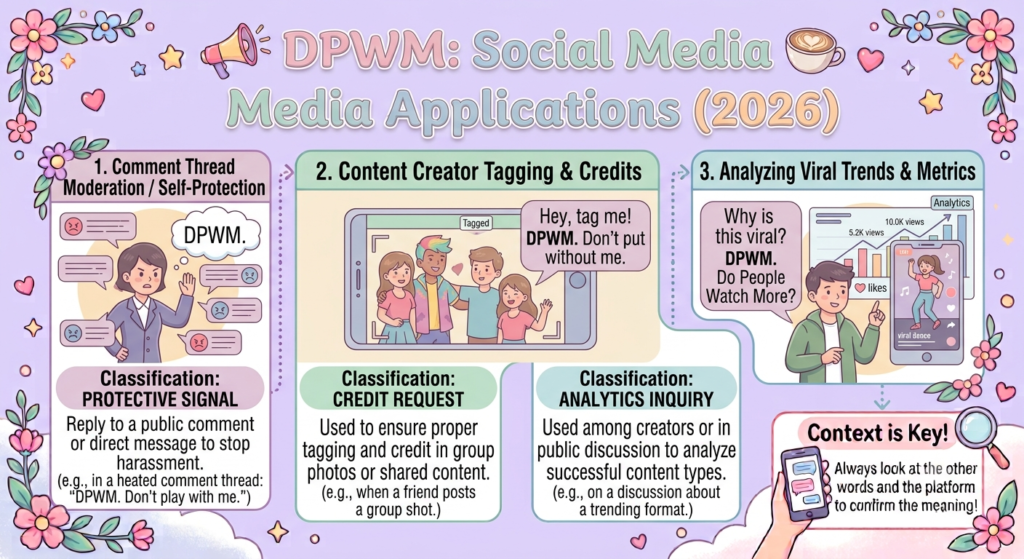
DPWM Meaning on Instagram
On Instagram, DPWM shows up in comments, DMs, and story replies, usually carrying the same core meaning as in regular texting. It’s frequently used to react to a surprising post or to playfully challenge something someone said in a caption.
- Comment: “DPWM, there’s no way you made this from scratch 😳”
- DM: “DPWM, I’m not falling for that again”
What Does DPWM Mean on TikTok
TikTok is one of the platforms most responsible for pushing DPWM into wider use, especially through reaction videos and dramatic captions. Creators often use it for comedic exaggeration, reacting to something shocking or unbelievable in a video.
- Caption: “When he said he’d never seen the show 💀 DPWM”
- Comment: “DPWM this can’t be real”
DPWM Meaning in Text: Snapchat
On Snapchat, DPWM usually reacts to a surprising snap or message, often used in quick replies to stories. The tone here tends to lean playful rather than confrontational, since Snapchat conversations are typically casual and fast-moving.
- “DPWM 😭 you didn’t actually do that”
- “wait fr? DPWM”
DPWM Meaning in Text From a Girl
The underlying meaning of DPWM doesn’t change based on who sends it, it still means “Don’t Play With Me.” What shifts is tone, and that depends entirely on the relationship and context rather than gender.
- Playful: “DPWM lol you’re so dramatic”
- Firm: “I already told you what happened. DPWM.”
Explained in detail here “What Does KK Mean in Text? Full Meaning & When to Use It“
DPWM vs Similar Expressions at a Glance
| Term | Meaning | Typical Tone |
| DPWM | Don’t Play With Me | Serious, playful, or shocked — depends on context |
| FR | For Real | Emphasizes sincerity, usually calmer |
| ISTG | I Swear to God | Stronger emphasis, often more intense |
| “I’m serious” | Literal statement | Direct, no ambiguity |
| DPW | Don’t Play (shortened variant) | Similar to DPWM, slightly less common |
DPWM stands out from this group because it carries the widest emotional range, the same four letters can signal a warning, a tease, or pure disbelief, while terms like FR and ISTG stay more consistently sincere.
How to Respond When Someone Sends You DPWM
Your reply should match the tone you’re picking up from the conversation:
- If it feels playful: respond in kind, “Haha okay okay, my bad 😂” keeps things light.
- If it feels serious: acknowledge it calmly, “Okay, I hear you, I wasn’t trying to dismiss it.”
- If you’re unsure: ask directly, “Wait are you being serious right now?” is a simple way to clear up any ambiguity.
Avoiding the topic or escalating with sarcasm tends to make a genuinely serious DPWM feel worse, so when in doubt, lean toward taking it seriously first.
DPW Meaning and What Does DPWH Mean in Text
A couple of near-identical abbreviations sometimes get mixed up with DPWM:
- DPW is essentially a shortened variant of the same idea, “Don’t Play”, used the same casual way as DPWM, just slightly less common.
- DPWH, on the other hand, isn’t texting slang at all in its most recognized form. It officially stands for the Department of Public Works and Highways, a Philippine government agency responsible for the country’s roads, bridges, and infrastructure. If you’ve seen “DPWH” in a news headline or government context, that’s almost certainly what it refers to, completely unrelated to the casual “DPWM” used in texting.
Where Not to Use DPWM
DPWM is informal slang, and it doesn’t translate well into:
- Professional emails or workplace Slack messages
- Academic writing or formal reports
- Conversations with people unfamiliar with internet slang
- Customer service or business communication, unless deliberately casual
Using it in these settings risks sounding unprofessional or, worse, coming across as aggressive when that clarity of tone gets lost in text.
Expert Q&A
Q: Is DPWM always aggressive? A: No, tone and context determine whether it reads as a firm warning or a lighthearted joke. Emojis and punctuation are the biggest clues.
Q: Is DPWM considered outdated or still commonly used? A: It remains active in Gen Z texting and social media, particularly on TikTok and Snapchat, though it’s less universally recognized than terms like “FR” or “LOL.”
Q: Should I use DPWM with someone I just started talking to? A: It’s safer to hold off until you know how that person communicates, using it too early with someone unfamiliar with the phrase can come across as unexpectedly intense.
ACC Meaning in Text: What It Really Stands For
Tips
- Pair DPWM with an emoji if you want to guarantee a playful read.
- Avoid using it in all caps unless you genuinely want to sound serious.
- If someone sends you a DPWM and you’re unsure of their tone, it’s always fine to just ask.
- Save it for casual, personal conversations; friends, partners, or close group chats, rather than anywhere formal.
FAQs
What does DPWM mean in a text message?
DPWM stands for “Don’t Play With Me,” used to express seriousness, disbelief, or playful teasing depending on the tone of the conversation.
Is DPWM rude?
Not inherently, it can sound firm or even a little sharp without emojis or context, but among friends it’s usually understood as playful rather than offensive.
What’s the difference between DPWM and DPW?
They mean essentially the same thing, “Don’t Play With Me” versus “Don’t Play”, with DPW simply being a shorter, slightly less common variant.
Where did DPWM come from?
It evolved from the long-standing spoken phrase “don’t play with me,” which texting and social media culture eventually shortened into an acronym, gaining traction especially through TikTok.
Should I use DPWM in professional communication?
No, it’s informal slang best kept to casual texting with friends, and it can come across as unprofessional or confusing in workplace or formal settings.
Does DPWM mean the same thing on every platform?
The core meaning stays consistent, but the tone shifts slightly, TikTok and Snapchat uses lean more playful, while private texts during a disagreement tend to be more serious.
References
- Common usage patterns observed across TikTok, Snapchat, Instagram, and WhatsApp conversations
- Department of Public Works and Highways (Philippines), official government agency definition
Check the term’s official slang entry on Merriam-Webster’s Slang & Trending section / Dictionary.com Slang
Conclusion
DPWM is a small phrase carrying a wide emotional range, “Don’t Play With Me” can be a genuine warning, a playful joke, or a reaction to something shocking, and the only real way to tell which one you’re looking at is context. Check the tone, the relationship, and the platform before you respond, and you’ll rarely misread it. Just remember to leave it out of anything formal and don’t confuse it with DPWH, which has nothing to do with texting at all.
