

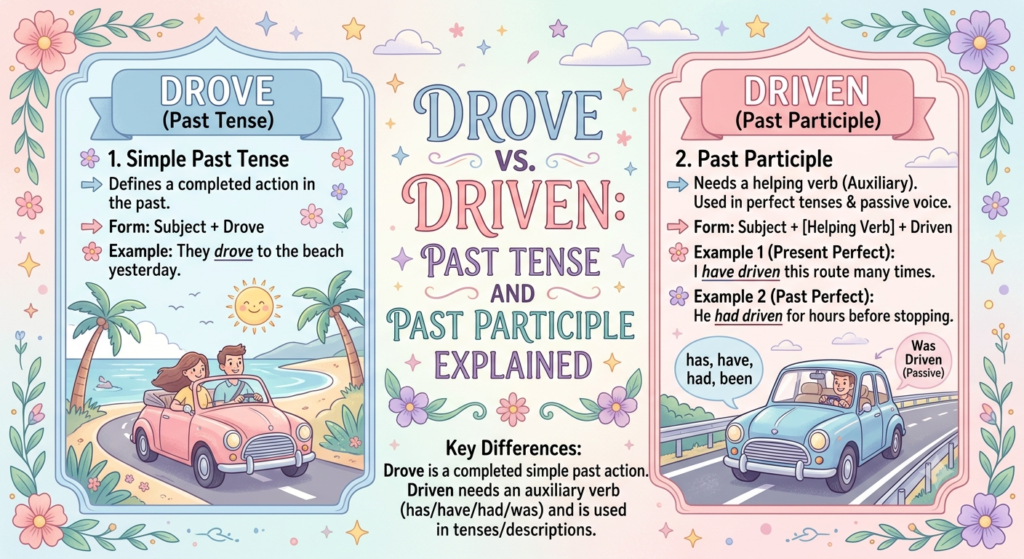
YYou tell a friend “I have drove to Chicago before,” and something feels slightly off the second it leaves your mouth. That instinct is right, the correct form is “I have driven to Chicago before.” The drove vs driven mix-up is one of the most common irregular verb errors in English, and it trips up native speakers just as often as learners.
This guide breaks down exactly when each form belongs, why “drove” sounds fine alone but wrong after “have,” and how to stop guessing for good.
Forms of “Drive” at a Glance
“Drive” is an irregular verb, which means it doesn’t follow the standard “-ed” pattern the way regular verbs do. Instead, it has three distinct forms:
- Base form: drive
- Simple past tense: drove
- Past participle: driven
Compare that to a regular verb like “walk,” which uses the same form for both past tense and participle: walked, walked. “Drive” doesn’t offer that shortcut, which is exactly why so many people search “is drove a word” or “drive past tense and past participle”, the irregular pattern breaks the assumption that one past form covers everything.
What Is the Simple Past? (Drove)
The simple past tense describes a single, completed action that happened at a specific point in time, with no helping verb attached.
- I drove to the airport this morning.
- She drove her brother’s car last weekend.
- They drove through three states on the trip.
If you can point to exactly when the action happened and there’s no “has,” “have,” or “had” nearby, “drove” is your answer.
What Is the Past Participle? (Driven)
The past participle never stands alone. It always pairs with a helping verb; has, have, had or appears in passive voice with a form of “be.”
- I have driven this route a hundred times.
- She has driven since she was sixteen.
- The car was driven off the lot yesterday.
Direct answer: “Driven” is the past participle of “drive,” used with helping verbs like has, have, and had, or in passive constructions. “Drove” is the simple past tense, used alone to describe a completed action without any helping verb attached.
Drove vs Driven: What’s the Real Difference?
The difference isn’t about meaning, both relate to the act of driving in the past. It’s entirely about grammatical function. “Drove” works as a standalone verb; “driven” needs support from a helping verb or appears in passive voice. Get that one distinction right, and every sentence falls into place.
How to Use “Drove” Correctly
Use “drove” whenever you’re stating a completed past action with no helper verb attached:
- He drove all night to make it home.
- We drove past the old house yesterday.
- She drove her kids to school before work.
- I drove that same road for ten years.
How to Use “Driven” Correctly
Use “driven” whenever a helping verb like has, have, or had appears; or when the sentence is in passive voice:
- They have driven across the country twice.
- He had driven for six hours before stopping.
- The truck was driven through the flooded street.
- She has driven professionally for over a decade.
Context Matters: How Tense Changes the Choice
The same event can be described with either word, depending entirely on the surrounding grammar — not on when the action happened.
- “I drove to work” (simple past, standalone)
- “I have driven to work every day this month” (present perfect, connects past to now)
- “I had driven to work before the storm hit” (past perfect, connects two past events)
This is why context, not meaning, decides the correct word. The event is identical; the sentence structure around it determines whether “drove” or “driven” belongs.
Common Errors to Avoid With “Drove vs Driven”
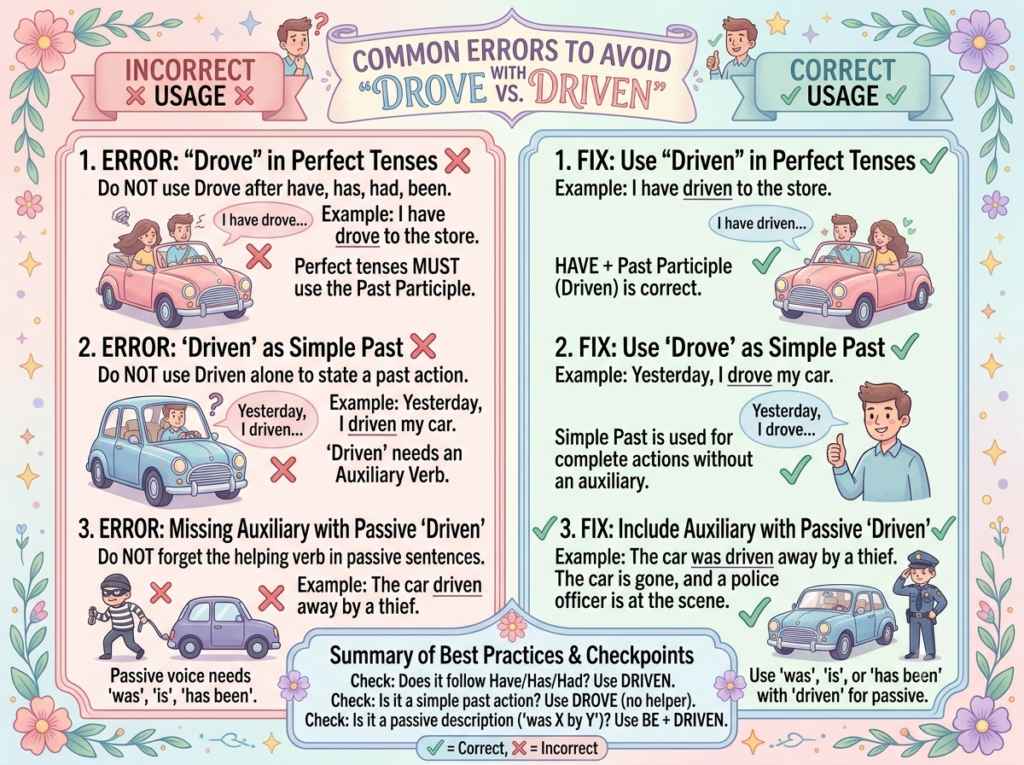
- Mistake: “I have drove this car before.”
Fix: “I have driven this car before.”
- Mistake: “She has drove to Texas twice.”
Fix: “She has driven to Texas twice.”
- Mistake: “The car was drove off the lot.”
Fix: “The car was driven off the lot.”
- Mistake: “Have you ever drove a manual car?”
Fix: “Have you ever driven a manual car?”
The fix is always the same: whenever “has,” “have,” “had,” “was,” or “were” shows up near the verb, “driven” is the only correct option.
Quick Decision Guide (Drove vs Driven)
| If your sentence has… | Use | Example |
| No helping verb | drove | I drove to the store. |
| has / have / had | driven | I have driven to the store. |
| is / was / were / been (passive) | driven | The car was driven yesterday. |
| A specific past time marker alone | drove | She drove there last night. |
| Present or past perfect tense | driven | They had driven for hours. |
Perfect Tenses With “Driven” (Deep Dive)
Perfect tenses connect a past action to another moment in time, and “driven” is required across all of them:
| Tense | Structure | Example |
| Present Perfect | has/have + driven | She has driven this route before. |
| Past Perfect | had + driven | He had driven three hours before the accident. |
| Future Perfect | will have + driven | By tonight, we will have driven 500 miles. |
| Passive Voice | is/was/been + driven | The car was driven to the shop. |
This table settles the common searches “has driven or has drove” and “had driven or had drove” in one glance, the participle “driven” is non-negotiable once a helping verb enters the picture.
Case Study: Real-Life Use of Drove vs Driven
A rideshare driver once wrote in a review response, “I have drove over 10,000 trips without a single complaint.” It read fine to casual readers, but a few customers flagged the grammar in follow-up comments, which nudged the tone of the review slightly. The correction; “I have driven over 10,000 trips”, is a small one, but in professional or public-facing writing, these details shape how polished the message feels.
Quote to Remember
“If there’s a helper, it’s ‘driven.’ If it’s alone, it’s ‘drove.'”
Keep that single line in your back pocket, and you’ll rarely need to double-check this rule again.
FAQs
Drove vs driven; can you give example sentences?
Sure: “I drove to the beach yesterday” (simple past) versus “I have driven to the beach many times” (present perfect with a helping verb). The presence of “have” is what shifts the correct word from “drove” to “driven.”
I have driven or I have drove; which is correct?
“I have driven” is correct. “I have drove” is a common spoken error, but it’s grammatically incorrect in standard English.
Drove vs driven; what’s the past participle?
“Driven” is the past participle of “drive.” It’s used with helping verbs like has, have, had, or in passive voice constructions.
Is there a worksheet or exercise to practice drove vs driven?
A simple practice method is writing ten sentences about driving experiences, half using “drove” alone and half using “driven” with has/have/had, then checking each one against the helping-verb rule.
Drove vs driven; what’s the grammar rule?
Use “drove” for a standalone past action with no helping verb, and “driven” whenever has, have, had, or a form of “be” appears before it. The rule never changes regardless of context.
What does “driven gear” mean; is that related to this grammar rule?
No, “driven gear” is a mechanical engineering term referring to the gear that receives motion from another gear (the “drive gear”), not a grammar usage. It’s a completely separate meaning of “driven” tied to machinery, not verb tense.
Have you ever “drove” or “driven”; which is correct?
“Have you ever driven” is correct. Since “have” is a helping verb in this question, the past participle “driven” is required, not “drove.”
What does “have driven” mean in a sentence?
“Have driven” indicates a past driving experience that connects to the present, often implying ongoing relevance or repeated occurrence, such as “I have driven this car for five years.”
What does “driven” mean as an adjective?
Outside of verb tense, “driven” can describe someone highly motivated or determined, as in “she’s a driven professional.” This adjective use is unrelated to the past participle rule but shares the same spelling.
What is the simple meaning of “drove”?
“Drove” simply means to have operated or steered a vehicle at some point in the past, used without any helping verb, as in “he drove to the store.”
Conclusion
The rule behind drove vs driven comes down to one quick check: is there a helping verb nearby? If yes, “driven” is correct. If the sentence stands alone describing a completed action, “drove” does the job. Keep that single test in mind next time you’re writing an email, a story, or even a text, and this common grammar trap won’t catch you off guard again.
