

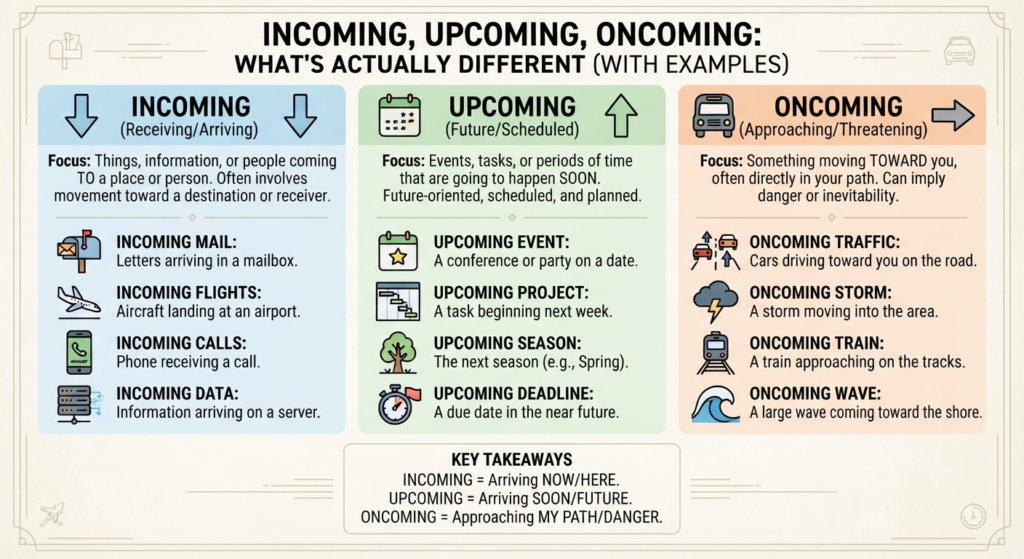
A text buzzes on your phone, “incoming call.” A friend mentions their “upcoming trip.” A road sign warns about “oncoming traffic.” All three words describe something that hasn’t arrived yet, but swap them around and your sentence stops making sense. Try saying “oncoming call” or “upcoming traffic” out loud, it just feels wrong, even if you can’t explain why.
That instinct is correct, and there’s a real rule behind it. The incoming vs upcoming vs oncoming confusion trips up learners and native speakers alike because all three words point toward the future, but each one answers a different question; arrival, timing, or direction. This guide breaks down exactly what separates them, with everyday examples, a side-by-side table, and the mistakes people make most often.
Understanding “Incoming”, “Upcoming”, and “Oncoming”
These three words share a root idea, something is approaching, but they attach that idea to three completely different concepts: entry, schedule, and direction. Once you separate those three concepts in your head, the word choice stops being a guessing game.
Here’s the fastest way to think about it:
- Incoming = something is arriving or entering right now
- Upcoming = something is scheduled to happen soon
- Oncoming = something is physically moving toward you
Notice that only one of the three; oncoming describes literal, visible motion. The other two can be entirely abstract, which is exactly where most of the confusion starts.
What “Incoming” Really Means
Incoming describes something in the process of arriving or being received, whether that’s physical, digital, or verbal. It’s the word for things entering a space, an inbox, or a system.
- “I have an incoming call from my dentist’s office.”
- “The airport announced three incoming flights.”
- “We’re reviewing incoming applications this week.”
- “The incoming students will start orientation on Monday.”
Notice that “incoming” doesn’t require physical movement at all, an incoming email doesn’t travel through the air toward you the way a car does down a street. It simply means something is on its way to reaching you, in whatever form that takes.
What “Upcoming” Really Means
Upcoming refers to something scheduled or expected in the near future. There’s no movement involved here at all, just timing. An upcoming event sits on a calendar, not on a collision course with anyone.
- “Our upcoming webinar is set for Friday afternoon.”
- “She’s nervous about her upcoming exam.”
- “The upcoming holiday season means longer shipping times.”
- “Fans are excited about the band’s upcoming album.”
If you can replace the word with “scheduled for later” or “coming up on the calendar” and the sentence still makes sense, upcoming is almost always your answer.
What “Oncoming” Really Means
Oncoming is the most physical of the three. It describes something moving directly toward you or your position, often with a sense of urgency, and it’s used almost exclusively for literal, visible motion.
- “Watch out for oncoming traffic before you cross.”
- “The sailors braced for the oncoming storm.”
- “She swerved to avoid the oncoming truck.”
- “The soldiers held their ground against the oncoming wave of attackers.”
You’ll rarely, if ever, see “oncoming” attached to something abstract like a meeting, a deadline, or an email; those situations belong to “incoming” or “upcoming,” never “oncoming.”
Side-by-Side Comparison
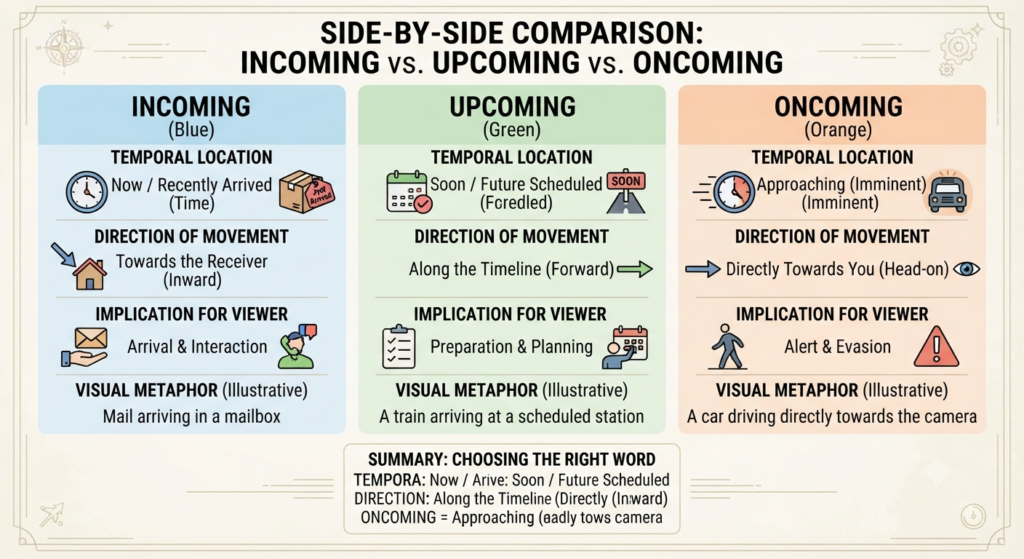
| Feature | Incoming | Upcoming | Oncoming |
| Core idea | Arriving or entering | Scheduled in the future | Physically approaching |
| Involves movement? | Sometimes (physical or digital) | No | Yes, almost always |
| Typical subject | Calls, emails, flights, students | Events, deadlines, releases | Traffic, storms, vehicles, danger |
| Sense of urgency? | Mild to moderate | Low | Often high |
| Common collocation | Incoming call, incoming mail | Upcoming event, upcoming exam | Oncoming traffic, oncoming storm |
| Can it be abstract? | Yes | Yes | Rarely |
| Opposite direction implied? | No | No | Yes — moving toward the observer |
Examples from Everyday Life
Seeing all three words used together in realistic settings makes the pattern click faster than any definition alone.
- At the airport: “The incoming flight is delayed, but our upcoming departure is still on time.” No oncoming here, nothing is physically bearing down on the traveler.
- On the road: “Drivers should watch for oncoming vehicles near the upcoming intersection.” Two different meanings of “coming” in one sentence, and neither is interchangeable.
- At school: “Incoming freshmen will register for their upcoming classes next week.” One word describes arrival, the other describes scheduling.
- In weather reports: “Residents were warned about the oncoming hurricane ahead of the upcoming weekend.” The storm moves toward you; the weekend simply arrives on the calendar.
Common Mistakes to Avoid
Most errors with these three words come from treating them as interchangeable synonyms, when they’re really answering three separate questions.
- “I have an oncoming meeting.” Wrong. Meetings are scheduled, not moving toward you physically. Use “upcoming meeting.”
- “Watch out for incoming traffic.” Technically odd. Traffic moving toward you on the road is “oncoming traffic,” not “incoming.”
- “The upcoming call is from my manager.” Wrong. A call that’s arriving right now is “incoming,” not “upcoming.”
- “We prepared for the incoming storm.” Debatable at best. A storm moving toward a location is typically described as “oncoming,” since it’s physical, directional movement.
- Using “oncoming” for anything digital. Emails, messages, and notifications are always “incoming,” never “oncoming,” because there’s no physical direction involved.
Easy Memory Tricks
A few quick mental shortcuts make these words stick without needing to memorize a rulebook.
- Incoming: Think “coming IN”, into your inbox, your phone, your building.
- Upcoming: Think “coming UP”, up on your calendar, up ahead in time.
- Oncoming: Think “coming ON” toward you, headlights coming straight on, right at your position.
Case Studies
A customer service center logs both “incoming call volume” (calls arriving now) and “upcoming staffing changes” (a scheduled shift next month) in the same weekly report, using each word correctly to keep the data unambiguous for anyone reading it later.
A city traffic department issues warnings about “oncoming traffic” near a construction zone while also announcing an “upcoming road closure” for the following week. One phrase describes vehicles moving toward drivers right now; the other describes a future event with no physical motion involved.
A university admissions office welcomes “incoming students” each fall while promoting its “upcoming orientation events” on the same webpage, a small but common example of how the two words divide arrival from scheduling within a single sentence.
Quotes to Help You Remember
- “If it’s arriving, it’s incoming. If it’s scheduled, it’s upcoming. If it’s moving straight at you, it’s oncoming.”
- “Incoming fills your inbox. Upcoming fills your calendar. Oncoming fills your windshield.”
Difference Between Incoming, Upcoming, and Oncoming
Incoming describes something arriving or entering now, upcoming describes something scheduled for the near future, and oncoming describes something physically moving toward you. The key test is simple: ask whether it’s arriving, scheduled, or approaching, that answer points you to the correct word almost every time.
Upcoming vs Incoming vs Forthcoming
“Forthcoming” overlaps closely with “upcoming,” describing something about to happen or be revealed, but it leans more formal and often implies availability or disclosure, “forthcoming details,” “forthcoming report.” “Upcoming” is the more casual, everyday choice for scheduled events, while “incoming” stays reserved strictly for arrival, not future timing at all.
Incoming or Upcoming President
Both terms exist here but mean different things. An incoming president is someone who has already been elected or selected and is about to take office; an upcoming president isn’t standard usage, since the role itself isn’t “scheduled” the way an event is; the correct phrase is always “incoming president” or “president-elect.”
Incoming or Upcoming Student
Incoming student is the standard, correct phrase, referring to someone about to enroll or arrive at a school. “Upcoming student” isn’t used in English, since “upcoming” describes events and timing, not people entering a place.
Incoming or Upcoming Year
Upcoming year is correct when referring to the next calendar or academic year as a scheduled period ahead, “budget planning for the upcoming year.” “Incoming year” isn’t standard phrasing, since a year isn’t something that “arrives” the way a call or a person does.
FAQs
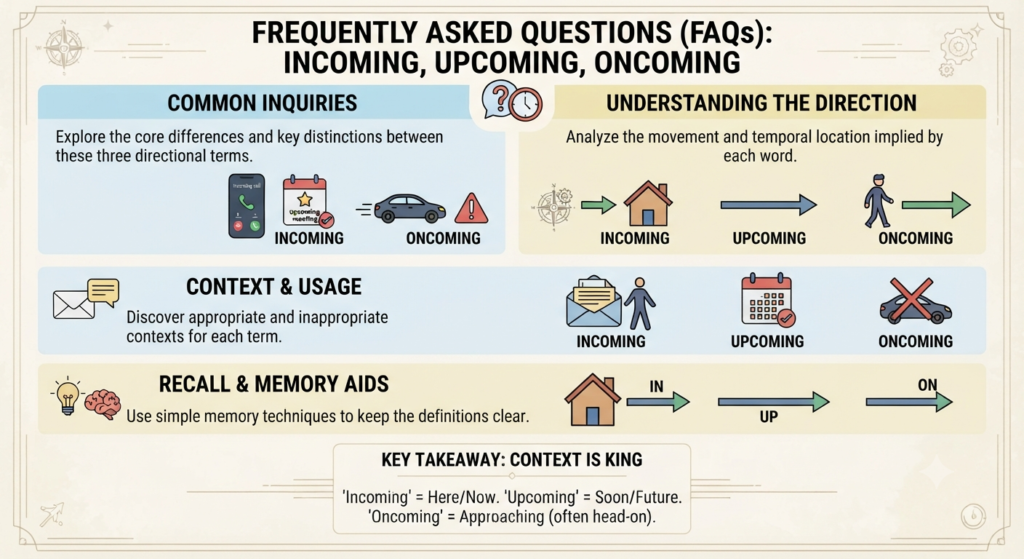
What is the difference between incoming, upcoming, and oncoming?
Incoming refers to something arriving now, upcoming refers to something scheduled for the future, and oncoming refers to something physically approaching, usually traffic, weather, or danger. The difference comes down to arrival versus timing versus direction.
Oncoming vs incoming traffic; which is correct?
Oncoming traffic is the correct phrase, since it describes vehicles physically moving toward you from the opposite direction. “Incoming traffic” isn’t standard usage in this context.
What does “incoming call” mean?
An incoming call is a phone call that is currently arriving on your device, meaning someone is calling you right now. It’s one of the most common and universally correct uses of the word “incoming.”
Can “upcoming” and “incoming” ever be used interchangeably?
No. Upcoming always refers to future scheduling with no movement involved, while incoming refers to something actively arriving or entering, swapping them usually produces a sentence that sounds off to native speakers.
What does incoming vs upcoming vs oncoming mean in everyday terms?
Incoming means something is arriving now, upcoming means something is planned for later, and oncoming means something is heading straight toward you. Learners outside English-speaking countries, including Urdu speakers, often find it easiest to map these to three separate ideas; arrival, schedule, and direction, rather than translating them as one shared concept.
Is “oncoming” only used for traffic?
No, though traffic is its most common use. Oncoming also describes storms, waves, crowds, or any other physical force moving toward a person’s location.
Conclusion
The incoming vs upcoming vs oncoming mix-up disappears once you stop treating the three words as synonyms and start asking one simple question: is it arriving, scheduled, or approaching? Incoming covers arrival, upcoming covers timing, and oncoming covers direction, three different jobs, even though all three words share that same forward-looking feel.
Next time you’re unsure which one fits, run through the quick test from this guide, or picture the memory tricks; coming in, coming up, coming on. Once that mental sorting becomes automatic, you’ll never second-guess an incoming call, an upcoming deadline, or oncoming traffic again.

1 thought on “Incoming, Upcoming, Oncoming: What’s Actually Different (With Examples)”