

You’re halfway through a sentence, “the new policy focuses on ___ inflation” — and your fingers freeze on that middle consonant. One T or two? Spellcheck doesn’t flag either one, which somehow makes the decision harder, not easier.
Here’s the short version of the combating vs combatting debate: both spellings are technically valid, but only one is standard in most modern writing, and the choice comes down to a single, learnable rule. This guide walks through where the confusion comes from, which spelling actually dominates today, and how one small consonant tells you almost everything about the style guide behind a piece of writing.
What Is the Difference Between Combating and Combatting?
There’s no difference in meaning between the two; both are present-participle or gerund forms of the verb “combat,” meaning to fight against, resist, or work to reduce something. The entire distinction is spelling, not definition.
- Combating: Single T, the dominant modern spelling
- Combatting: Double T, an older or regionally specific variant
Whichever version you pick, the word functions identically in a sentence: “Governments are combating poverty” and “Governments are combatting poverty” describe the exact same action. The gap between them is purely orthographic.
Why Do Both Spellings Exist?
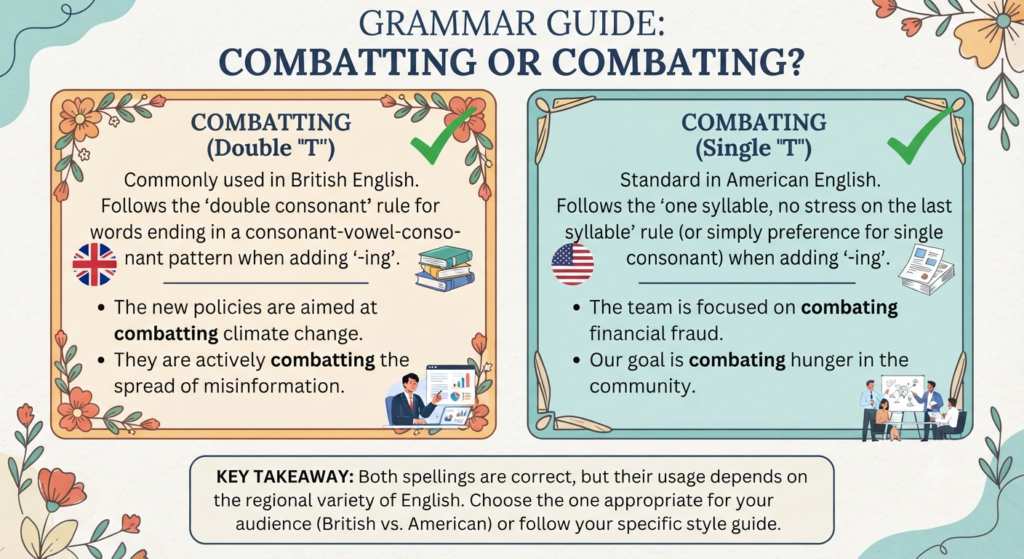
The root cause is a genuine English spelling rule, applied inconsistently across regions and eras. English typically doubles a verb’s final consonant before adding “-ing” when the stress falls on the last syllable, that’s why “run” becomes “running” and “regret” becomes “regretting.”
“Combat,” though, is usually stressed on the first syllable in American pronunciation; COM-bat, not com-BAT. Under the standard rule, that means no doubling is needed, which produces “combating.” British English has historically been more liberal about doubling final consonants regardless of stress placement, which is how “combatting” survived and stayed in circulation.
Add in generations of writers generalizing from words like “getting” and “setting”, where doubling is correct and you get a spelling that looks like it should have two T’s, even when the underlying rule says otherwise.
Combating vs Combatting: Which Spelling Is More Common?
Combating is the more common and widely accepted spelling in modern English, particularly in American writing, journalism, and formal documents. “Combatting” still appears, mostly in British publications and older texts, but it’s increasingly treated as a secondary variant rather than an equally standard option.
Search interest and published content both lean heavily toward the single-T version. If you’re writing for a broad, mixed, or unspecified audience, combating is the statistically safer default.
When Should You Use Combating?
Reach for combating in the vast majority of writing situations, especially:
- American audiences, publications, and corporate content
- News, journalism, and press releases
- Academic papers following US-based style guides
- Global or international content where consistency matters more than regional flavor
- Any context where you’re unsure which audience you’re writing for
Examples:
- “The city is combating rising crime rates with community programs.”
- “Researchers are combating antibiotic resistance through new drug trials.”
- “Nonprofits are combating food insecurity across rural regions.”
When Should You Use Combatting?
Combatting is appropriate mainly in British English contexts, particularly older or more traditional UK publications that favor consonant doubling regardless of stress patterns. It’s not incorrect, it’s simply less dominant and more regionally specific.
Use it when:
- You’re writing specifically for a UK audience or publication with an established style preference for it
- You’re matching the spelling conventions of a historical or quoted British text
- Your organization’s style guide explicitly specifies the double-T form
Examples:
- “The council is combatting anti-social behaviour in the borough.”
- “Officials are combatting rising fuel costs this winter.”
Combating vs Combatting: Side-by-Side Comparison
| Feature | Combating | Combatting |
| Consonant count | Single T | Double T |
| Region | American English, global default | Primarily British English |
| Modern usage frequency | Dominant, far more common | Less common, declining |
| Style guide preference | AP Style, Chicago Manual of Style, Merriam-Webster | Some UK style guides, older texts |
| Best for | US audiences, global content, journalism | UK-specific or historical writing |
| Grammar logic | Follows standard no-doubling rule (unstressed final syllable) | Follows broader UK doubling convention |
| Formality | Standard, modern, widely accepted | Acceptable but increasingly dated |
Real-Life Example: How a Content Team Standardized Its Writing
A marketing agency managing a large content library noticed its writers were split roughly down the middle between “combating” and “combatting” across dozens of articles. Editors initially assumed it was a minor issue, until readers began leaving comments questioning which spelling was actually correct.
The editorial team reviewed major publications and style guide recommendations, found that “combating” appeared far more consistently across current professional writing, and standardized every future piece to the single-T spelling. The result wasn’t just cleaner copy, it removed a recurring distraction that had been quietly undermining the brand’s credibility with careful readers.
Data and Usage Trends (2025–2026)
Recent content analysis across news sites, blogs, and SEO-focused publications shows a consistent pattern: combating appears dramatically more often than combatting in current online writing, and that gap has widened over the past several years rather than narrowed. Long-term tracking tools that chart word frequency across published books show a similar shift, with the double-T spelling peaking decades ago and declining steadily since.
The practical takeaway isn’t just historical trivia, it reflects where English is actually heading. Digital publishing, SEO writing, and international audiences all favor consistency, and combating has become the de facto global standard as a result.
How to Remember the Correct Choice
A simple trick locks this in permanently: “Combat doesn’t stress the end, so don’t double the T.” Since the stress in “combat” falls on the first syllable rather than the last, there’s no grammatical reason to double the final consonant, which is exactly why “combating” follows the standard rule and “combatting” doesn’t.
If you want an even shorter version: when in doubt, go with one T. It’s shorter to type, matches AP and Chicago style guidance, and works for virtually any audience.
Mini Quiz: Combating vs Combatting
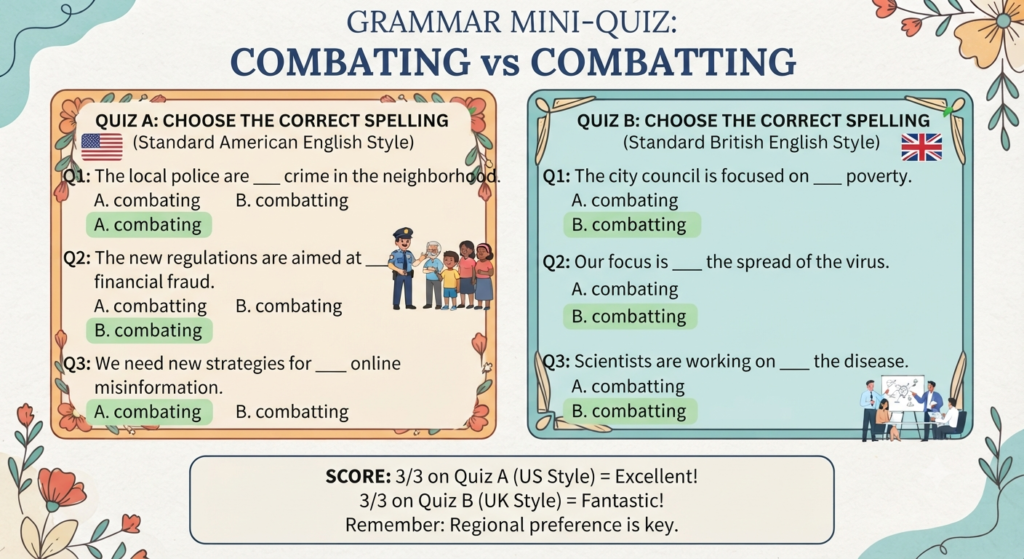
Test yourself with these quick fill-in-the-blank examples before checking your answers below.
- The health department is _____ the spread of the virus.
- Local police are _____ theft in the downtown district.
- The UK charity announced new efforts aimed at _____ homelessness.
- Scientists are _____ climate change through renewable energy research.
Answers: 1. combating, 2. combating, 3. combatting (or combating, UK context), 4. combating
Credible References
Major American dictionaries and style guides; including Merriam-Webster, the AP Stylebook, and the Chicago Manual of Style, list “combating” as the standard or preferred spelling in modern usage. British dictionaries and some UK-based style guides continue to recognize “combatting” as an accepted regional variant, though it appears less frequently in contemporary published writing than it once did.
More Questions People Ask About Combating vs Combatting
Is “combatted” or “combated” correct for the past tense?
The same logic applies here as with the “-ing” form: combated (single T) is the standard modern spelling, while combatted (double T) is the older or British-leaning variant. Whichever form you choose for “combating” should match for the past tense as well.
Does “combat” ever double its consonant in any form?
Generally no, in standard American usage, because the stress sits on the first syllable, the modern rule avoids doubling across combat’s related forms, including combated, combating, and combats.
Is “combatant” spelled with one T or two?
Combatant is spelled with a single T in both American and British English, this noun form isn’t part of the same doubling debate as the verb’s “-ing” and “-ed” forms.
Frequently Asked Questions
Combating vs Combatting; what does the Oxford Dictionary say?
Oxford’s British-English references list “combatting” as an accepted spelling reflecting British doubling conventions, while also recognizing “combating” as increasingly common, most modern Oxford-affiliated style resources now favor the single-T form for general use.
Combating or combatting; UK usage?
In UK writing, both spellings appear, but “combatting” has traditionally been more common there than in American English due to Britain’s broader tendency to double final consonants regardless of stress.
What does “combating” mean?
“Combating” means actively fighting against, resisting, or working to reduce something harmful, such as a disease, problem, or threat. It’s the present-participle or gerund form of the verb “combat.”
Combating or combatting; AP style?
AP Style follows the single-T spelling, “combating,” making it the standard choice for journalists, news organizations, and most professional publications in the US.
Is “combating” a real word?
Yes, “combating” is a standard, dictionary-recognized word and the present-participle form of “combat,” widely used in news, academic writing, and everyday English.
How do you pronounce “combating”?
“Combating” is pronounced with the stress on the first syllable, KOM-buh-ting, which is also the reason the modern spelling avoids doubling the final consonant.
What’s a synonym for “combating”?
Common synonyms include fighting, opposing, resisting, countering, and tackling, depending on context and tone.
Conclusion
The combating vs combatting question really comes down to one small grammatical fact: because “combat” stresses its first syllable, the standard English doubling rule doesn’t apply, which makes combating the correct, modern, widely accepted spelling in almost every context. “Combatting” isn’t wrong, exactly; it’s just a regional holdover that’s fading from everyday use, mostly confined to British writing and older texts.
If you only remember one thing from this guide, make it this: when you’re unsure, choose the single T. It matches AP style, Chicago style, and the spelling most readers expect to see and that small consistency adds up to writing that reads as polished, not distracted by a detail most people never even notice you got right.
