

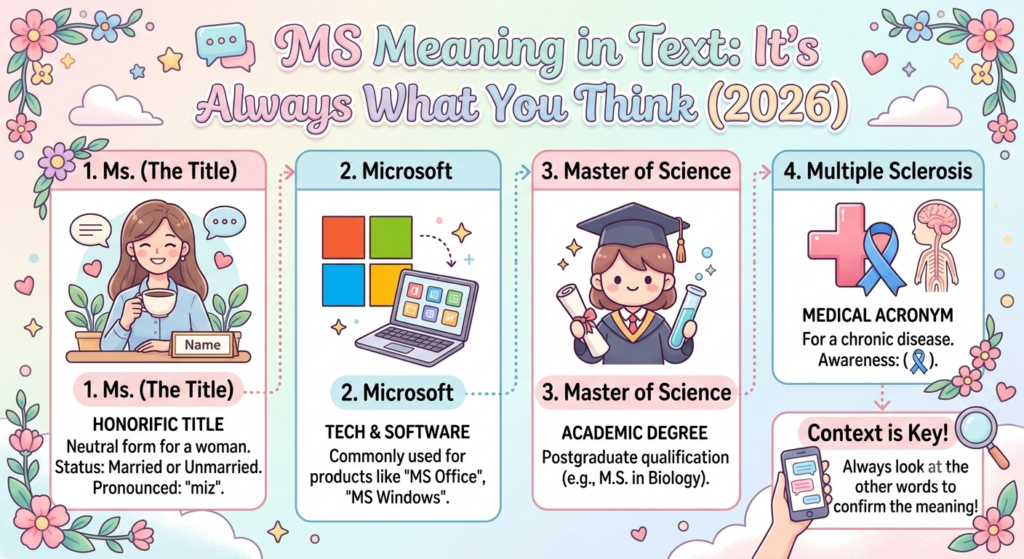
Someone texts you “ms” and you pause for half a second, unsure if they mean they miss you, they’re sending a message, or something else entirely. MS meaning in text genuinely shifts depending on the conversation, and guessing wrong can lead to a slightly awkward reply.
This guide breaks down every common meaning of MS, where the abbreviation came from, how it shows up across different platforms, and how to figure out quickly and confidently, which one someone actually means.
What Does MS Mean in Text?
Direct answer for quick reference: In casual texting, MS most often stands for “Miss,” used to express that you miss someone, or as a shorthand version of the formal title “Ms.” It can also mean “message” in some conversations. The correct meaning depends entirely on the surrounding context and the platform you’re using.
- “MS you so much, been way too long.” (miss)
- “Send me an MS when you land.” (message)
Secondary & Less Common Meanings of MS in Text
Beyond “miss” and “message,” MS carries several other meanings depending on the setting:
- Microsoft: Used in workplace or tech conversations (“Working late on the MS project.”)
- Multiple Sclerosis: Used in health, awareness, or medical discussions (“She was recently diagnosed with MS.”)
- Master of Science: An academic degree, common in professional bios or LinkedIn-style contexts (“He’s finishing his MS this year.”)
- Millisecond: Used by gamers and in tech contexts to describe delay or ping (“My ping is 45 ms.”)
- Manuscript: Used in publishing and academic writing (“Please submit your MS by Friday.”)
None of these overlap with the casual “miss” meaning, and mixing them up outside their intended field would read as a clear misunderstanding rather than a stylistic choice.
Background & Origin of “MS” in Text
The abbreviation has a longer history than texting culture itself. “Ms.” as a formal title emerged in the mid-20th century and gained real traction during the feminist movement of the 1970s, offering women a way to be addressed without revealing marital status, unlike “Miss” or “Mrs.”
Texting culture picked up the same two letters decades later for an entirely different purpose. Early SMS messaging came with strict character limits, which pushed people to drop vowels and shorten common words wherever possible, “miss” became “ms” the same way “message” occasionally got the same treatment. Social media then carried that shorthand forward, cementing MS as flexible, casual slang rather than a strictly formal abbreviation.
Find out more “GIF Meaning in Text: What It Really Stands For“
Usage of “MS” in Different Texting Contexts
Context does most of the work in figuring out which MS you’re looking at:
- Emotional or nostalgic messages, almost always “miss.” (“MS those summer nights.”)
- Quick, practical requests, likely “message.” (“Drop me an MS when you’re free.”)
- Workplace or tech conversations, likely “Microsoft” or a technical term. (“Migrating everything to MS Teams.”)
- Health-related conversations, likely “Multiple Sclerosis.” (“Her mom was diagnosed with MS last year.”)
- Academic or professional bios, likely “Master of Science.” (“She has an MS in data analytics.”)
The tone and subject matter of the surrounding conversation almost always eliminates every meaning except one.
Meanings of MS Across Major Platforms
MS Meaning in WhatsApp
On WhatsApp, MS leans emotional far more often than technical, since the app is used heavily for personal, one-on-one conversations. “MS our late-night calls” reads as a nostalgic, affectionate message rather than anything work-related.
What Does MS Mean Snapchat
On Snapchat, MS tends to show up in quick, casual replies to stories or snaps, usually carrying the same “miss” meaning as WhatsApp, but with a more playful or flirty undertone given the platform’s casual culture.
MS Meaning on TikTok
On TikTok, MS occasionally appears in comments reacting to nostalgic or emotional content; throwback videos, old photos, or “how it started” posts, again typically meaning “miss,” rarely anything technical.
“MS” in Non-Slang Fields
Outside of texting entirely, MS carries specific, well-established meanings in professional and academic writing:
- In medicine, MS refers to Multiple Sclerosis, a chronic neurological condition, and appears frequently in health articles, patient forums, and awareness campaigns.
- In technology, MS commonly refers to Microsoft, especially in workplace chats discussing tools like MS Teams, MS Office, or MS Excel.
- In academia and publishing, MS refers to a manuscript, an unpublished document submitted for review — or to a Master of Science degree, depending on the sentence.
- In science and engineering, ms (lowercase, unspaced) refers to milliseconds, a unit of time used in physics, computing, and gaming contexts.
Similar term explained here “DK Meaning: Text, Chat & Social Media Explained“
Common Misconceptions
- Assuming MS always means “miss”, it’s the most common casual meaning, but far from the only one.
- Confusing MS with “msg”, “msg” is the more standard shorthand for “message” in most modern texting; MS meaning “message” is less common and more regional.
- Treating “Ms.” and “Miss” as identical, “Ms.” is a neutral title regardless of marital status, while “Miss” traditionally implies someone unmarried.
- Assuming lowercase “ms” always means slang, in technical writing, lowercase “ms” almost always refers to milliseconds, regardless of capitalization habits in casual texting.
Similar Terms & Confusing Alternatives
A few related abbreviations often get tangled up with MS:
- MSG: Shorthand for “message,” more commonly used than MS for this specific meaning.
- IMY: “I miss you,” a fuller alternative to a lone “MS” when someone wants to be unambiguous.
- DM: “direct message,” specific to social platforms, distinct from the more general “message” meaning of MS.
How to Interpret MS Correctly
A simple mental checklist clears up almost any ambiguity:
- What’s the conversation about? Emotional and casual; likely “miss.” Technical or workplace; likely Microsoft or another field-specific meaning.
- What platform is it on? WhatsApp and Snapchat lean emotional; Slack or email leans technical.
- Is there other context nearby? Words like “diagnosed,” “symptoms,” or “neurologist” point clearly to Multiple Sclerosis; words like “Teams,” “Excel,” or “Office” point to Microsoft.
- Is it capitalized unusually? Not a hard rule, but formal contexts (academic, medical, technical) tend to use MS more deliberately than casual texting does.
How to Respond to MS in Text
Once you’ve figured out the intended meaning, replying naturally is straightforward:
- If it means “miss”: “Aw, MS you too! We need to catch up soon.” Matching the same casual shorthand keeps the tone consistent.
- If it means “message”: A simple confirmation works fine, “Got it, thanks!”, since the abbreviation itself doesn’t require special acknowledgment.
- If you’re genuinely unsure: Asking directly is always the safest option, “Wait, what do you mean by MS?” avoids any awkward misreading.
Differences Between MS & Similar Words
Mr, Mrs, Ms, Miss Meaning
| Term | Meaning | Marital Status Indicated? |
| Mr. | Title for a man | No |
| Mrs. | Title for a married woman | Yes — married |
| Miss | Title for an unmarried woman or young girl | Yes — unmarried |
| Ms. | Neutral title for a woman | No |
Ms. was specifically created to give women the same neutral option men have always had with “Mr.”, a title that doesn’t reveal or depend on marital status.
SYBAU Meaning Explained: TikTok, Texting & Gen Z Slang Guide
Miss, Mrs, Ms Pronunciation
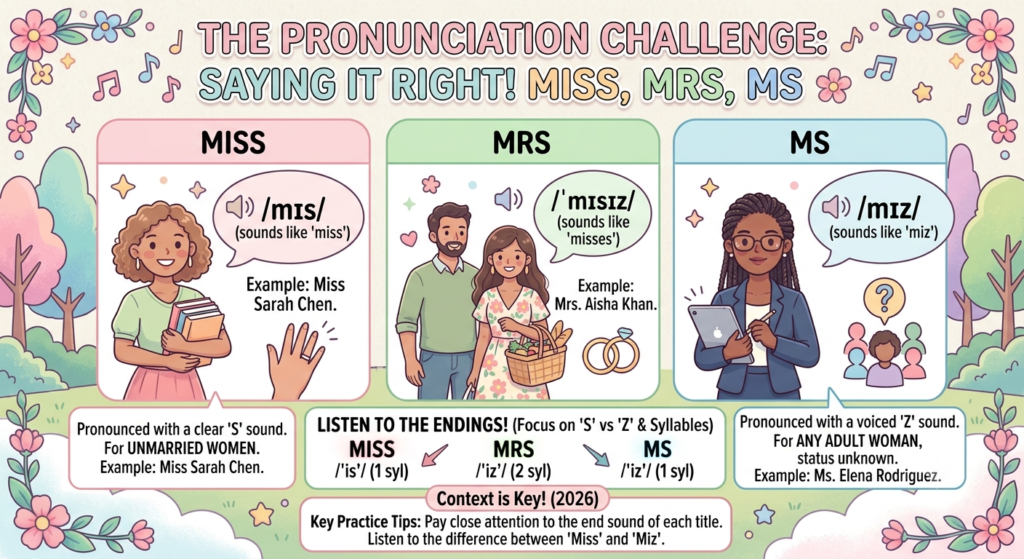
Pronunciation is another common point of confusion:
- Miss is pronounced exactly as it’s spelled, “miss.”
- Mrs. is pronounced “missus,” despite the spelling looking nothing like it.
- Ms. is pronounced “mizz,” a soft “z” sound rather than an “s.”
Knowing the pronunciation difference matters more in speech than in texting, but it explains why “Ms.” sometimes gets mistakenly read aloud as “miss” by people unfamiliar with the title.
Popularity & Trend Insights
Interest in “MS meaning in text” has grown steadily as texting slang keeps expanding across more platforms and age groups. Unlike trend-driven slang that fades within a season, MS remains stable specifically because it isn’t tied to one single meaning, its flexibility across emotional texting, technical shorthand, and academic or medical contexts keeps it consistently searched rather than seasonally relevant.
Check the term’s official slang entry on Merriam-Webster’s Slang & Trending section / Dictionary.com Slang
FAQs
What does MS mean in chat in English?
In most casual English texting, MS means “miss,” used to express that you miss someone or something, though it can also mean “message” depending on context.
What does MS mean in terms of gender?
“Ms.” is a gender-neutral title for women that doesn’t indicate marital status, unlike “Miss” (unmarried) or “Mrs.” (married).
What does MS mean in chat from a girl?
The meaning doesn’t change based on who sends it, MS from a girl still typically means “miss,” often used affectionately or nostalgically, depending on the conversation.
What does MS mean on Snapchat?
On Snapchat, MS usually means “miss,” often used in casual, quick replies to snaps or stories, sometimes with a playful or flirty tone.
What’s the difference between Mr., Mrs., Ms., and Miss?
Mr. is used for men regardless of marital status; Mrs. indicates a married woman; Miss indicates an unmarried woman or young girl; Ms. is neutral and doesn’t reveal marital status at all.
How do you pronounce Miss, Mrs., and Ms.?
“Miss” is pronounced as spelled, “Mrs.” is pronounced “missus,” and “Ms.” is pronounced “mizz”, three different sounds despite looking similar in writing.
Is MS the same as “msg”?
Not exactly, “msg” is the more standard, widely recognized shorthand for “message,” while “MS” meaning message is less common and more dependent on personal or regional texting habits.
Can MS mean something medical in a text?
Yes, if the conversation involves health, diagnosis, or symptoms, MS most likely refers to Multiple Sclerosis rather than the casual “miss” meaning.
Conclusion
MS is a small abbreviation doing a lot of work, in casual texting it usually means “miss,” but shift the context to a workplace chat, an academic bio, or a health conversation, and it becomes Microsoft, a Master’s degree, or Multiple Sclerosis without warning. The fastest way to get it right is to read the sentence around it: the topic, the platform, and the tone will almost always point you to the correct meaning. Once you’ve got that habit down, “MS” stops being confusing and starts being just another piece of everyday texting shorthand.

1 thought on “MS Meaning in Text: It’s Not Always What You Think (2026)”