
If you’ve ever paused mid-sentence wondering whether to write “she has showed me” or “she has shown me,” you’re not alone. The shown vs showed confusion trips up native speakers and learners alike, and honestly, it’s one of the most common irregular verb mix-ups in English. The good news? Once you understand the one rule that separates them, you’ll never second-guess yourself again.
By the end of this article, you’ll know exactly when to use each form, why “showed” sometimes sounds correct but isn’t, and how to spot the mistake in your own writing before anyone else does.
Definition
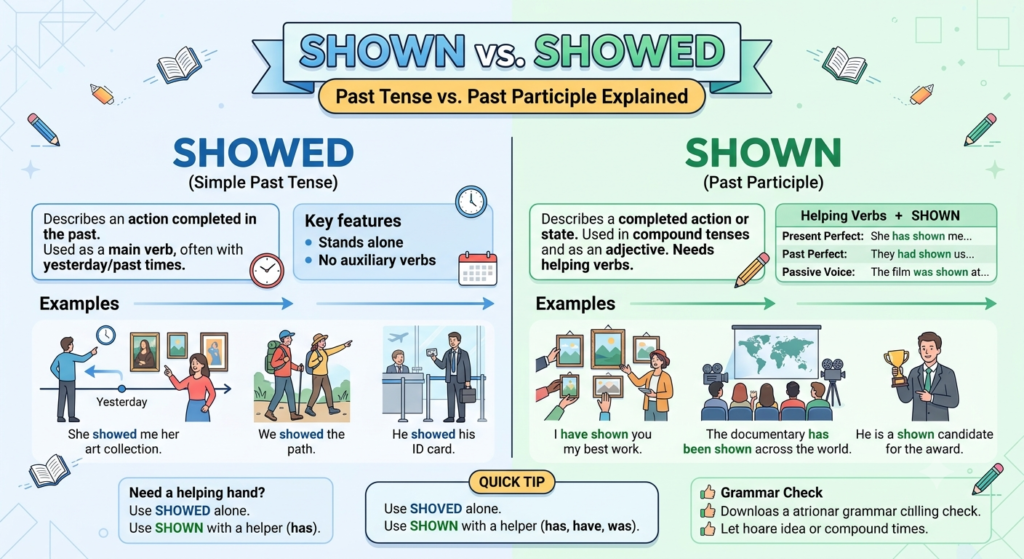
Here’s the short answer for anyone in a hurry: “Showed” is the simple past tense of “show,” used for completed actions in the past (I showed you). “Shown” is the past participle, used with helping verbs like has, have, or had (I have shown you), and in passive voice (It was shown). That’s the entire rule in one sentence, but let’s unpack why it matters.
Understanding the Verb “Show”
“Show” is an irregular verb, meaning it doesn’t follow the standard “-ed” pattern all the way through. Regular verbs like “walk” use the same form for both past tense and past participle: walked, walked. “Show” breaks that pattern.
Its three main forms are:
- Base form: show
- Simple past tense: showed
- Past participle: shown
This irregularity is exactly why so many people search “is showed a word” or “show past tense and past participle”, the verb doesn’t behave the way most English verbs do, and that inconsistency is where the confusion starts.
When to Use “Showed”; The Simple Past Tense
Use “showed” when you’re describing a single, completed action that happened at a specific point in the past, with no helping verb attached. If you can point to when it happened, “showed” is almost always your answer.
Examples
- She showed me her new apartment last weekend.
- The teacher showed the class a documentary yesterday.
- He showed up late to the meeting again.
- They showed great courage during the crisis.
- The results showed a clear improvement in sales.
Notice that none of these sentences use “has,” “have,” or “had” before the verb. That’s your visual cue: standalone past-tense sentences take “showed.”
When to Use “Shown”; The Past Participle
“Shown” never stands alone. It always needs a helping verb most commonly a form of “have” (has, have, had), or it appears in passive voice constructions with “be” (is, was, were, been).
- I have shown you this before.
- She has shown remarkable patience.
- They had shown no interest until now.
- The data was shown to the board yesterday.
- New evidence has been shown to support the theory.
If you’re asking yourself “is it shown or showed” in a sentence with “has,” “have,” or “had,” the answer is settled: it’s shown, every time.
Why “Shown” Matters in Perfect Tenses
English uses what’s called perfect tenses to connect a past action to another point in time; either the present, an earlier past moment, or an anticipated future one. “Shown” is the required past participle in all three.
Breaking Down Perfect Tenses (with “Shown”)
| Tense | Structure | Example |
| Present Perfect | has/have + shown | She has shown us the report. |
| Past Perfect | had + shown | He had shown them the plans before the deadline. |
| Future Perfect | will have + shown | By June, we will have shown the prototype to investors. |
| Passive Voice | is/was/been + shown | The findings were shown at the conference. |
This table alone answers most of the confusion behind “has shown or has showed” and “had shown or had showed” searches — the participle “shown” is non-negotiable once a helping verb enters the sentence.
“Have Showed” vs “Have Shown”; The Grammar Test
Here’s a quick mental test you can run every single time: if there’s a helping verb (has, have, had, was, been) directly before the main verb, only “shown” is grammatically correct. “Have showed,” “has showed,” and “had showed” are all incorrect in standard English, even though they sometimes appear in casual speech or older dialectal usage.
Try this substitution trick: replace “show” with a verb you already know is irregular in the same way, like “eat” (ate/eaten) or “go” (went/gone). You’d never say “I have went” — and by the same logic, you shouldn’t say “I have showed.”
Real-Life Examples and Common Usage Notes
Grammar rules stick better with real context. Here’s how the distinction plays out across everyday writing:
- Email at work: “I showed the client the mockups yesterday, and she has shown interest in moving forward.”
- Casual conversation: “He showed me his garden last spring, but I haven’t shown mine to anyone yet.”
- News reporting: “New data has shown a decline in emissions since the policy was shown to local officials.”
One usage note worth flagging: some regional dialects, particularly in parts of the American South and rural Britain, use “showed” informally in place of “shown” (“I’ve showed him already”). It’s understandable in speech, but it’s considered nonstandard in formal writing, academic papers, and professional communication.
Side-by-Side Comparison: “Shown” vs “Showed”
| Feature | Showed | Shown |
| Type | Simple past tense | Past participle |
| Needs helping verb? | No | Yes (has/have/had/was/been) |
| Used in perfect tenses? | No | Yes |
| Used in passive voice? | No | Yes |
| Example sentence | I showed her the file. | I have shown her the file. |
| Standalone use | Correct | Incorrect (grammatically broken alone) |
Quick Reference Summary Table
| If your sentence has… | Use |
| No helping verb, single past action | showed |
| has / have / had | shown |
| is / was / were / been (passive voice) | shown |
| A specific past time marker (yesterday, last week) alone | showed |
Quick Memory Tips to Remember
- “Shown” needs a friend. It never appears alone; it always leans on a helping verb.
- Think: “Have” hangs out with “shown.” The two rhyme in rhythm if you say them together a few times.
- If you can swap in “gone” or “eaten” and the sentence still needs a helper verb, “shown” is correct.
- “Showed” stands on its own two feet, no support needed.
Common Mistakes and How to Avoid Them
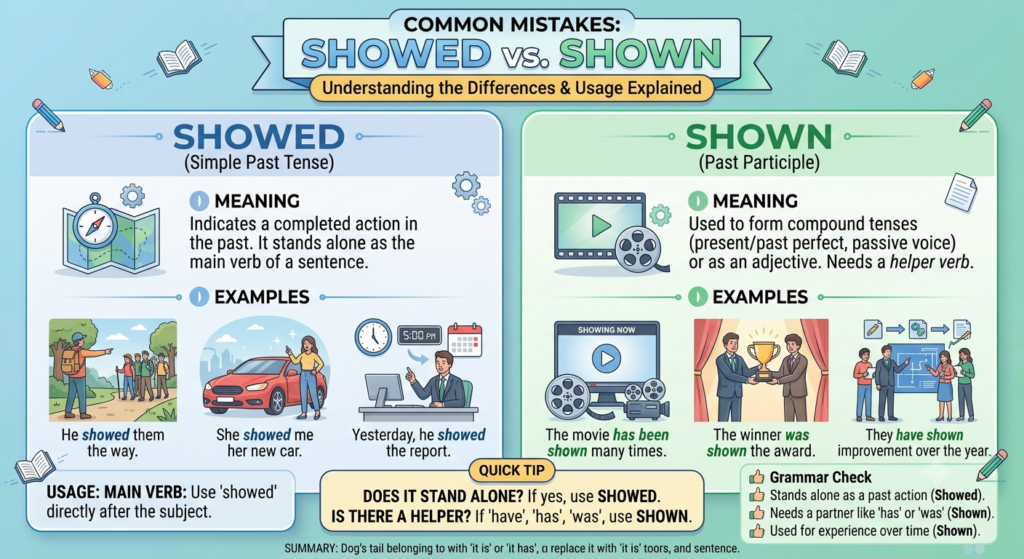
- Mistake: “She has showed me the results.”
Fix: “She has shown me the results.”
- Mistake: “They had showed up early.”
Fix: “They had shown up early.”
- Mistake: “The proof was showed to the jury.”
Fix: “The proof was shown to the jury.”
- Mistake: Mixing tenses in the same sentence, like “I showed her and I have showed him too.” Fix: Keep the participle consistent: “I showed her and I have shown him too.”
A simple proofreading habit fixes most of these: whenever you spot “has,” “have,” “had,” “was,” “were,” or “been” near the verb “show,” stop and check that “shown” follows, not “showed.”
Case Study: A Common Workplace Mix-Up
A marketing manager once sent a company-wide email stating, “The Q3 numbers have showed strong growth across all regions.” It was technically understandable, but it read as slightly off to more grammar-conscious colleagues, and one client later mentioned it in a follow-up call, questioning the polish of the communication. The fix was simple: “have shown” instead of “have showed.” It’s a small correction, but in professional writing, these details shape how credible and careful your communication appears.
Linguistic Insight & Expert Opinion
According to most style guides, including those referenced by university writing centers, “showed” as a past participle is considered a nonstandard dialectal variant rather than an acceptable alternative in formal English. Linguists note that English irregular verbs resist full regularization slowly over centuries; “show” is currently in a transitional zone where “shown” remains the accepted standard, but “showed” occasionally creeps into casual and regional speech as the language drifts toward simplification. For now, though, careful writers stick with “shown” in every perfect and passive construction.
Self Assessment Section
Test yourself — fill in the blank with “showed” or “shown”:
- She ______ me the photos last night.
- They have ______ great improvement this quarter.
- He ______ up without warning.
- The report ______ to the board yesterday, passive voice.
- We had never ______ him our new office before.
(Answers: 1. showed, 2. shown, 3. showed, 4. was shown, 5. shown)
FAQs
Is it “shown” or “showed”?
Both are correct, but in different situations. Use “showed” for simple past tense without a helping verb, and “shown” whenever a helping verb like has, have, had, or was appears in the sentence.
Have shown vs have showed; which is correct?
“Have shown” is correct. “Have showed” is a common but grammatically incorrect construction in standard English.
Has shown or has showed?
“Has shown” is the correct form. “Has showed” is nonstandard and should be avoided in formal or professional writing.
Had shown or had showed?
“Had shown” is correct for past perfect tense. “Had showed” is incorrect in standard grammar.
Is “showed” a word?
Yes, “showed” is a real word, it’s the simple past tense of “show.” It’s only incorrect when used after helping verbs like has, have, or had, where “shown” is required instead.
What is the past tense and past participle of “show”?
The simple past tense of “show” is “showed,” and the past participle is “shown.” They serve different grammatical roles and aren’t interchangeable.
Why does “show” have two different past forms?
“Show” is an irregular verb, meaning it doesn’t follow the standard pattern where past tense and past participle are identical. English has many such irregular verbs, and “show” is one of them.
Conclusion
The rule behind shown vs showed really comes down to one question: is there a helping verb in the sentence? If yes, “shown” is your answer. If the sentence stands alone describing a completed past action, “showed” does the job. Keep this quick test in mind next time you’re writing an email, a report, or even a text message, and you’ll never have to second-guess this common grammar trap again.
