

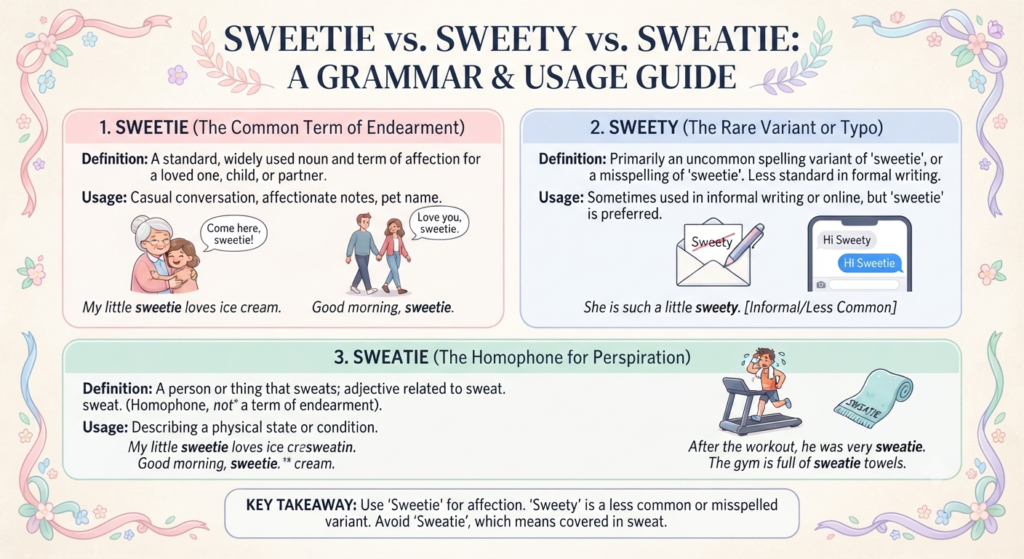
You’ve typed it a dozen times and second-guessed it every single time: is it sweetie, sweety, or, heaven forbid, sweatie? The comparison of sweetie vs sweety vs sweatie shows up constantly in texts, comments, and even greeting cards, and most people never actually stop to check which one is right.
Here’s the short answer before we go deeper: only one of these three is a real, dictionary-recognized word. The other two are either a casual variant or an outright typo that can change your meaning entirely. By the end of this guide, you’ll know exactly which spelling to use, why the confusion exists in the first place, and how to avoid an awkward autocorrect moment the next time you’re texting someone you care about.
Sweetie vs Sweety vs Sweatie: Why These Spellings Confuse People
The confusion isn’t really about vocabulary, it’s about how English handles sound versus spelling. All three words are pronounced almost identically when spoken quickly, so the brain doesn’t automatically flag which version looks correct on the page.
Add in mobile keyboards, predictive text, and the muscle memory of typing fast, and you get three lookalike spellings competing for the same slot in a sentence. A few specific habits make it worse:
- Phonetic spelling: People write words the way they sound, and “sweet-ee” can just as easily become sweety as sweetie.
- Pattern-matching with other words: “party,” “beauty,” and “cutie” all end in a “y” sound, so sweety feels visually normal even though it isn’t the standard form.
- Keyboard proximity: The letters “e” and “a” sit close together on a phone keyboard, which is a common source of the sweatie typo.
None of this means the confusion is unreasonable. It just means the fix is simple once you know the rule.
Why English Spelling Creates Mix-Ups Like Sweetie vs Sweety
English spelling rarely follows one consistent logic, because the language pulls from Old English, French, and Latin roots all at once. Words that sound the same on the tongue can end up spelled completely differently on the page, and affectionate nicknames are some of the worst offenders.
Sweetie follows a common English pattern where an adjective (sweet) gets a diminutive “-ie” ending to turn it into a warm, informal noun — the same pattern you see in “cutie,” “sweetie pie,” and “bestie.” That “-ie” ending is what standard dictionaries recognize, not the “-y” ending that shows up in casual writing.
Sweetie vs Sweety: The Real Difference
This is the comparison most people actually care about, since sweatie rarely gets used on purpose. Here’s the breakdown:
- Sweetie is the standard, dictionary-listed spelling used in American and British English alike. It’s the version you’ll see in published writing, books, and formal contexts where a term of endearment is appropriate at all.
- Sweety is a nonstandard variant. It isn’t “wrong” in the sense of being unreadable; everyone understands what you mean, but it doesn’t appear as a recognized headword in major English dictionaries the way sweetie does.
Sweety tends to show up more often in fast texting, social media comments, and among speakers who learned English outside the US or UK, where the spelling has taken on a life of its own in casual writing. It’s not offensive or incorrect in tone, it’s simply not the version that grammar checkers or style guides will approve.
Sweatie: The Odd One Out; What It Really Means
Sweatie deserves its own section because it isn’t just an informal variant, it’s a different word entirely if you take it literally. Add “-ie” to “sweat” instead of “sweet,” and you get something that reads as a diminutive form of “sweaty,” not a term of affection at all.
In practice, sweatie almost never appears on purpose. It shows up because:
- Autocorrect swaps the vowel without the writer noticing.
- Fast typing skips a letter and produces the wrong word.
- Someone genuinely mishears “sweetie” and spells it phonetically the wrong way.
Quick Answer: “Sweatie” is not a recognized term of endearment in English. If read literally, it would describe someone who is sweaty, which is why using it by accident can create an unintentionally funny or even awkward message. Stick with “sweetie” for affection.
Pet Names in American English and Where “Sweetie” Fits
American English uses affectionate nicknames constantly, in families, relationships, and even casual friendships. Sweetie sits comfortably alongside other common terms of endearment like honey, babe, darling, and sweetheart.
What makes sweetie distinct is its versatility. It works for:
- Romantic partners (“Good morning, sweetie”)
- Parents talking to kids (“Come here, sweetie”)
- Friends being warm or reassuring (“Thanks, sweetie, you’re a lifesaver”)
Compare that to a term like “darling,” which can feel more old-fashioned or formal depending on the region, or “babe,” which leans almost exclusively romantic. Sweetie’s flexibility is part of why it’s stayed so common across generations of American speech.
Where These Words Come From: The History Behind Sweet, Sweetie & Sweety
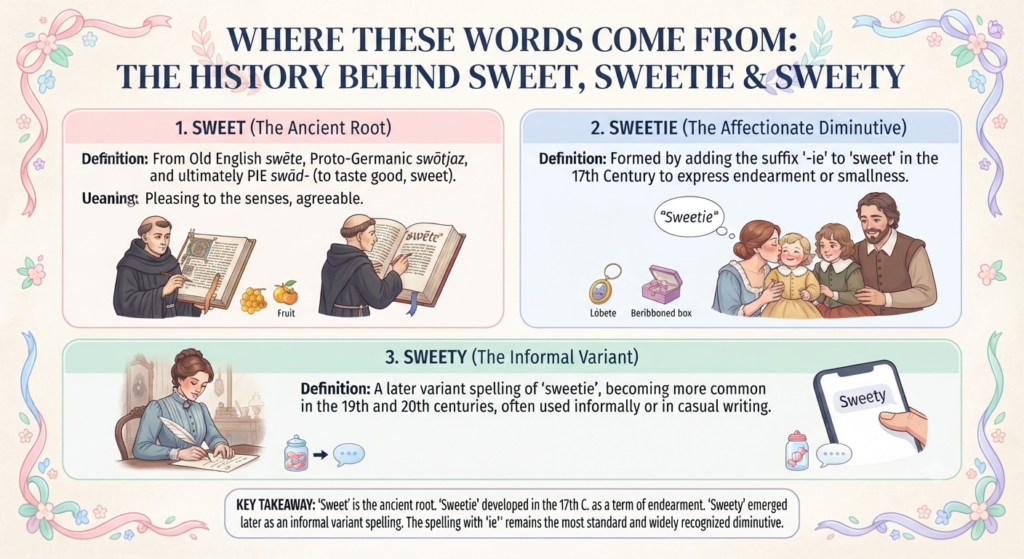
The root word sweet traces back to Old English “swete,” originally describing taste before it expanded to describe temperament, kindness, and affection. That shift from a flavor word to an emotional one, happened gradually over centuries of everyday use.
The “-ie” suffix is a diminutive marker, a small addition that softens a word and makes it feel more personal or endearing. English uses this same pattern in words like “doggie,” “auntie,” and “movie,” which is exactly how “sweet” became “sweetie” rather than staying a plain adjective. “Sweety,” by contrast, developed later as an informal spelling variant rather than through the same grammatical pattern, which is part of why dictionaries never fully adopted it.
Context Matters: When to Use These Terms (and When to Avoid Them)
Spelling aside, tone and setting matter just as much when you’re deciding whether to use a pet name at all. A word that feels warm between close friends can feel condescending coming from a stranger or a colleague.
| Context | Sweetie | Sweety | Sweatie |
| Texting a partner or close friend | Natural and warm | Understood, but nonstandard | Reads as a typo |
| Talking to a child | Common and appropriate | Informal, less standard | Avoid entirely |
| Professional email or workplace chat | Can seem unprofessional | Same issue, plus a spelling flag | Confusing and unprofessional |
| Greeting cards or personal notes | Correct and expected | Acceptable casually | Avoid |
| Addressing a stranger or acquaintance | Can feel presumptuous | Same concern | Avoid |
The pattern is consistent: sweetie is the only version that holds up in formal or semi-formal writing, while sweety stays limited to casual texting, and sweatie doesn’t belong anywhere on purpose.
Choosing the Right Word: Practical Tips You Can Use Today
If you want a simple rule to keep in your back pocket, use this:
- Default to “sweetie” in any writing you want to look polished or correct.
- Reserve “sweety” for casual texting only, and know it may read as a spelling mistake to some readers.
- Never use “sweatie” unless you’re intentionally joking about sweating and even then, spell out the joke so it doesn’t land as a typo.
- Read your message back before sending, autocorrect is the single biggest reason sweatie slips through.
- Match the term to the relationship, a pet name that feels sweet to a partner can feel patronizing to a coworker or acquaintance.
FAQs
Sweetie or sweety; which one should I use?
Sweetie is the correct, dictionary-recognized spelling. “Sweety” is a common informal variant, but it isn’t considered standard in professional or edited writing.
What does sweetie mean?
Sweetie is a term of endearment used to address someone with warmth, affection, or kindness typically a partner, close friend, child, or family member.
What does it mean when a girl calls you sweetie?
It usually signals friendliness, warmth, or casual affection rather than a strictly romantic statement on its own. Context and tone with the rest of the conversation matter more than the single word.
What is a “sweetie girl”?
This isn’t a standard English term, it’s typically a casual, affectionate way of describing someone as sweet-natured or endearing, often used informally in conversation or as a nickname rather than a fixed phrase.
What does “sweetie pie” mean?
Sweetie pie is an extended, extra-affectionate version of sweetie, often used toward children or loved ones to express fondness in a playful, gentle way.
What’s a good synonym for sweetie?
Common alternatives include honey, darling, sweetheart, dear, and babe, each carrying a slightly different level of formality or romantic tone.
Is sweatie ever an acceptable spelling?
No, it’s not a recognized word in standard English and is almost always a typo or autocorrect error for “sweetie.”
Conclusion
When you compare sweetie vs sweety vs sweatie side by side, the choice really isn’t close: sweetie is the correct, standard spelling for this term of endearment, sweety is an informal variant best kept to casual texts, and sweatie is a mistake worth catching before you hit send. Next time you’re writing something affectionate, glance back at your message once before sending it, that one habit is enough to keep “sweetie” sweet instead of sweaty.
