

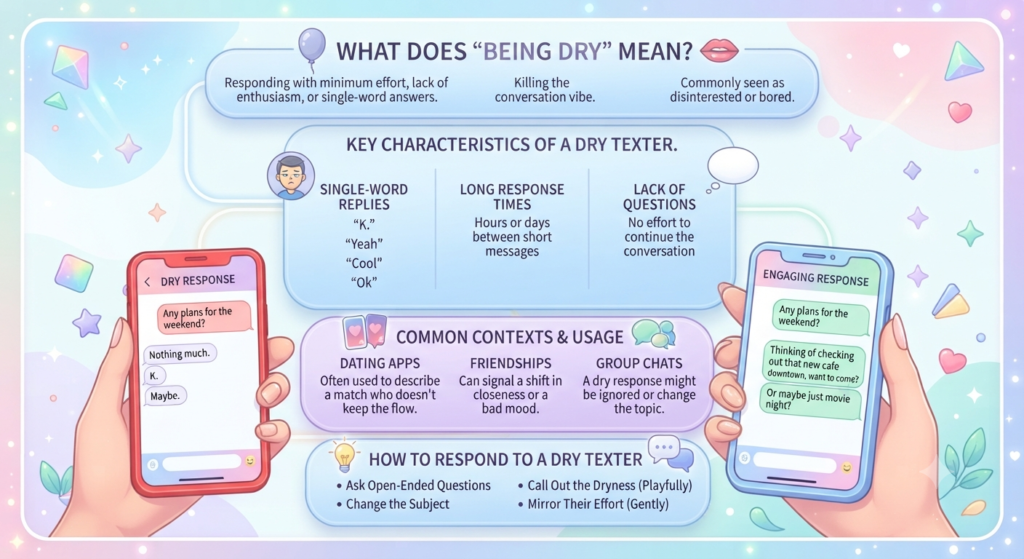
You send a message you thought was funny. You get back “lol ok.” Ten minutes later, you’re staring at your phone wondering if you did something wrong and then someone tells you, “honestly, you’re dry.” If you’ve landed here confused, you’re not alone. The dry meaning in text conversations has become one of the most common call-outs in modern messaging, and it trips people up because it isn’t really about the word “dry” at all. It’s about energy.
This guide breaks down exactly what it means in texting, where the phrase shows up, real conversation examples, and when it’s fine to use versus when it can come across as harsh. By the end, you’ll know how to spot dry texting, how to fix it, and how to respond if someone throws the label at you.
What Is the Meaning of “You’re Dry”?
In texting slang, “you’re dry” means your messages feel flat, short, or low-effort , like you’re not putting any energy into the conversation. It’s the dry texting meaning in a nutshell: one-word replies, no follow-up questions, no emojis, no enthusiasm.
Grammatically, “your dry” (with the possessive “your”) is incorrect, the correct phrase is “you’re dry,” short for “you are dry.” Both spellings get searched constantly, which is why you’ll see the term written both ways online, but only one is grammatically right.
At its core, calling someone dry means:
- Their replies are too short to carry the conversation (“k,” “lol,” “yeah”)
- They’re not asking questions back
- There’s no emotional tone; no excitement, no curiosity, no jokes
- The chat feels one-sided, like you’re doing all the work
Where did “dry” come from? The slang likely traces back to African American Vernacular English (AAVE), where “dry” described anything boring or lacking vibe; a dry party, a dry joke, a dry personality. As texting and social media took over daily communication, the word shifted to describe conversations themselves, and it stuck.
Where Is “You’re Dry” Commonly Used?
The phrase isn’t limited to one app. It shows up anywhere a conversation happens mostly through short written messages:
| Platform | How “dry” typically shows up |
| iMessage / WhatsApp | One-on-one chats where replies get shorter over time |
| Instagram DMs | Common among Gen Z and millennials calling out low-effort replies |
| TikTok comments & videos | “Signs you’re a dry texter” is a recurring content trend |
| Snapchat | Streaks that keep going but conversations that go nowhere |
| Discord / gaming chats | Flat reactions to jokes or plays (“dry” reaction to a good play) |
| Dating apps (Tinder, Hinge, Bumble) | A dry opener (“hey”) or dry replies often kill a match fast |
| X (Twitter) threads | Used as a quick clapback to a boring or low-energy reply |
Across all of these, the meaning barely changes. It’s always about a mismatch in energy between two people texting.
Examples of “You’re Dry” in Real Conversations
Seeing the phrase in context helps it make sense quicker than just looking up a definition.Here are some typical conversations you might come across:
Casual/friendly (teasing tone):
A: I just got the job!!
B: cool A: lol why are you so dry
Dating context (more serious signal):
A: What are you doing this weekend?
B: Nothing much
A: Any plans to do something fun?
B: Not really (A reads this as dry texting; low interest, no effort to keep things going)
Group chat callout:
A: guys we should plan the trip this week
B: k C: bro is being so dry rn 💀
Self-aware admission:
“Ngl I’m a dry texter, I do way better in person.”
Notice the pattern: it’s rarely about content, it’s about effort and momentum. A reply can be short and still not be “dry” if it’s paired with a question or some personality. “Nothing much, you?” reads completely differently than just “nothing.”
When to Use and When Not to Use “You’re Dry”
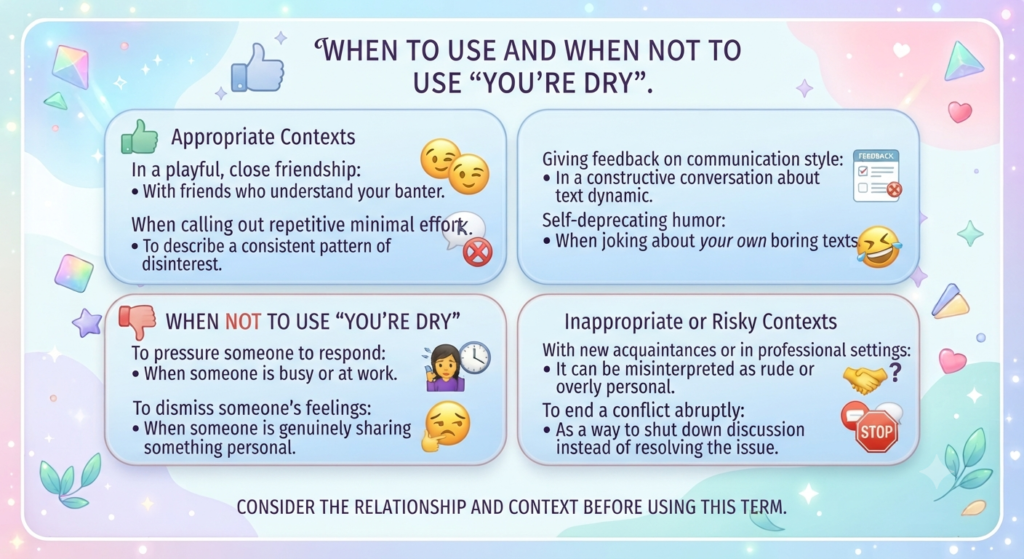
Like most slang, tone and relationship context decide whether “you’re dry” lands as playful or hurtful.
Good times to use it:
- Teasing a close friend who’s clearly just being lazy with replies
- People chatting in a group and making light jokes and funny comments
- Calling out a genuinely boring reply to something exciting, as a joke
Times to avoid it:
- During a serious or emotional conversation, calling someone dry mid-vent can feel dismissive
- With someone you don’t know well, since tone can easily be misread over text
- When someone is clearly busy, stressed, or going through something, short replies aren’t always about interest
- In professional or work messaging, where it reads as unprofessional
Quick gut check: if you’d feel comfortable saying it out loud, face-to-face, in that exact moment it’s probably fine to text. If it would sound harsh or dismissive in person, it’ll land the same way in a DM.
Similar Slang Words and Related Terms
“Dry” doesn’t exist in isolation; it’s part of a whole vocabulary around texting energy:
- Dry texter: someone who consistently gives short, low-effort replies as a pattern, not a one-off
- Cold reply: similar to dry, but often implies distance or annoyance rather than just low energy
- One-word answers: the literal behavior that gets someone labeled dry
- Left on read: no reply at all, a step beyond dry texting
- Dry humor: unrelated meaning: subtle, deadpan jokes that are actually funny, despite the flat delivery
- Bleeding someone dry: an idiom meaning to drain someone financially or emotionally, unrelated to texting
- Running someone dry: similar idiom, meaning to exhaust someone’s patience, energy, or resources
Knowing these helps you avoid mixing up texting slang with the older, unrelated idioms that also use the word “dry.”
FAQs
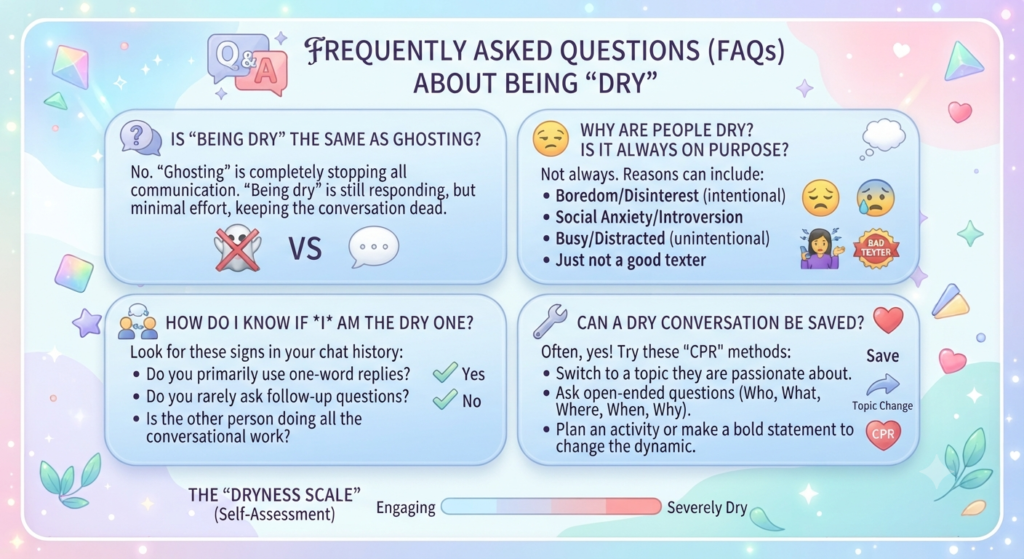
What does it mean if someone says you’re dry?
It means your replies feel boring, short, or low-effort like you’re not putting energy into the conversation. It’s usually about tone and engagement, not the actual words you’re using.
What does “dry” mean in slang?
In slang, “dry” describes anything lacking excitement, personality, or effort; a boring party, a flat joke, or an unengaging text conversation all count as “dry.”
What does dry mean in Gen Z slang?
For Gen Z, “dry” almost always refers to texting energy; short, unenthusiastic replies with no emojis, questions, or follow-up. It’s one of the most common call-outs in group chats and DMs.
What does “dry” mean in dating?
In dating, dry texting is often read as a red flag for low interest. Short, effortless replies with no questions back can signal someone isn’t invested, though it can also just mean they’re a better communicator in person than over text.
You’re being so dry meaning?
This is a direct call-out, usually said mid-conversation, telling someone their replies feel flat or boring compared to the energy being put in by the other person.
You’re bleeding me dry meaning?
This is an unrelated idiom meaning someone is draining you financially or emotionally over time. It has nothing to do with texting slang.
You’re dry meaning in Urdu?
There’s no direct slang equivalent in Urdu, but the closest translation of the concept would be describing someone as “بورنگ” (boring) or unenthusiastic in conversation, the texting-specific meaning of “dry” is an English-language internet slang term.
Dry meaning in chat?
In chat apps, “dry” describes messages or conversations that feel short, low-energy, and lacking in effort, the digital version of a flat, uninterested tone of voice.
You’re dry meaning TikTok?
On TikTok, “dry” is a popular trend topic, often used in videos listing “signs you’re a dry texter” or reacting to screenshots of boring conversations.
Dry slang meaning?
Broadly, “dry” as slang means boring, unenthusiastic, or lacking energy applicable to texting, personalities, jokes, or entire conversations.
Dry and wet meaning?
In slang, “dry” and “wet” are sometimes used as opposites for energy levels; “dry” being boring or flat, “wet” being an unrelated and separate slang term used in different contexts. They aren’t a standard pair in texting slang the way “dry” alone is.
Go dry meaning?
“Go dry” typically isn’t standard texting slang. In general English it usually refers to giving up alcohol or a well/source running out of water, not to messaging behavior.
You’re running me dry meaning?
This means someone or something is exhausting your energy, patience, or resources over time; an idiom about being worn down, separate from the texting slang use of “dry.”
Conclusion
At the end of the day, “you’re dry” is really just a modern way of saying a conversation has lost its spark. It’s rarely a permanent judgment, it’s a snapshot of one exchange, one mood, one moment when energy didn’t match. If you get called dry, don’t panic; try adding a question, a joke, or a bit more detail next time. If you’re the one calling someone dry, save it for friends who’ll take it as a joke, not a jab. Either way, now you know exactly what’s being said and how to keep your next chat from going flat.

1 thought on “You’re Dry Meaning: How It’s Used in Texts, Chats & DMs”