

You’ve probably typed “the task is complete” and then, two sentences later, written “we completed the task” without thinking twice. Both are correct, but knowing exactly why is where complete vs completed starts tripping people up. One describes a state; the other describes an action, and mixing them up can make even a well-written sentence feel slightly off.
This guide breaks down the grammar behind both words, when each one applies, and how to stop second-guessing yourself in emails, reports, and everyday writing.
Core Difference at a Glance
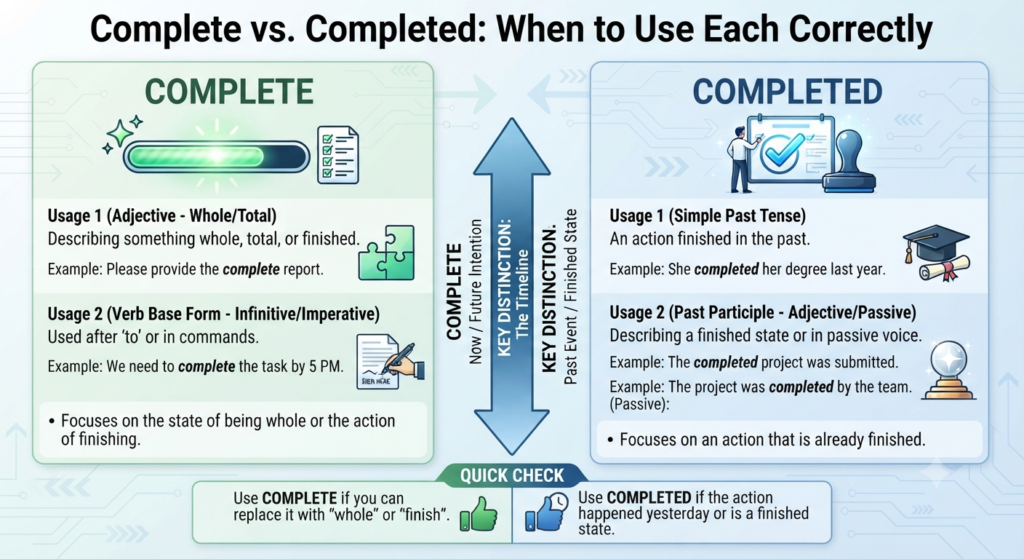
Here’s the direct answer: “Complete” describes a state; something whole, finished, or lacking nothing. Use “complete” for conditions (“the form is complete”) and “completed” for finished actions (“she completed the form”).
Understanding Complete: Base Word, Two Roles
“Complete” does double duty in English; it functions as both an adjective and a verb, and that dual role is exactly where a lot of the confusion starts.
Complete as an Adjective
As an adjective, complete describes a condition; something whole, entire, or with nothing missing. It typically follows linking verbs like “is,” “was,” “seems,” or “looks.”
- “The report is complete.”
- “Her collection of vintage records is complete.”
- “The kit comes complete with all necessary tools.”
Notice there’s no action happening in any of these sentences, each one is simply describing how something currently exists.
Complete as a Verb
As a verb, complete means to finish or bring something to its end, and it behaves like any regular verb, it changes form depending on tense.
- “I will complete the assignment tonight.” (future)
- “Please complete the form before submitting.” (command/present)
- “They complete the paperwork every Friday.” (habitual present)
Compare it with “”People Do” or “People Does”? The 3-Second Grammar Test“
Conjugation of the Verb “Complete”
| Tense | Form | Example |
| Base/Present | complete | “I complete my reports weekly.” |
| Third-person singular | completes | “She completes her workout every morning.” |
| Past | completed | “He completed the course last year.” |
| Present participle | completing | “They are completing the final review.” |
| Past participle | completed | “We have completed the audit.” |
This table matters because it shows exactly where “completed” comes from, it isn’t a separate word with its own grammar rules; it’s simply “complete” doing its job in past and perfect tenses.
Understanding Completed: The Finished-Action Form
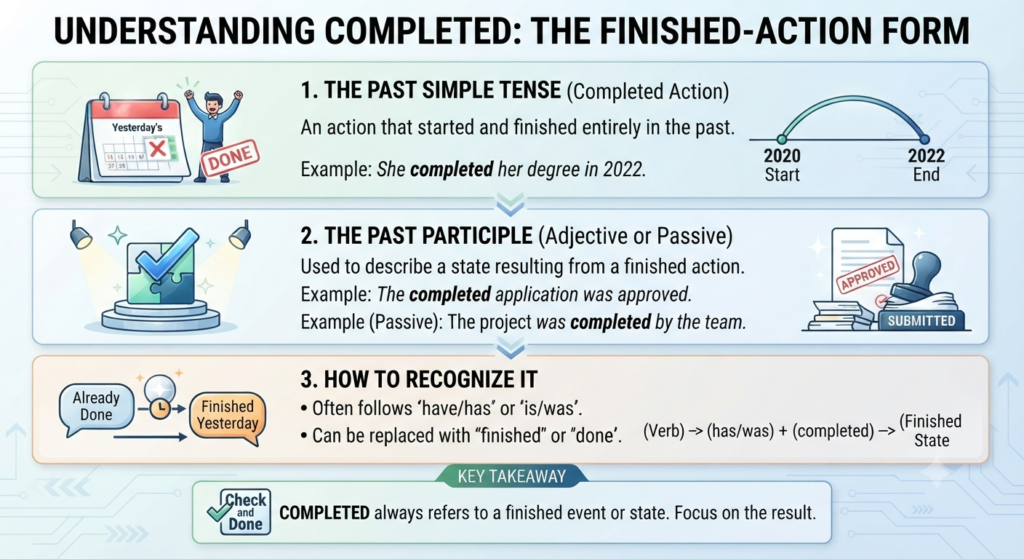
“Completed” usually means something has already been done, and it appears in two different ways in grammar.
Completed as a Verb Form
In its most common role, completed functions as a past-tense or past-participle verb, appearing in simple past, present perfect, and passive constructions.
- “She completed her degree in 2021.” (simple past)
- “They have completed the merger.” (present perfect)
- “The bridge was completed ahead of schedule.” (passive voice)
Each of these sentences reports on an action that someone or something carried out, the emphasis is on the doing, not just the end result.
Completed as an Adjective
Less commonly, “completed” also works as a participial adjective, sitting directly in front of a noun to describe something that went through a finishing process.
- “Please submit the completed form.”
- “The completed manuscript ran four hundred pages.”
- “Attach the completed application to your email.”
The distinction here is subtle but useful: “completed form” implies a process happened to that form, someone filled it in, while “complete form” simply says the form, as an object, is whole.
Here’s what it means “The “-ly” Suffix Explained: Meaning, Usage & Word List“
Complete vs. Completed: How Grammar Shapes Meaning
State vs. Action
The cleanest way to remember the difference: complete describes what something is; completed describes what someone did. “The report is complete” tells you about its current condition. “She completed the report” tells you about an event that occurred.
Tense-Based Usage Guide
- Present tense, describing a state: Complete (“The kitchen is complete.”)
- Present tense, describing an action/command: Complete (“Please complete the survey.”)
- Past tense, describing a finished action: Completed (“He completed the survey.”)
- Present perfect: Completed (“We have completed the survey.”)
- Passive voice: Completed (“The survey was completed by noon.”)
- Modifying a noun to show process: Completed (“The completed survey is attached.”)
Quick Decision Flowchart
Ask yourself these questions in order:
- Am I describing a current condition, with nothing missing? Use “complete.”
- Am I giving a command or describing a habitual/future action? Use “complete.”
- Am I describing an action that already happened? Use “completed.”
- Am I modifying a noun to show it went through a finishing process? Use “completed.”
Complete vs. Finished: Why They Aren’t the Same
“Complete” and “finished” often get treated as interchangeable, but they carry slightly different implications. Something complete has all its parts, nothing is missing. Something finished has reached its end, often implying a process has stopped, regardless of whether every piece is technically accounted for.
A recipe list can be “complete” (every ingredient is listed) without the dish itself being “finished” (cooked and ready to eat). The difference between the two words is more important in technical or careful writing than in everyday talk, where they are used together without much difference.
Real-World Usage in Key Fields
Business and Professional Writing
- “The quarterly report is complete and ready for review.”
- “We have completed the client onboarding process.”
- “Please find the completed contract attached.”
Status updates tend to favor “complete” for brevity, while narrative updates about what a team accomplished lean on “completed.”
Is It “Appreciative Of” or “Appreciative For”? Most People Mix This Up
Education and Academic Writing
- “Her thesis is complete after two years of research.”
- “Students completed the exam within the allotted time.”
- “The completed assignment is due Friday.”
Everyday Conversation
- “Dinner is complete; everyone can sit down.”
- “I completed my workout an hour ago.”
- “Mission complete!”
Examples from Literature, Media, and Real Usage
Published writing tends to favor “complete” for its lighter, more natural feel in descriptive sentences, while “completed” carries more formal weight in reporting or passive constructions:
- “The collection felt complete for the first time in years.” (descriptive, literary tone)
- “The investigation was completed within six months.” (formal, reportorial tone)
- “Once completed, the building became the tallest structure in the city.” (process-focused narrative)
Common Errors and How to Avoid Them
- Using “complete” where past tense is required:
❌ “I complete the project yesterday.”
✅ “I completed the project yesterday.”
- Adding an unnecessary adverb:
❌ “The process was completed completely.”
✅ “The process was completed.”
- Using “completed” after “is” when a state is meant:
❌ “The puzzle is completed.” (technically understood, but “complete” is simpler and more natural)
✅ “The puzzle is complete.”
- Mixing forms within the same sentence unnecessarily: Keep consistent tense and role throughout a sentence unless you’re intentionally contrasting a state and an action.
Practical Exercises
Fill in each blank with “complete” or “completed”:
- The project ______ last week. (completed)
- The report is ______. (complete)
- Please ______ your homework before dinner. (complete)
- She has ______ her certification. (completed)
- Once ______, please sign the form below. (completed)
Case Study: Project Launch Scenario
A product manager sends this update to stakeholders: “I’m happy to report that the development phase is now complete. All features were completed ahead of schedule, and the completed build has been sent to QA for final testing.” Notice how all three forms coexist naturally in one message,”complete” describes the current state of the phase, “completed” reports the finished action, and “completed build” modifies the noun to show it went through the development process.
Read the full grammar rule on Purdue OWL
FAQs
Complete vs completed; what’s the grammar rule?
“Complete” functions as an adjective (describing a state) or a present-tense verb, while “completed” is the past tense and past participle form, used for finished actions, perfect tenses, and passive constructions.
Can you give examples of complete vs completed?
“The form is complete” describes a current condition; “She completed the form yesterday” describes a past action; both are correct, just grammatically different.
Is it “the task/project is complete” or “is completed”?
“The task is complete” is the more natural, commonly preferred phrasing for describing a state, though “the task is completed” is also grammatically acceptable and slightly more formal.
Should I say “once it is complete” or “once it is completed”?
Both are used, but “once completed” is more common in formal or procedural writing, since it emphasizes the finishing action rather than just the resulting state.
What does “to be complete” actually mean?
“To be complete” means to have all necessary parts, with nothing missing, it describes wholeness or fullness, not necessarily that a process has occurred.
What’s the difference between “completed” and “done”?
“Completed” is more formal and often implies a structured process was finished, while “done” is casual and broadly means an activity has ended, regardless of formality.
Should I write “was completed” or “is completed”?
“Was completed” places the action in the past (“the audit was completed last month”), while “is completed” describes a present-tense passive state, “complete” is usually the more natural choice when simply describing current status.
Is “completed” ever wrong to use as an adjective?
No, but it’s less common than using “complete” in that role; “the completed form” is correct and implies a process, while “the complete form” simply says the form is whole.
Conclusion
The difference between complete and completed comes down to a simple test: are you describing what something is, or what someone did? “Complete” handles states, conditions, and commands. “Completed” handles finished actions, perfect tenses, and process-driven descriptions. Run your sentence through that test once, and choosing correctly becomes automatic rather than a guessing game.
