

You’re halfway through an email, “if anyone has questions” or “if anyone has questions,” and suddenly you’re not sure which one is right. “Anyone has vs. anyone has” is one of those grammar points that trips up native speakers just as often as English learners, because the “correct” answer actually shifts depending on the sentence around it.
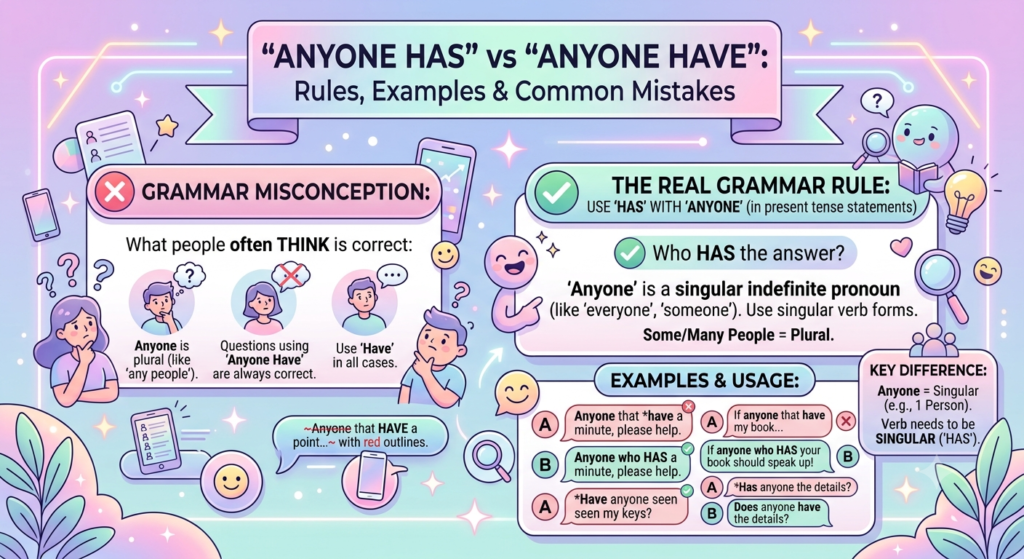
Here’s the short version before we get into why: in a plain statement, you say, “Anyone has.” In a question built with “does,” you say “anyone have.” That single distinction resolves most of the confusion, but there are enough exceptions and edge cases that it’s worth walking through properly, which is exactly what this guide does.
Why “Anyone Has vs. Anyone Have” Confuses So Many People
The confusion isn’t really about grammar rules; it’s about how the word “anyone” feels. It refers to a vague, possibly large group of people, so our brains want to treat it as plural. “Anyone” sounds like it could mean dozens of people, so “have” feels like the natural match.
Grammatically, though, “anyone” is singular. It’s built from “any” + “one,” and that “one” is doing real work; it’s why the rulebook insists on “has,” not “have,” in ordinary statements. Spoken English muddies this further, because in fast conversation, people drop helper words and blur has/have” together until neither sounds wrong.
The Core Rule Behind Anyone Has vs. Anyone Have
Quick answer: Use “anyone has” in statements, because “anyone” is a singular indefinite pronoun. Use “anyone have” only when it follows an auxiliary verb like “does,” “did,” or “if” in certain constructions; the auxiliary carries the tense, so the main verb reverts to its base form.
That’s the entire rule in one paragraph. Everything below is about applying it correctly in the situations where it gets tricky.
Find out more: “There Is No or There Are No? How to Choose the Right One.”
Understanding “Anyone Has” (The Default Form)
“Anyone has” is your default. Use it any time “anyone” is the subject of a plain declarative sentence; no “does,” no “did,” no inversion.
- Anyone has the right to disagree.
- Anyone has access to the shared drive.
- Anyone has a reason to double-check their work.
Notice the pattern: these are all statements, not questions. If you can read the sentence aloud and it isn’t asking anything, “has” is almost certainly what belongs there.
When “Anyone Have” Is Actually Correct
“Anyone have” isn’t a mistake by default; it’s correct in specific structures, mainly:
- Questions with “does”: “Does anyone have a pen?” Here, “does” carries the singular agreement, so “have” stays in its base form.
- Negatives with “doesn’t”: “Anyone doesn’t have permission without approval,” same logic, the auxiliary does the agreement work.
- Certain conditional or subjunctive-leaning sentences: “If anyone has objections, speak now” appears in older or more formal writing, though “if anyone has objections” is far more common in modern English and safer to use.
- Elliptical spoken questions: “Anyone have a charger?” drops the “does” entirely. It’s common in speech and casual writing, but the fully correct written form is “Does anyone have a charger?”
The pattern across all four: whenever an auxiliary verb (stated or implied) is doing the agreement job, “have” is what follows “anyone,” not “has.”
Subject–Verb Agreement Made Simple
If you only remember one trick, make it this one: replace “anyone” with “he” or “she” and see which verb sounds natural.
- “He has the right to vote.” ✅ so
- “Anyone has the right to vote.” ✅
- “He has the right to vote.” ❌ So
- “Anyone have the right to vote” ❌ (outside of question/auxiliary structures)
Because “anyone,” “everyone,” “someone,” and “nobody” are all indefinite pronouns that behave as singular, this same substitution test works across the whole family of words, not just “anyone.”
Similar term explained here: “‘Work in Process’ vs ‘Work in Progress’: Usage, Meaning & Examples“
Common Mistakes You Should Avoid
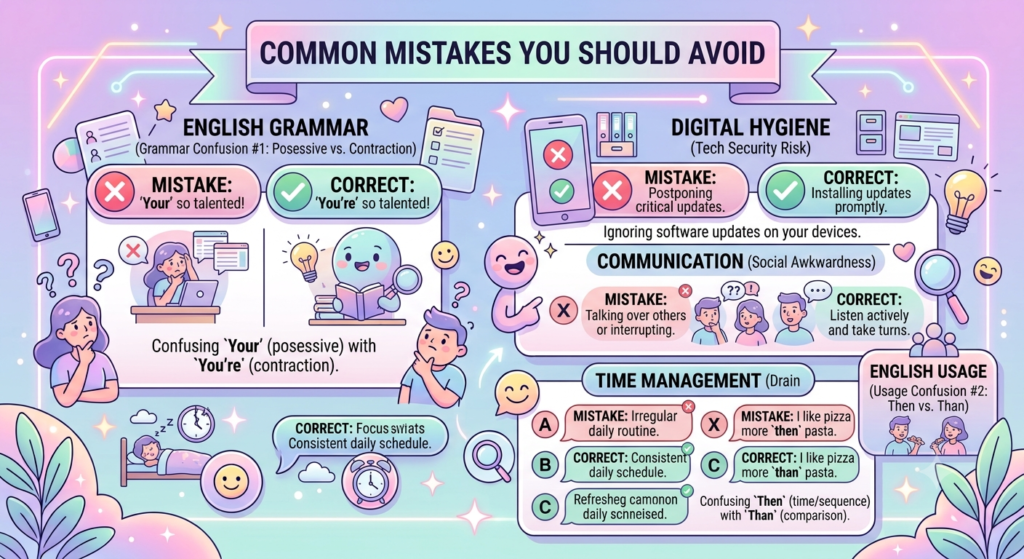
- ❌ Anyone has responsibilities. ✅ Anyone has responsibilities.
- ❌ Does anyone have the answer? ✅ Does anyone have the answer?
- ❌ Has anyone finished the report? ✅ Has anyone finished the report?
- ❌ If anyone has concerns, let me know. ✅ If anyone has concerns, let me know. (Safer and more standard than the older “have” variant.)
The second mistake, “does anyone have,” is arguably the more common one in writing, because people correctly sense that “anyone” wants “has,” then mistakenly carry that instinct into a sentence where “does” has already claimed the agreement role.
Spoken English vs. Written English
Spoken English is genuinely more forgiving here. “Anyone have a minute?” sounds completely normal at work, in a classroom, or among friends; English speakers drop the “does” constantly because context fills in the gap.
Written English, especially formal writing, doesn’t offer that same flexibility. Emails, reports, essays, and professional documents expect the fuller, grammatically complete form: “Does anyone have a minute?” If you’re writing something that needs to read as polished, default to writing out the auxiliary rather than trusting the shortcut.
Regional and Style Variations
There’s no major regional split on the core rule; American and British English both follow the same “has” for statements and the “have” for auxiliary-led questions pattern. Where style does shift slightly:
- British English leans toward “anyone” over “anybody” in both speech and formal writing.
- American English uses “anyone” and “anybody” fairly interchangeably, with “anybody” reading as marginally more casual.
- Academic and legal writing, regardless of country, sticks rigidly to “has” in statements and treats “anyone have” (without an auxiliary) as an error worth flagging in an edit.
Read the full grammar rule on Purdue OWL
Context Changes Everything
The same two words can be correct or incorrect depending purely on what surrounds them. “Anyone have” is wrong on its own as a flat statement but instantly correct the moment “does” or “did” enters the sentence. This is why memorizing a single fixed phrase (“always use has”) actually causes more mistakes than learning the underlying structure; the rule depends on sentence type, not on the words “anyone has” or “anyone have” in isolation.
Anybody Has vs. Anybody Have
“Anybody” follows the identical rule set as “anyone”; it’s just as singular, and the has/have logic transfers directly:
- Anybody has a copy of the agenda. ✅
- Does anybody have a copy of the agenda? ✅
- Anybody have a copy of the agenda? (informal, spoken), fine in casual speech, not in formal writing.
The only real difference between “anyone” and “anybody” is tone: “anybody” reads slightly more conversational, while “anyone” feels a touch more formal or neutral. Neither word changes the grammar rule itself.
Real-Life Examples You’ll Actually Use
| Sentence Type | Correct Form | Example |
| Statement | has | Anyone has the ability to improve with practice. |
| Question with “does” | have | Does anyone have the meeting notes? |
| Negative with “doesn’t” | have | Anyone doesn’t have the authority to approve this alone. |
| Conditional (modern, preferred) | has | If anyone has questions, raise your hand. |
| Perfect tense question | have (after “has”) | Has anyone—incorrect; correct: Has anyone finished? |
| Casual spoken question | have | Anyone have a spare charger? |
Quick Fix Guide for Instant Clarity
Stuck mid-sentence? Run through this in order:
- Is there a “does,” “did,” or “doesn’t” already in the sentence? Use have.
- Is it a plain statement with no auxiliary verb? Use has.
- Is it a modern conditional starting with “if”? Use “has” (safer and more standard than the older “have” form).
- Still unsure? Swap “anyone” for “he” or “she” and trust whichever verb sounds natural.
Practice Section: Test Yourself
Try filling in the blank before checking the answer:
- ______ anyone have a suggestion for dinner? (Does)
- Anyone ______ the right to ask questions. (has)
- If anyone is concerned, email me directly. (has)
- ______ anyone have your number? (Does)
- Anyone ______ finished the assignment yet? (“Has—”Has anyone finished?”)
If you got four or five right, you’ve already internalized the rule better than most native speakers do on the first try.
Case Study: Real Writing Improvement
A hiring manager once reviewed two versions of the same internal memo. The first read: “Anyone with concerns about the new schedule should reach out.” The second read: “Anyone with concerns about the new schedule should reach out.” Neither used “has”; but the fix wasn’t about has/have at all; it exposed a deeper habit of leaning on shaky grammar instead of restructuring the sentence cleanly. Once the writer learned the underlying has/have rule, similar sentences across the memo (and later documents) stopped needing a second pass entirely.
Expert Insight
Editors who review formal writing for a living tend to flag “anyone have” far more often than “anyone has,” not because “have” is always wrong, but because writers use it reflexively in statements where “has” belongs. The fix isn’t memorizing more examples; it’s pausing to ask whether an auxiliary verb is already present in the sentence. That one habit resolves the vast majority of has/have errors on its own.
Is It “Friendlier” or “More Friendly”? Grammar Rule + Examples
FAQs
Anyone has, or anyone has, which is correct?
Both can be correct depending on the sentence: use “anyone has” in plain statements, and “anyone have” only after an auxiliary verb like “does” or “did.”
Does anyone have it, or does anybody have it?
Both are grammatically correct; “anyone” and “anybody” are interchangeable in this structure, with “anybody” sounding slightly more casual.
Someone has or someone has?
The same rule applies: “someone has” in statements (“Someone has the keys”), and “have” only after an auxiliary verb (“Does someone have the keys?”).
If anyone has or anyone has?
Modern English strongly prefers “if anyone has” (“If anyone has questions, ask now”); “if anyone have” is an older, more formal construction that’s largely fallen out of everyday use.
Did anyone have or have?
“Did anyone have” is correct; “did” is the auxiliary carrying the past tense, so the main verb drops to its base form, “have.”
What does “anyone has or anyone has” mean in grammar terms?
It refers to subject-verb agreement with the singular indefinite pronoun “anyone,” where the correct verb form depends on whether the sentence is a statement or a question built with an auxiliary verb.
Can I use “anyone have” in casual messaging apps, or should I stick to “anyone has”?
In texts, Slack, or group chats, “anyone have” is widely used and understood. “Anyone have the link?” reads as completely normal shorthand. It’s still worth defaulting to “anyone has” in statements even in casual settings, since the shortcut only really applies to dropped-auxiliary questions, not plain declarative sentences.
What’s the rule for “anyone” with singular or plural verbs?
“Anyone” is always grammatically singular, even though it refers to an unspecified person from a potentially large group. That’s why it pairs with singular verb forms like “has,” “is,” and “was,” never with plural forms like “have” or “are” in a standalone statement.
What is the correct usage of “anyone has” versus “anyone have” in professional emails?
Professional emails should use “anyone has” in statements (“If anyone has feedback, please reply”) and the full “does anyone have” in questions (“Does anyone have the updated file?”). Dropping the “does,” as in “Anyone have the file?” reads as too casual for most workplace correspondence.
Examples of Sentences Where “Anyone Has” Is Correct
- Anyone has the option to opt out at any time.
- Anyone has a fair shot at winning the contest.
- Anyone has the ability to request a refund within 30 days.
- Anyone has access to the training materials once they’re hired.
- If anyone has trouble logging in, contact IT support.
- Anyone has the right to appeal the decision.
Each of these is a plain statement with no auxiliary verb in play, which is exactly the condition where “has” is the only grammatically correct choice.
Conclusion
The has/have confusion around “anyone” isn’t really about memorizing two fixed phrases; it’s about noticing whether an auxiliary verb is already doing the agreement work in your sentence. Statements take “has.” Questions and negatives built with “does,” “did,” or “doesn’t” take “have.” Once that distinction clicks, you’ll stop second-guessing yourself mid-sentence, and the “he or she” substitution trick will catch anything that still feels uncertain.
