

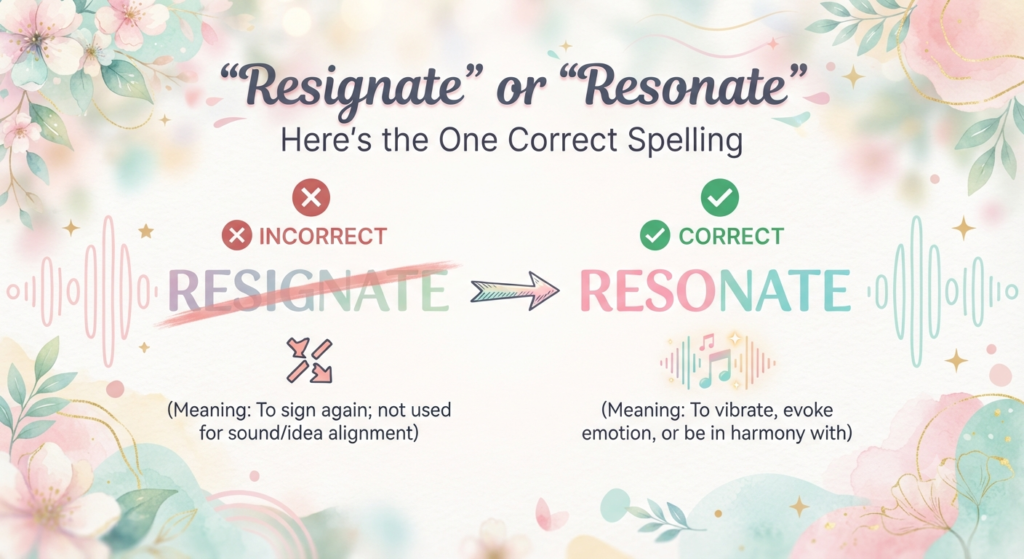
You’ve typed it, deleted it, and typed it again: “resignate” or “resonate”, which one is actually right? Here’s the direct answer before anything else: only “resonate” is a real English word. The word “resignate” isn’t found in any major dictionary, even though it might sound natural when used in a sentence.
This guide covers why the mix-up happens so often, what “resonate” actually means, where it came from, and how to use it with total confidence going forward.
Resignate or Resonate: Why This Mix-Up Happens Everywhere
This isn’t a rare typo; it’s one of the more common spelling errors in modern writing, showing up in emails, social captions, and even published articles. The two words sound nearly identical when spoken aloud, and that phonetic overlap is doing most of the damage.
There’s also a structural trap at play. English is full of legitimate words ending in “-inate”, designate, originate, relegate — and it’s easy to unconsciously apply that same pattern to a word that doesn’t actually follow it.
The Core Mix-Up: What People Think They’re Saying vs. What They Actually Say
When someone says a song or a story “resignates” with them, what they mean is that it strikes a chord, creates a feeling of connection, or leaves a lasting impression. That meaning belongs entirely to “resonate.” “Resignate” isn’t a milder or alternate version of that idea, it’s simply not a word with any definition attached to it.
Why People Keep Using “Resignate” (Even Though It Isn’t a Real Word)
A few forces reinforce the error:
- Phonetic similarity: “resonate” and “resignate” sound almost the same in casual speech.
- Pattern-matching to “-inate” words: Designate, originate, and relegate all follow a similar rhythm.
- Accidental blending with “resign”: The visual and audible overlap with “resign” nudges people toward the incorrect spelling.
- Repetition in casual writing: Once an error appears often enough in social media or informal text, it starts to look “normal,” even though it never became a recognized word.
- Autocorrect gaps: Some spell-checkers don’t reliably flag it, letting it slip through unnoticed.
Not sure? see “Is It “Friendlier” or “More Friendly”? Grammar Rule + Examples“
Is “Resignate” a Real Word? The Unfiltered Answer
No, “resignate” is not a recognized English word. It doesn’t appear in Merriam-Webster, Oxford, Cambridge, Collins, or any other major dictionary. It has no dictionary definition, no historical usage, and no legitimate grammatical role. It’s best understood as a persistent misspelling of “resonate,” not a valid alternative or informal variant.
The Correct Word: What “Resonate” Actually Means
Resonate is a verb with both a literal and a figurative meaning:
- Literal (sound-based): to produce or be filled with a deep, reverberating sound, “The bass resonated through the concert hall.”
- Figurative (emotional/intellectual): to evoke a strong feeling of connection, agreement, or lasting impact, “Her speech resonated with the entire audience.”
The figurative sense is the one people reach for most often in everyday writing, describing an idea, story, or piece of art that genuinely connects with someone on a personal level.
What Dictionaries and Style Guides Say About “Resonate”
Major dictionaries are consistent and specific in how they define the word:
- Merriam-Webster describes it as producing a deep, reverberating sound, relating harmoniously, or producing a lasting effect.
- Oxford defines it as having particular meaning or importance for someone, or affecting them in a personal or emotional way.
- Cambridge describes it as causing someone to think of something similar, or having an emotional effect on them.
None of these same sources list “resignate” in any form, not as a variant spelling, not as informal usage, not even as an entry flagged “non-standard.” It simply isn’t there.
See the full breakdown “What Happen or What Happened: Meaning, Grammar & Examples“
Etymology: How “Resonate” Evolved from Latin to Today
“Resonate” traces back to the Latin verb resonare, built from re- (“again”) and sonare (“to sound”); literally, “to sound again” or “to echo.” That root meaning carried directly into Middle English, where “resonate” described physical sound and reverberation.
Over time, English speakers extended the word metaphorically, applying the same idea of an “echo” to emotional and intellectual experiences an idea that “resonates” with someone is one that echoes inside them long after they first encounter it. “Resignate,” by contrast, has no such lineage. It didn’t evolve from Latin, Old English, or any documented linguistic path, it’s a modern error, not an aged variant.
Resonate vs Resignate: Key Differences at a Glance
| Feature | Resonate | Resignate |
| Dictionary status | Recognized in all major dictionaries | Not recognized anywhere |
| Meaning | To echo, reverberate, or evoke strong emotional connection | No meaning, not a word |
| Origin | Latin resonare, Middle English | No linguistic origin |
| Correct usage | Formal and informal writing, speech | None, always an error |
| Common cause | N/A | Phonetic mix-up with “resonate,” pattern-matching to “-inate” words |
The table makes it simple: whenever you’re unsure, “resonate” is always the safe, correct choice, there’s no context where “resignate” is acceptable.
How to Use “Resonate” Correctly in Everyday Life
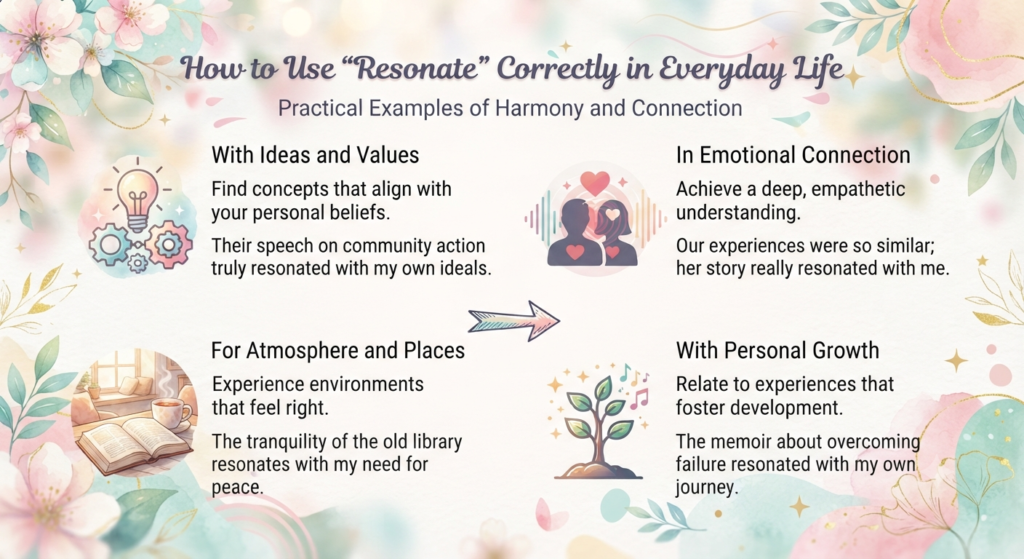
“Resonate” works cleanly across registers, from casual conversation to professional writing:
- “That song really resonates with me every time I hear it.”
- “Her message resonated with employees through each department.”
- “The theme of the novel resonates with anyone who’s experienced loss.”
- “His voice resonated through the auditorium during his speech.”
- “This idea resonates with our brand’s prime values.”
Notice the pattern: “resonate” is almost always followed by “with” when describing an emotional connection, “resonates with me,” “resonates with the audience,” “resonates with readers.”
Writing Messages That Truly Resonate
Beyond spelling it correctly, there’s a craft to writing content that actually resonates with an audience:
- Be specific, not generic: Vague statements rarely create the “echo” that resonance depends on.
- Tap into shared experience: Messages land harder when readers recognize themselves in them.
- Use concrete details: Specificity makes ideas memorable, which is part of what makes them resonate.
- Keep emotional honesty at the center: Audiences notice when a message feels manufactured rather than genuine.
Complete vs Completed: When to Use Each Correctly
Communication Tips to Make Your Messages Resonate
- Lead with the emotional core of your point before the supporting details.
- Avoid overused phrases that dilute impact, resonance depends on originality, not repetition.
- Match tone to audience; a message that resonates with one group may fall flat with another.
- Read your writing aloud, if it doesn’t create any reaction in your own ear, it likely won’t in someone else’s.
Practice: Exercises to Master “Resonate”
- Write three sentences using “resonate”, one literal (sound-based), two figurative (emotional).
- Rewrite this incorrect sentence correctly: “Her story really resignated with the whole room.”
- Describe a moment, song, or story that genuinely resonated with you, and explain why in two or three sentences.
- Say both words aloud, “resonate” and “resignate” and notice which one you’ve been defaulting to in casual speech.
Repetition like this is what turns “resonate” into your automatic, reflexive choice.
Read the full grammar rule on Purdue OWL
FAQs
What does “resignate or resonate” actually mean?
Only “resonate” carries a real meaning; to echo, reverberate, or evoke a strong emotional connection. “Resignate” has no meaning because it isn’t a recognized word.
What’s a good synonym for “resonate”?
Common synonyms include “strike a chord,” “connect with,” “reverberate,” and “resound,” depending on whether you’re describing sound or emotional impact.
What does “resignate” mean?
“Resignate” doesn’t mean anything on its own, it’s a common misspelling of “resonate,” not a separate word with its own definition.
Can you give examples of “resonate” used correctly?
Yes, “This message really resonates with our audience” and “The cello’s tone resonated throughout the room” both use the word correctly, in figurative and literal senses.
Is “resignate” a real word?
No. It doesn’t appear in Merriam-Webster, Oxford, Cambridge, or any other major dictionary, and it has no accepted definition.
How do you define “resonate”?
To resonate is to produce a deep, reverberating sound, or, figuratively, to evoke strong emotional or personal connection in someone.
What does “resonates with me” or “resonates with someone” mean?
It means something; an idea, story, or piece of media, creates a strong sense of personal connection or recognition, as if it echoes the listener’s own experience or feelings.
Why do people accidentally type “resignate” instead of “resonate”?
The two words sound alike when spoken, and “resignate” resembles the pattern of legitimate “-inate” words like “designate” or “originate,” which makes the error easy to make without noticing.
Conclusion
The debate over “resignate or resonate” really has a simple resolution: “resonate” is the only correct word, and “resignate” carries no dictionary meaning at all, no matter how often it turns up in casual writing. Whenever you’re describing something that connects emotionally, echoes personally, or leaves a lasting impression, “resonate” is the word doing that work. Make it your reflexive choice, and the mix-up disappears for good.
