

You’re writing an email, and you type “there is no options available.” Something feels off, so you change it to “there are no options available.” Which one was actually right? The there is no vs there are no question comes down to a single grammar principle, subject-verb agreement but the exceptions and tricky cases are where most people, including native speakers, slip up.
This guide breaks down exactly when to use each phrase, walks through the trickiest edge cases (uncountable nouns, collective nouns, percentages), and clears up why you constantly hear “there’s no rules” in casual speech even though it technically breaks the rule.
What “There Is No” and “There Are No” Actually Mean
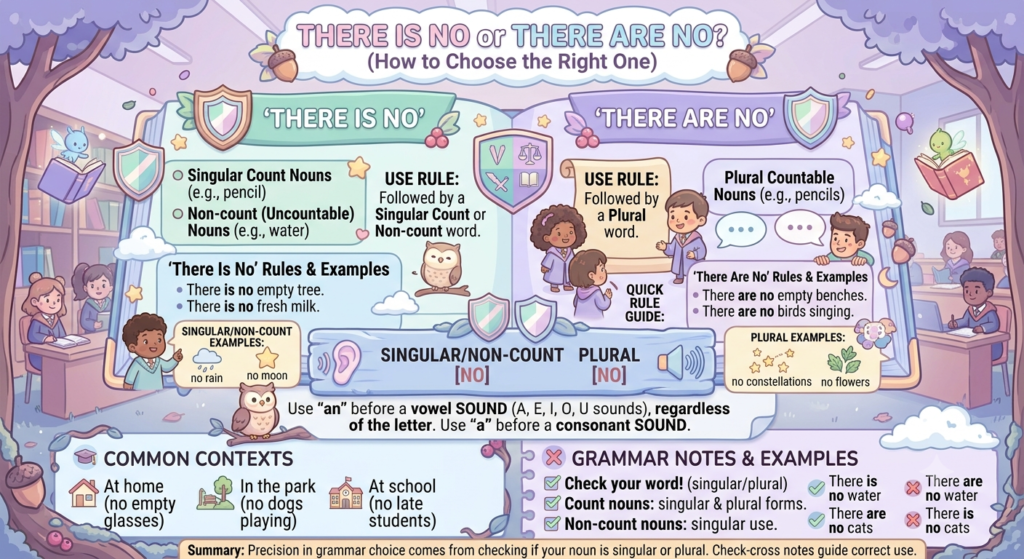
Both phrases exist to say that something doesn’t exist or isn’t present — the difference is entirely about whether the noun that follows is singular/uncountable or plural. This is a classic case of subject-verb agreement, where the verb (“is” or “are”) must match the noun that comes after “no,” even though that noun looks like it comes after the verb in the sentence.
- There is no + singular or uncountable noun
- There are no + plural noun
That’s the entire rule in one line. Everything else in this article is just applying it to trickier real-world cases.
Using “There Is No” Correctly
Use “there is no” when the noun following it is singular or uncountable. The verb “is” agrees with a singular subject, so this only works when what you’re describing can’t be counted as multiple separate units.
- There is no reason to worry.
- There is no time left.
- There is no doubt about it.
- There is no way to fix this tonight.
With Uncountable (Mass) Nouns
Uncountable nouns; things like water, money, information, advice, or furniture don’t have a plural form, so they always pair with “is,” never “are.”
- There is no money left in the budget.
- There is no information available yet.
- There is no furniture in the new apartment.
- There is no water in the tank.
This is exactly the pattern behind the common ESL confusion “there is no money or there are no money”, the correct form is always “there is no money,” because money is uncountable.
With Infinitives and Gerunds
When “no” is followed by a verb form acting as a noun, an infinitive or gerund, it’s still treated as singular, so “is” is correct.
- There is no denying the results.
- There is no escaping the deadline.
- There is no point in arguing.
Using “There Are No” Correctly
Use “there are no” when the noun following it is plural, meaning it can be counted and there’s more than one potential unit.
- There are no seats left.
- There are no easy answers here.
- There are no mistakes in this report.
- There are no rules against it.
This is the pattern behind “there is no reason or there are no reasons”; both are grammatically correct, but they mean slightly different things. “There is no reason” treats the concept as a single abstract idea, while “there are no reasons” emphasizes the absence of multiple individual justifications.
Common Errors and How to Fix Them
Error: Treating Uncountable Nouns As Plural
The most frequent mistake is pairing “are” with a mass noun because it sounds like it should be plural.
- Incorrect: There are no equipment in the gym.
- Correct: There is no equipment in the gym.
Equipment, like furniture, information, and advice, has no plural form in standard English, so it always takes “is.”
Error: Confusion with Collective Nouns
Collective nouns; team, staff, family, committee, describe a group but are grammatically singular in most contexts, which throws people off.
- Incorrect: There are no staff available today.
- Correct: There is no staff available today.
Staff, like team and committee, is usually treated as a single unit unless you’re specifically emphasizing the individual members within it.
Tricky Cases Most Learners Struggle With
Collective Nouns That Shift Meaning
Some collective nouns can go either way depending on whether you’re emphasizing the group as one unit or the individuals within it:
- There is no team ready to take this on. (the team as a single entity)
- There are no players ready for the match. (individual people within the group)
Mass Nouns Used in a Countable Way
Certain nouns are normally uncountable but shift to countable when referring to types or categories.
- There is no coffee left. (the substance itself)
- There are no coffees on the menu I like. (referring to different types/varieties)
Quantified Expressions
Once you add a specific quantifier, the noun’s countability can change the required verb.
- There is no amount of money that would convince me.
- There are no amounts left unaccounted for.
Fractions, Percentages, and Numbers
Percentages and fractions are especially tricky because the verb depends on the noun that follows the number, not the number itself.
- There is no 50 percent discount available. (discount is singular)
- There are no percentages showing improvement. (percentages is plural)
Real-World Comparison Examples
| Sentence Type | Correct Form | Example |
| Uncountable noun | There is no | There is no water left. |
| Singular countable noun | There is no | There is no answer yet. |
| Plural countable noun | There are no | There are no answers yet. |
| Collective noun (as one unit) | There is no | There is no committee formed yet. |
| Collective noun (as individuals) | There are no | There are no committee members present. |
| Gerund/infinitive phrase | There is no | There is no turning back now. |
Modern Speech Trends: Why People Say “There’s No Rules”
If you’ve noticed phrases like “there’s no rules” or “there’s no excuses” showing up constantly in casual speech, social media, and even song lyrics, you’re not imagining it. This is a well-documented trend in spoken English where “there’s” (a contraction of “there is”) gets used as a catch-all before both singular and plural nouns, regardless of strict agreement rules.
Linguists refer to this as a natural simplification pattern, contractions tend to resist the full agreement rules that their expanded forms follow, especially in fast, informal speech. It’s extremely common and rarely judged harshly in conversation, but formal writing, academic papers, and professional documents still expect the full “there are no” before plural nouns.
Pro Tips to Never Forget the Rule
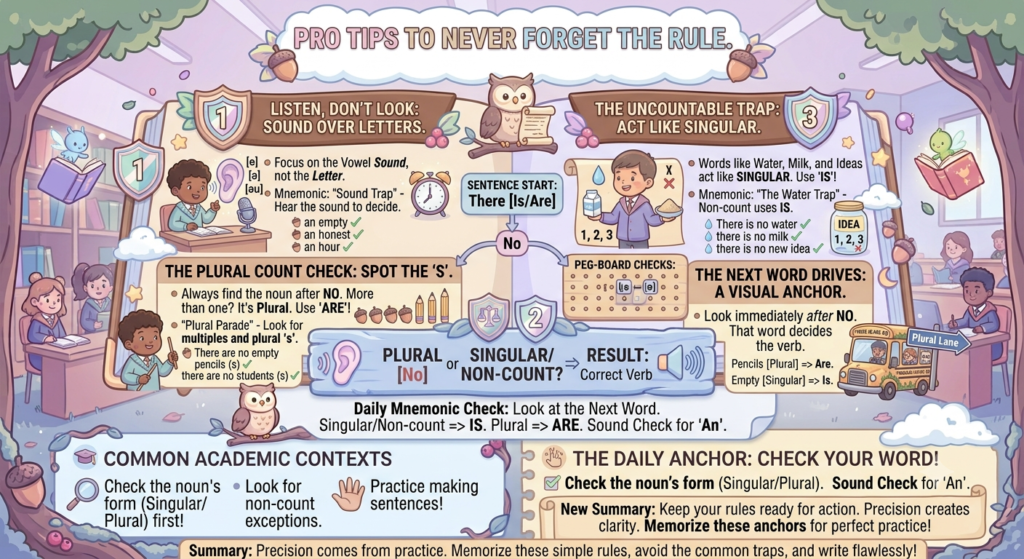
- Find the real noun first. Always look at the noun immediately following “no,” not the word “there,” since that noun determines whether you need “is” or “are.”
- Ask: can I count it? If you can say “one, two, three” of it, it’s plural and countable, use “are.” If not, use “is.”
- Watch for disguised plurals. Words like “information,” “advice,” “furniture,” and “equipment” sound like they should take “are,” but they’re always uncountable.
- Say it out loud. Reading the sentence aloud often exposes an awkward mismatch your eyes might skip over.
- When unsure, simplify. Swap a tricky noun for a word you’re certain about (like “cats” for plural or “water” for uncountable) to double-check which form fits.
FAQs
There is no vs there are no; what’s the meaning difference?
“There is no” pairs with singular or uncountable nouns, while “there are no” pairs with plural nouns. Both express absence, but the verb form must match the noun that follows.
There is no vs there are no; can you give sentence examples?
Sure: “There is no time to waste” (singular/uncountable) and “There are no tickets left” (plural). The noun right after “no” decides which verb form is correct.
What’s the general grammar rule for there is no vs there are no?
Use “is” with singular and uncountable nouns, and “are” with plural nouns, this is standard subject-verb agreement applied to existential sentences starting with “there.”
Are there exercises to practice there is no vs there are no?
Yes, a simple practice method is writing ten sentences with random nouns (some singular, some plural, some uncountable) and testing yourself on which verb form fits each one before checking the answer.
Is “there’s no” acceptable before a plural noun?
In casual speech, “there’s no” is commonly used before plural nouns (“there’s no rules”), but it’s considered grammatically incorrect in formal writing, where “there are no” is required.
Is it “there is no way” or “there are no ways”?
Both are correct depending on the meaning: “there is no way” refers to the concept as a single abstract idea, while “there are no ways” emphasizes multiple specific methods or options.
Is it “there is no need” or “there are no needs”?
“There is no need” is the standard, more natural phrasing, treating “need” as an abstract singular concept. “There are no needs” is grammatically valid but far less common and usually refers to specific, itemized requirements.
Does “there is/are no” change with negative questions?
Yes, the same agreement rule applies: “Is there no solution?” for singular/uncountable nouns, and “Are there no solutions?” for plural nouns.
Conclusion
The rule behind there is no vs there are no is simpler than it feels once you strip away the tricky edge cases: match the verb to the noun that follows, not to the word “there” itself. Singular and uncountable nouns take “is,” plural nouns take “are,” and the exceptions; collective nouns, gerunds, quantified expressions, all still bend back to that same core logic. Next time you’re unsure, pause, find the real noun, and ask whether you could count it. That one habit will make this rule automatic.

1 thought on “There Is No or There Are No? How to Choose the Right One”