

YIf you’ve ever typed “WIP” into a report and then paused, wondering whether it stands for work in process or work in progress, you’re not overthinking it, the two phrases really do get used differently depending on who’s talking. One shows up on a factory floor. The other shows up on a construction site, a design portfolio, or even a job application tracker. They look almost identical, but the context behind each one tells a slightly different story.
This guide breaks down what each phrase actually means, where they overlap, and where mixing them up can genuinely confuse a reader; whether you’re writing an inventory report or just trying to figure out what your Workday application status is telling you.
What is work in process?
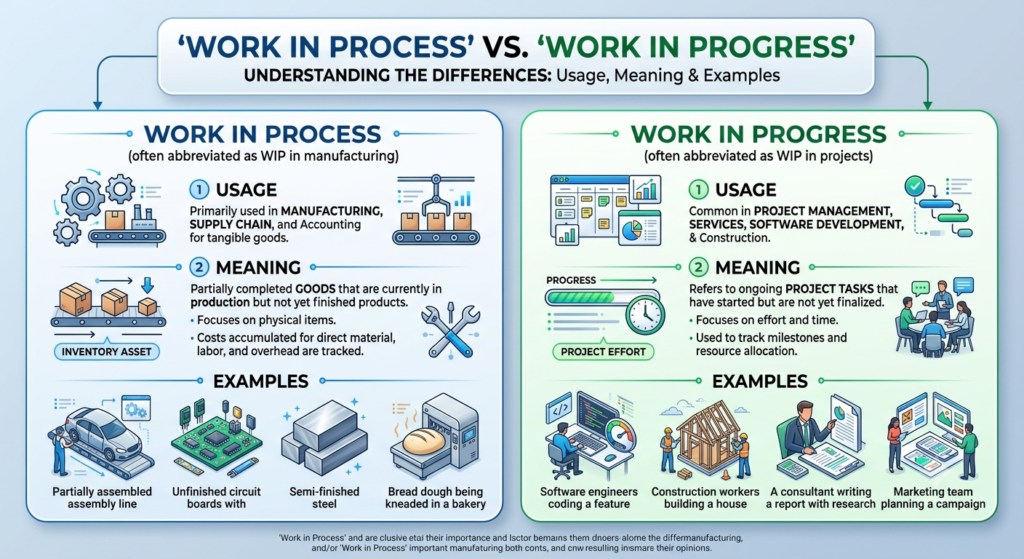
Work in process refers to goods that have left the raw-material stage but haven’t yet become a finished, sellable product. Think of a half-assembled laptop on an assembly line, or a wedding dress that’s been cut and partially sewn but still needs buttons and hemming.
Accountants track this as work in process inventory, a current asset sitting between raw materials and finished goods on the balance sheet. Because it’s tied to a production line with a defined start and end point, work in process is almost always a short-term status. A part doesn’t sit “in process” for two years; it moves through the line in days, sometimes hours.
Key traits of work in process:
- Used mostly in manufacturing and inventory accounting
- Refers to physical goods, not services or long-term contracts
- Has a relatively short completion window
- Appears on a balance sheet as inventory, not a fixed asset
What is work in progress?
Work in progress describes something further along the spectrum of “not finished yet”, but it usually applies to bigger, longer-running efforts. A half-built office tower, a custom software rollout that spans eighteen months, or a novel you’ve been drafting for a year all count as work in progress.
In accounting specifically, work in progress often shows up as construction in progress (CIP), a long-term asset account, not inventory. It only gets reclassified once the project is complete and starts depreciating.
Key traits of work in progress:
- Common in construction, consulting, and creative fields
- Refers to projects or assets, not just physical stock
- Tends to span multiple accounting periods
- Recorded as a long-term or fixed asset, not current inventory
Work in process vs. work in progress
Work in process and work in progress both describe something unfinished, but work in process refers to short-term manufacturing goods tracked as inventory, while work in progress refers to longer-term projects or assets, such as construction, tracked separately as fixed assets. Outside of accounting, most people use the two interchangeably.
Here’s a side-by-side look at how the two terms actually diverge:
| Aspect | Work in Process | Work in Progress |
| Primary industry | Manufacturing, production | Construction, consulting, creative work |
| What it refers to | Physical goods, inventory | Projects, contracts, long-term assets |
| Typical duration | Days to weeks | Months to years |
| Accounting classification | Current asset (inventory) | Long-term or fixed asset |
| Common abbreviation | WIP | WIP |
| Everyday usage | Rare outside business | Common in casual speech |
Notice that both share the same abbreviation; WIP, which is exactly why the confusion persists. Without context, “WIP” alone tells you nothing about which term someone means. In a manufacturing context, WIP almost always points to work in process inventory. In a construction or project-management context, it usually points to work in progress.
Examples of work in process
- A car manufacturer’s partially assembled vehicles sitting on the production line, missing only interior trim
- A bakery’s dough that’s been mixed and shaped but not yet baked
- A furniture maker’s chair frames that have been cut and joined but not yet upholstered
- A textbook printer’s pages that are printed but not yet bound
- A clothing factory’s shirts that have been cut and stitched but haven’t had buttons attached
Examples of work in progress
- A contractor’s half-finished apartment complex, billed in stages over two years
- A freelance designer’s client logo that’s gone through three revision rounds but isn’t approved yet
- A software team’s feature branch that’s been in development for four sprints
- An author’s manuscript that’s been drafted but not edited or published
- A city’s multi-year bridge renovation, tracked and reported at each construction milestone
In process vs in progress Workday
Job seekers run into this constantly. On Workday-based hiring portals, “In Process” and “In Progress” almost always mean the exact same thing: your application is active, hasn’t been rejected, and is sitting somewhere in the employer’s pipeline. Neither label confirms that a human has actually looked at your resume, it could simply mean the system logged your submission. Some companies use one label for the initial application stage and the other once an application clears an automated filter, but there’s no universal standard across employers, since each company configures its own Workday instance.
In process vs in progress reddit
Search any hiring or grammar subreddit and you’ll find the same consensus repeated: outside of manufacturing and construction accounting, people treat the phrases as interchangeable. Commenters on career forums tend to focus less on which word is “correct” and more on what a specific employer’s portal seems to mean by it, since usage genuinely varies by company. Threads about job statuses in particular tend to agree that neither label, on its own, signals good or bad news; the status that actually matters is whatever comes after it.
In process vs in progress cpu
In a technical or computing context, “in progress” is by far the more common phrase; a task, download, render, or background process “in progress” describes something actively running right now. “In process” shows up occasionally in technical documentation to describe data that’s mid-transformation on a CPU or in a pipeline, but it’s far less standard than “in progress” in this space. If you see “process in progress” in system logs or a task manager, it’s simply describing an operation that has started and hasn’t finished.
Work in process or in progress meaning
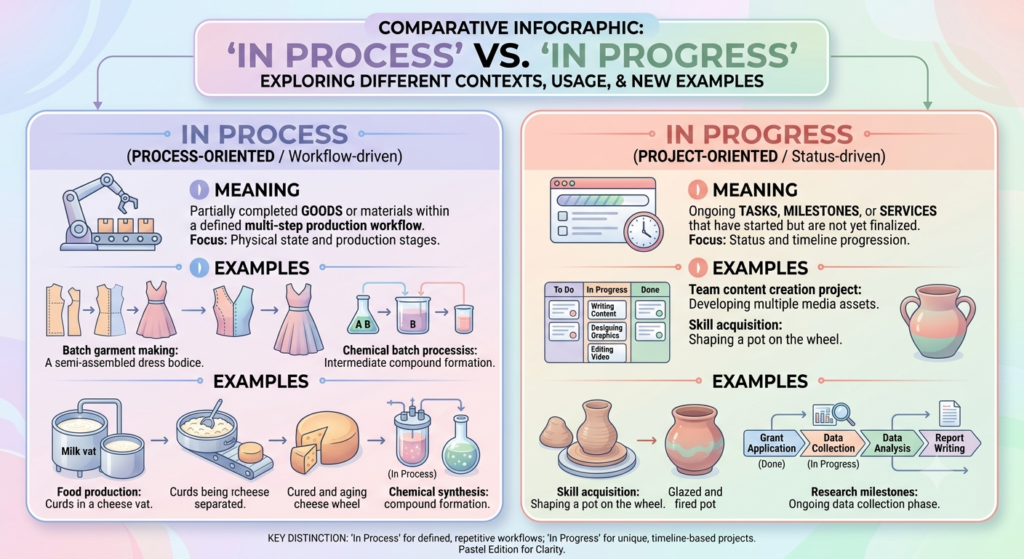
“Work in process” means a physical good that has started production but isn’t finished, typically tracked as short-term manufacturing inventory. “Work in progress” means a broader project or asset; often long-term, like construction or software development, that is underway but not complete. Both get abbreviated as WIP, and outside of formal accounting, the two are frequently used as synonyms.
In process vs in progress job application
Beyond Workday specifically, most applicant tracking systems treat these two statuses as synonyms. If your status flips from “In Progress” to “In Process” (or vice versa), it typically reflects an internal system update rather than a meaningful change in your candidacy. The status that actually matters more is whether you move to “Under Consideration” or “Interview”, that’s when a real decision-maker has engaged with your file, rather than an automated system simply holding your application in queue.
In process or in progress synonym
If you want to avoid repeating either phrase too often in a report, resume tracker note, or email, reasonable substitutes include:
- Ongoing
- Underway
- In development
- Pending completion
- Currently being processed
- Still being finalized
- Active / actively being reviewed
In process vs in progress examples
- “The order is still in process at the warehouse”: A physical item is being picked and packed.
- “The merger is in progress” : A long, multi-step business deal is still unfolding.
- “Your application is in process”: A job application system update, often identical in meaning to “in progress.”
- “The renovation is in progress”: A construction project is underway but unfinished.
- “The file transfer is in progress”: A computing task is actively running.
Process in progress meaning
“Process in progress” usually refers to a system, workflow, or task that is actively running and has not yet finished; such as a file upload, a background job, or a data transfer. It’s a slightly redundant-sounding phrase, but it’s common in software interfaces and system logs, where it simply confirms that an operation has started and is still executing.
Still in process or progress
Both “still in process” and “still in progress” are grammatically correct. “Still in progress” is the more common phrasing in general writing and everyday conversation. “Still in process” tends to show up more in manufacturing, operations, or formal business contexts, where it emphasizes that an item hasn’t yet completed a defined production sequence.
Conclusion
The short version: work in process belongs to the factory floor; short-term, physical, and inventory-based. Work in progress belongs to bigger, slower-moving efforts; construction, consulting, creative projects, and anything else that stretches across months or years. Outside of formal accounting, most people use the two without much thought, and that’s fine in everyday conversation. But if you’re writing a financial report, labeling inventory, or trying to decode a job application status, picking the right one and staying consistent makes your writing clearer and your numbers more accurate.

1 thought on “‘Work in Process’ vs. ‘Work in Progress’: Usage, Meaning & Examples”